
Vocabulary Quiz for Kids
How the Scales are Structured
Who Usually Takes This Test?
See How You Compare
Below is a preview of how scores are typically distributed across each scale.
Example Questions From the Test
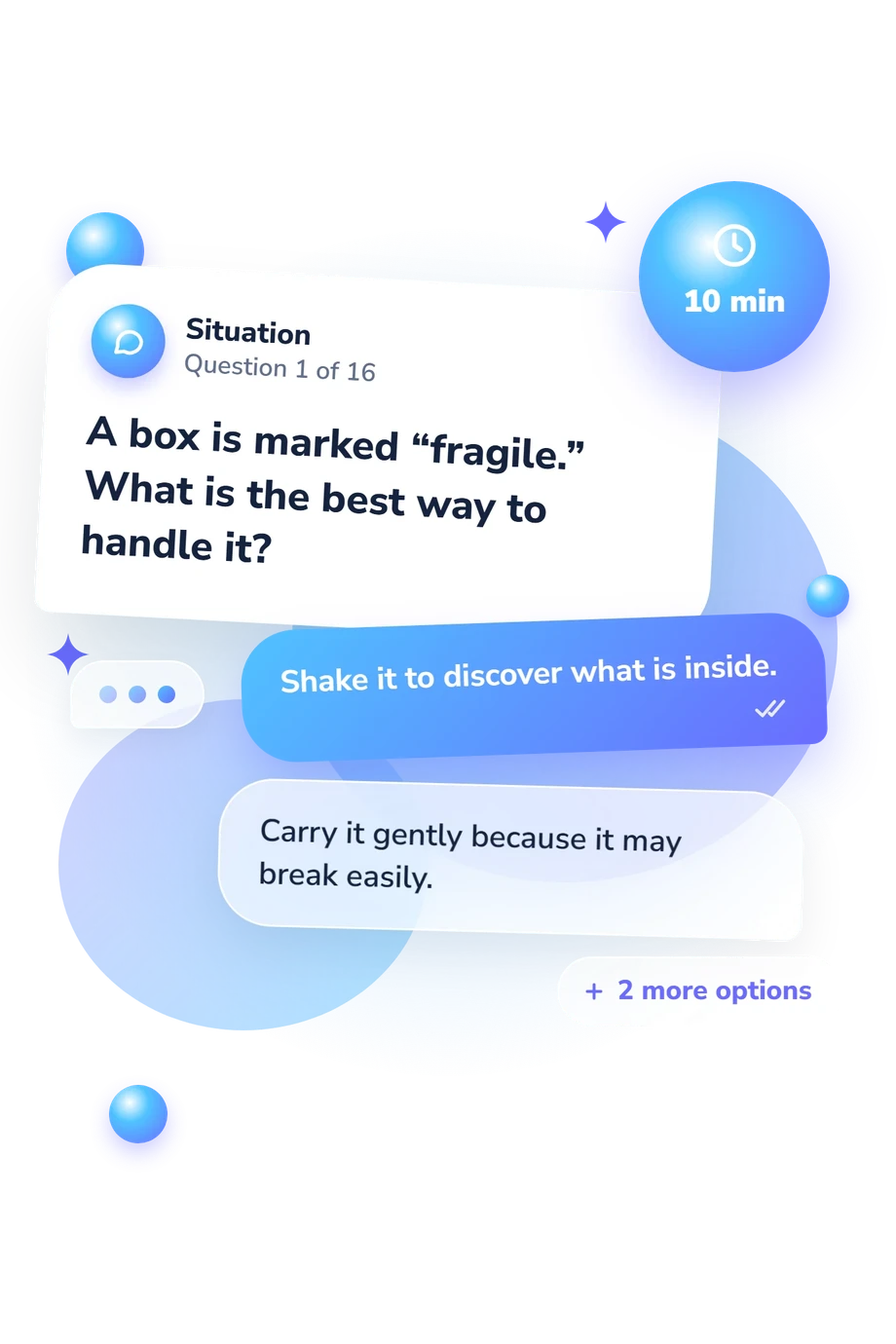
- Shake it to discover what is inside.
- Carry it gently because it may break easily.
- Leave it outdoors because it needs fresh air.
- Turn it over because the label marks the bottom.
- Perfectly round
- Unusually light
- Very large
- Ready to eat
- She tested each rock before stepping on it.
- She raced across before anyone else.
- She counted how many rocks she could see.
- She stopped to watch the water sparkle.
Vocabulary Quiz for Kids - Description and methodology of the test
Parents and teachers can use this activity with a young learner to decide which kinds of word questions deserve attention. The vocabulary quiz for kids offers a practical snapshot that can guide the next reading or discussion activity. As a word quiz for kids, it helps adults choose manageable areas for practice.
What This Assessment Measures
These questions examine receptive vocabulary: connecting a word with its meaning and interpreting a word’s meaning in a sentence or situation. They include definitions, context clues, inferences, and behaviors that illustrate a trait. The result shows performance on tested words and clue types, not general language development.
The questions draw on three abilities:
- Word meaning recognition shows whether the learner can match a target word with its definition.
- Contextual inference shows whether surrounding details help the learner determine meaning.
- Meaning in action shows whether the learner can connect a trait with behavior that demonstrates it.
For families, the result offers a snapshot of children's word knowledge through Kids' Vocabulary Knowledge (0-16): Building Foundations (0-6), Developing Word Power (7-12), or Strong Word Power (13-16). These bands describe performance and do not measure giftedness, intelligence, or school placement.
Methodology and Scientific Basis
Each item presents a short sentence or everyday situation with four answer choices. The learner selects the option that best fits a word's meaning, an action, or an inference from context. This gives the questionnaire both direct definition tasks and context-supported tasks without claiming to sample all language skills.
One point is awarded for each correct answer, producing the displayed practice score. It is an unvalidated practice measure, so its bands describe performance on this set. A stronger result suggests more consistent recognition of the tested meanings, while a lower result identifies useful targets for repeated exposure.
The item focus is conceptually consistent with Watkins and DeThorne (2000), comparable in format to the PPVT-5, and discussed alongside the broader assessment issues raised by Pearson, Hiebert, and Kamil (2007); it is not an adaptation of the published instrument. When interpreting the result, account for reading fluency, attention, guessing, unfamiliar contexts, and current word exposure before choosing vocabulary practice for children. Use the result to guide practice alongside broader observations of language use.
- Watkins, Ruth V., and Laura S. DeThorne. (2000). Assessing children's vocabulary skills: From word knowledge to word-learning potential. Seminars in Speech and Language, 21(3), 235-244. 10.1055/s-2000-13197
- Dunn, Douglas M. (2019). Peabody Picture Vocabulary Test (5th ed.) [Measurement instrument]. Bloomington, MN: NCS Pearson.
- Pearson, P. David, Elfrieda H. Hiebert, and Michael L. Kamil. (2007). Vocabulary assessment: What we know and what we need to learn. Reading Research Quarterly, 42(2), 282-296. 10.1598/RRQ.42.2.4
Updated: