
Ozone Quiz
How the Scales are Structured
Who Usually Takes This Test?
See How You Compare
Below is a preview of how scores are typically distributed across each scale.
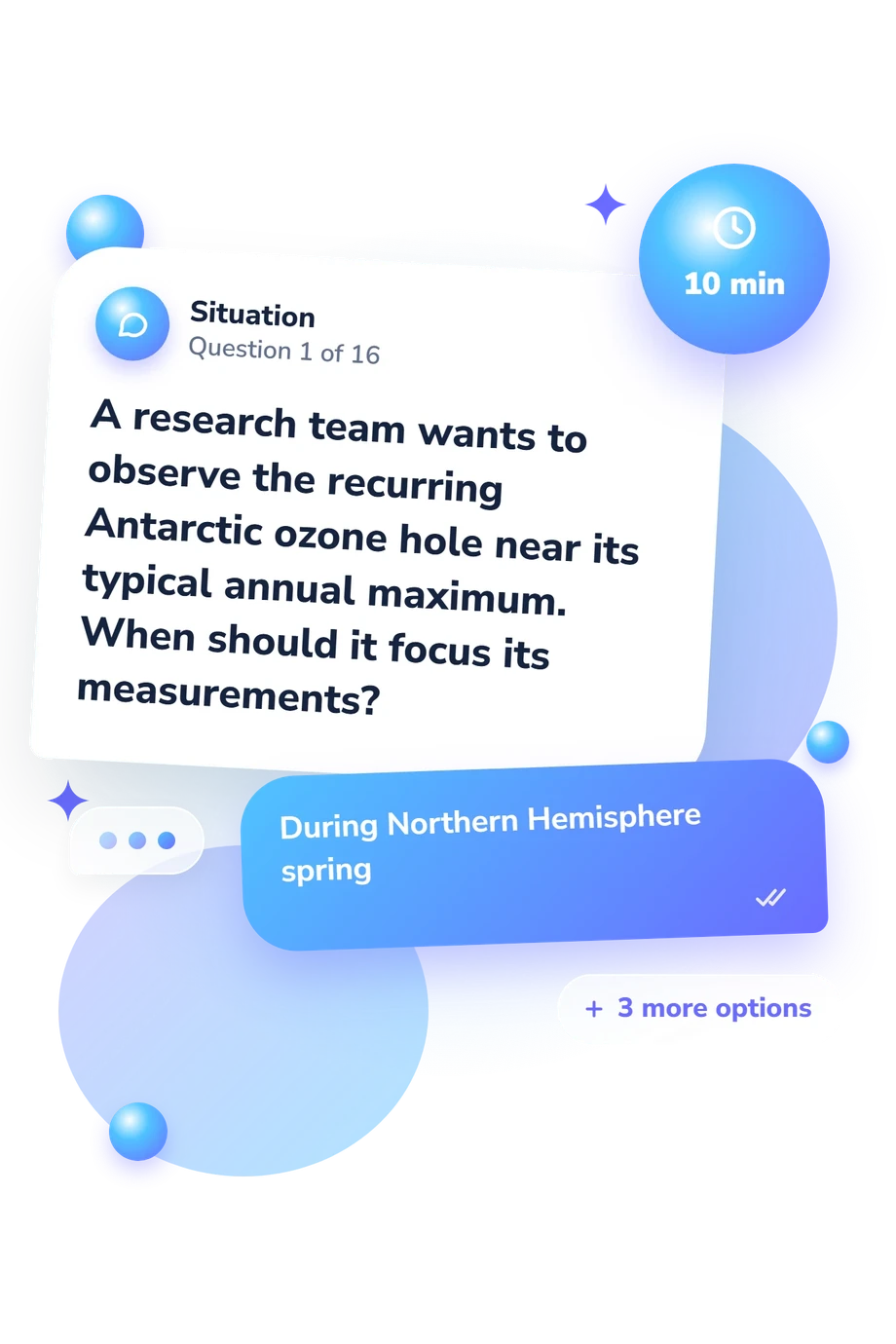
Example Questions From the Test
- The Montreal Protocol
- The Convention on Biological Diversity
- The Kyoto Protocol
- The Ramsar Convention
- The speed at which ozone molecules move
- The toxicity of ozone in drinking water
- The total amount of ozone in a vertical column of atmosphere
- The ultraviolet brightness of the Sun
- CO₂, a molecule containing carbon and oxygen
- O₂, the usual diatomic form of oxygen gas
- O₃, a molecule containing three oxygen atoms
- N₂O, a compound containing nitrogen and oxygen
Ozone Quiz - Description and methodology of the test
For readers who want to connect atmospheric science with everyday environmental questions, this quiz on ozone provides a focused knowledge check. It suits curious learners, students, and anyone reviewing how ozone behaves in different parts of the atmosphere. The result from this quiz about ozone links well-understood concepts with topics that may deserve another look during further study.
What This Assessment Explores
This assessment measures understanding of ozone across atmospheric location, chemistry, effects, measurement, depletion, and policy. It distinguishes protective stratospheric ozone from harmful ground-level ozone and asks readers to connect mechanisms with situations such as sunny-day pollution and seasonal monitoring. As a quiz about the ozone layer, it shows which relationships are understood and which need review.
The single displayed scale is Ozone Knowledge (0-16): Foundations to build (0-6) marks concepts to review; Developing understanding (7-12) marks a useful grasp with details to strengthen; Strong understanding (13-16) marks accurate connections across ozone science and policy.
The questions cover four thematic areas:
- Location explains why altitude changes ozone’s environmental role.
- Chemistry describes how oxygen, light, and pollutants participate in formation.
- Measurement and effects connect monitoring units with health consequences.
- Depletion and policy link persistent chemicals, chlorine cycles, and international controls.
Methodology and Scientific Basis
Each item offers four answer choices and asks for the best response. Questions move from definitions and formulas to scenarios involving sunlight, traffic emissions, seasonal observation, health, laboratory conditions, and international agreements. The format tests recognition and basic causal reasoning.
The questionnaire does not document how individual answers contribute to the displayed result, so an additive scoring rule should not be inferred. Results depend on learning, memory, attention, and interpretation of each option. The questionnaire’s ozone questions are most useful for directing study, not ranking scientific ability.
The closest conceptual source is the Ozone-layer knowledge questionnaire (Celikler & Aksan, 2011). The present online questionnaire is conceptually consistent with that work, not a reproduction or validated adaptation. The questionnaire’s subject matter is consistent with Salawitch and colleagues’ 2022 ozone-layer update in a report published in 2023, and with Solomon’s review of ozone chemistry, depletion, monitoring, and policy.
The questionnaire is presented as a focused learning profile rather than a standardized population measure. Honest answers and current context matter, and one score cannot capture the full depth of scientific understanding.
- Dilek Çelikler and Zeynep Aksan (2011). Determination of pre-service elementary science teachers' knowledge level about ozone layer. Procedia - Social and Behavioral Sciences, 15, 1438-1444. 10.1016/j.sbspro.2011.03.308
- Ross J. Salawitch, Laura A. McBride, Chelsea R. Thompson, Eric L. Fleming, Richard L. McKenzie, Karen H. Rosenlof, Sarah J. Doherty, and David W. Fahey (2023). Twenty Questions and Answers About the Ozone Layer: 2022 Update. Scientific Assessment of Ozone Depletion: 2022, 75 pp. World Meteorological Organization, Geneva, Switzerland.
- Susan Solomon (1999). Stratospheric ozone depletion: A review of concepts and history. Reviews of Geophysics, 37(3), 275-316. 10.1029/1999RG900008
Updated: