
Reflection and Refraction Quiz
How the Scales are Structured
Who Usually Takes This Test?
See How You Compare
Below is a preview of how scores are typically distributed across each scale.
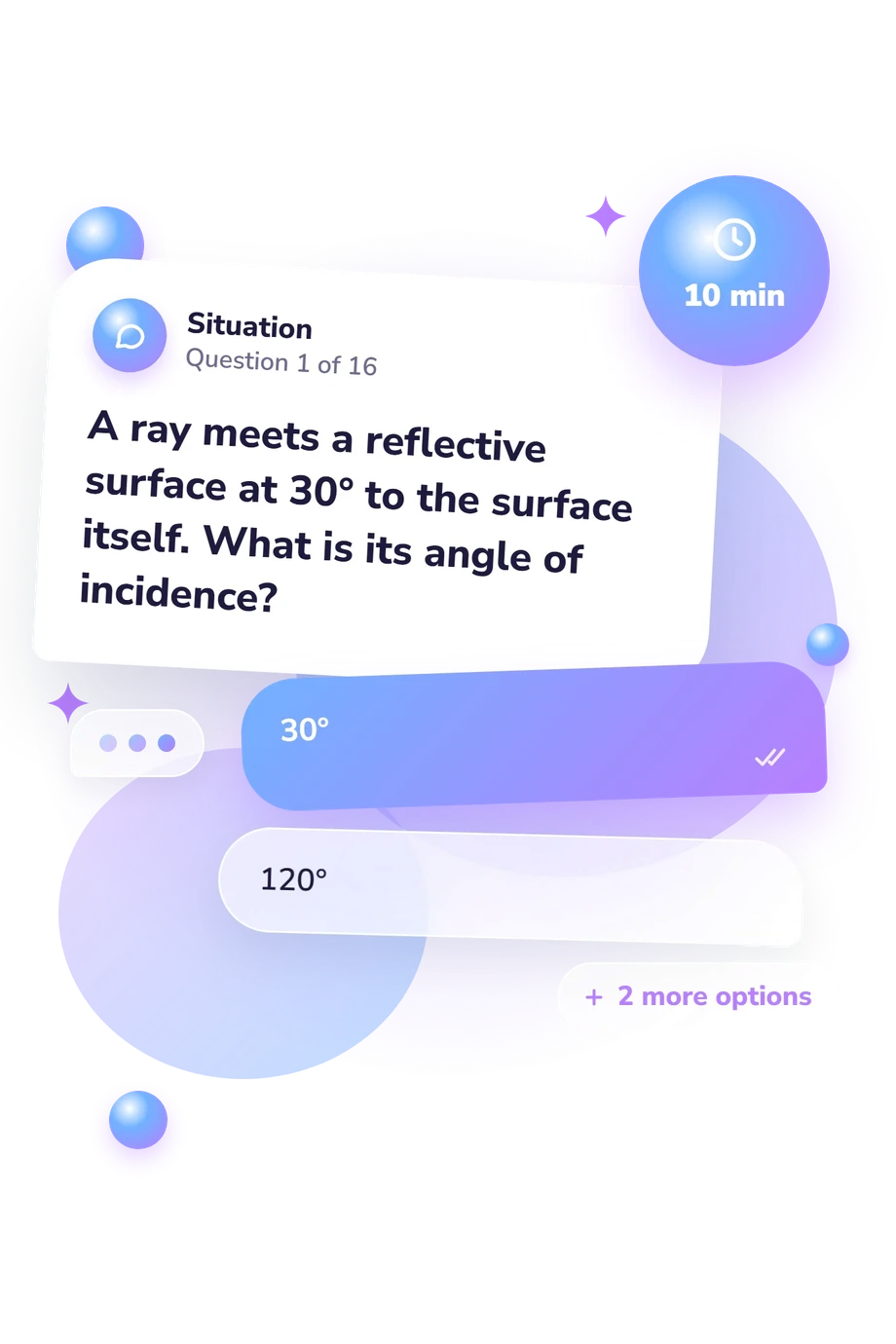
Example Questions From the Test
- 30°
- 120°
- 90°
- 60°
- Speed
- Wavelength
- Direction in every case
- Frequency
- 5°
- 20°
- 10°
- 40°
Reflection and Refraction Quiz - Description and methodology of the test
Students and curious learners can use this reflection and refraction quiz to check whether core ideas in geometrical optics are clear before more advanced study. Questions about refraction help identify principles worth reviewing when light enters, leaves, or travels through transparent materials.
What This Assessment Explores
The assessment examines understanding of reflection and refraction in optical situations. It suits learners checking classroom optics and asks them to reason about normals, angles, image properties, apparent depth, dispersion, critical angles, and refractive index. The score summarizes performance across the principles covered; a lower band guides review of normals, angles, image properties, and light at boundaries.
The questions cover four topic groups:
- Mirror laws and ray geometry show whether you use normals, incidence, and reflection correctly.
- Boundary refraction indicates whether you connect refractive index with speed, direction, and wavelength.
- Total internal reflection and dispersion show how you apply critical-angle and wavelength effects.
- Image questions reveal whether you identify plane-mirror properties, apparent depth, and lateral displacement.
The scale is Reflection and Refraction Knowledge (0-16). Its bands are Foundations to build (0-6), Developing understanding (7-12), and Strong understanding (13-16).
Methodology and Evidence Base
Each item presents a physics situation or definition with four answer choices. The format emphasizes conceptual recognition and transfer rather than extended calculation. Correct answers add one point; the bands describe performance on the tested concepts, not a percentile ranking.
In that sense, the optics knowledge test samples ideas that appear in classroom ray diagrams and verbal reasoning. Tadeo and Yoo's study is the closest related published study because it specifically examines recognition of reflection and refraction concepts. The broader Light Phenomena Conceptual Assessment offers supplementary context for conceptual optics, while University Physics supplies standard relationships for mirrors, refraction, speed, wavelength, frequency, and refractive index. The online questionnaire is conceptually consistent with these works, not validated or adapted from them.
The questionnaire is presented without a standardization procedure. Its bands are descriptive interpretations of total score, so the result is a raw performance summary: a strong band means selected principles were handled accurately here, while a lower band identifies topics for review. Multiple-choice answers can miss partial reasoning, and performance may change with prior instruction, wording, or concentration.
- Ndihokubwayo, Kizito, Jean Uwamahoro, Irénée Ndayambaje, and Michael Ralph. "Light Phenomena Conceptual Assessment: An Inventory Tool for Teachers." Physics Education, 55(3), 035009, 2020. DOI 10.1088/1361-6552/ab6f20
- Tadeo, Danilo Jr, and Junehee Yoo. "Students' Recognition of Concepts of Reflection and Refraction in Multiple Representational Formats." Jurnal Pendidikan Fisika, 10(2), 75-92, 2022. DOI 10.26618/jpf.v10i2.7639
- Ling, Samuel J., Jeff Sanny, and William Moebs. University Physics Volume 3. Houston, TX: OpenStax, 2016.
Updated: