
Princess Slut Loser Quiz
How the Scales are Structured
Who Usually Takes This Test?
See How You Compare
Below is a preview of how scores are typically distributed across each scale.
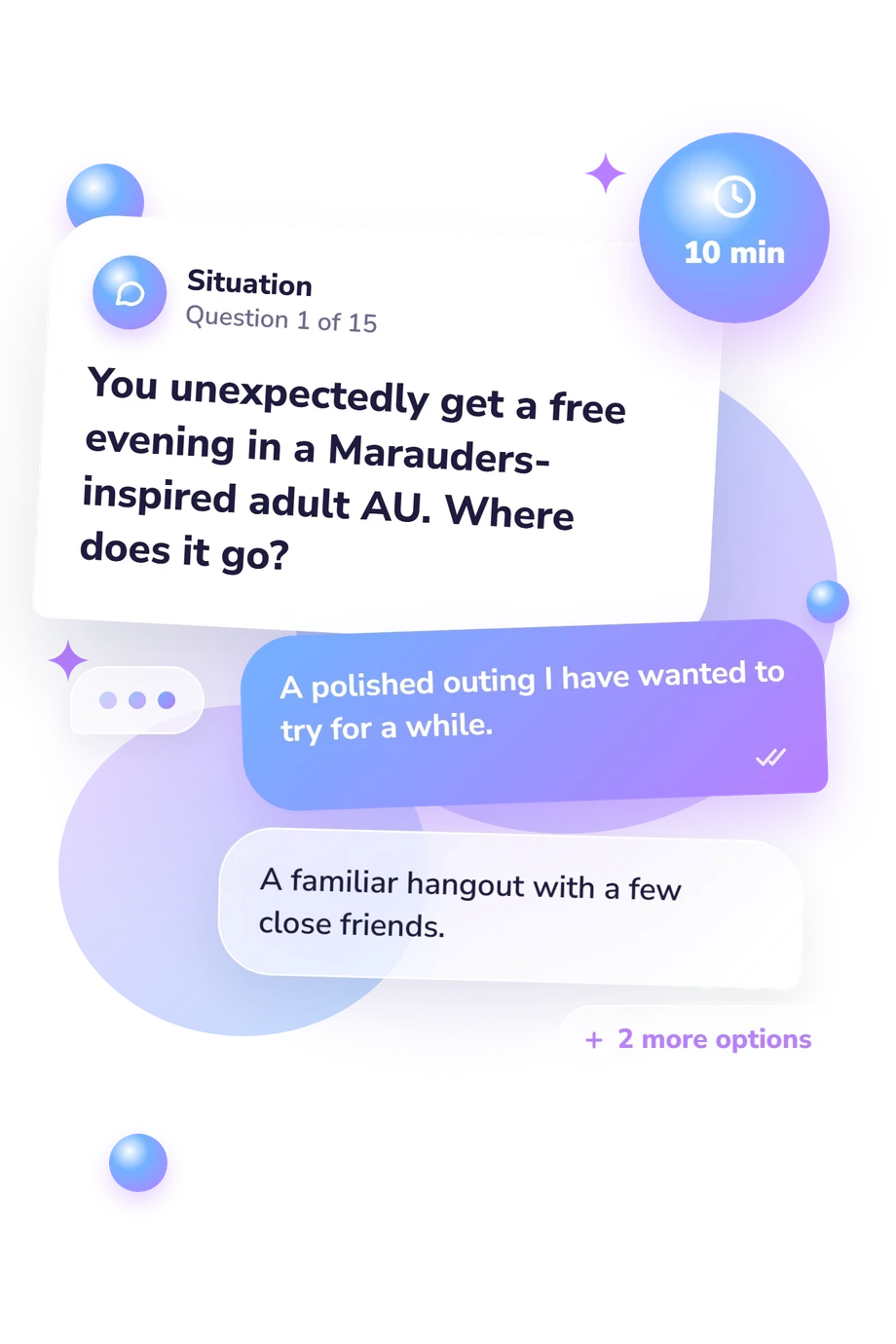
Example Questions From the Test
- Something practical that I had been meaning to buy.
- A small present built around an inside joke.
- A beautifully wrapped keepsake chosen with obvious care.
- A sweeping, memorable gesture with a touch of spectacle.
- Slip in quietly and find the people I already know.
- Greet a few familiar faces before settling somewhere comfortable.
- Make a playful entrance that gets the room smiling.
- Arrive composed, impeccably dressed, and ready to be noticed.
- Comfortable clothes with a simple magical accessory.
- An elegant look with one intriguing detail.
- A daring outfit designed to attract a second glance.
- A sensual, theatrical transformation that owns the room.
Princess Slut Loser Quiz - Description and methodology of the test
Adults who want a playful way to reflect on social style, romantic energy, and their relationship with awkwardness may find this Princess Slut Loser Quiz useful. As an archetype personality quiz, it turns familiar preferences into three exaggerated profiles rather than fixed identities. The result can prompt conversation about confidence, ceremony, sensuality, humor, and recovery from mishaps. Read it as a snapshot of affinities, not a verdict about character.
What This Assessment Explores
Across the scenarios, the three-way format works as a princess slut or loser quiz in a playful, self-descriptive sense. It covers attention, flirtation, gifts, entrances, boundaries, embarrassment, cancelled plans, and comic failure. Adults who prefer imaginative self-reflection may find these categories approachable.
The displayed dimensions capture these affinities:
- Loser (0-15) measures affection for awkward humor and lovable underdog energy: 0-5 Lightly Offbeat, 6-10 Endearing Underdog, 11-15 Loser Icon.
- Princess (0-15) measures ceremony, elevated standards, graceful boundaries, and thoughtful treatment: 0-5 Grounded Royalty, 6-10 Polished Streak, 11-15 Regal Core.
- Slut (0-15) measures playful, consensual adult flirtation and sensual confidence: 0-5 Selective Spark, 6-10 Playful Heat, 11-15 Magnetic Provocateur.
These are affinities, not measures of intelligence, competence, worth, or required behavior.
Methodology and Scientific Basis
Each scenario offers four response options, generally moving from private or practical choices toward more theatrical, sensual, ceremonial, or chaotic ones. Selections produce separate totals for the three profiles; the displayed highest total marks the strongest affinity, while near-tied totals can form a blend. No item-level point value should be inferred beyond that stated profile logic.
For a playful personality test, this structure is conceptually consistent with Self-schema theory (Markus, 1977), which describes self-relevant patterns as organizing how people process information about themselves. The sensual dimension can be read alongside sexual self-schema research by Andersen and Cyranowski (1994), and the humor dimension alongside Martin et al. (2003)'s work on individual humor styles. These are conceptual parallels, not proof that this questionnaire is an adaptation or validated reproduction of those instruments.
As an online self-report tool, it has no stated population norms, reliability estimate, or clinical threshold. Current mood, self-presentation, and comfort with playful exaggeration may influence responses, so the profile is best used to notice patterns and start reflection rather than to make a formal psychological judgment.
- Hazel R. Markus (1977). Self-Schemata and Processing Information About the Self. Journal of Personality and Social Psychology, 35(2), 63-78. 10.1037/0022-3514.35.2.63
- Barbara L. Andersen and Jill M. Cyranowski (1994). Women's Sexual Self-Schema. Journal of Personality and Social Psychology, 67(6), 1079-1100. 10.1037/0022-3514.67.6.1079
- Rod A. Martin, Patricia Puhlik-Doris, Gwen Larsen, Jeanette Gray, and Kelly Weir (2003). Individual Differences in Uses of Humor and Their Relation to Psychological Well-Being: Development of the Humor Styles Questionnaire. Journal of Research in Personality, 37(1), 48-75. 10.1016/S0092-6566(02)00534-2
Updated: