
What Am I in School Quiz
How the Scales are Structured
Who Usually Takes This Test?
See How You Compare
Below is a preview of how scores are typically distributed across each scale.
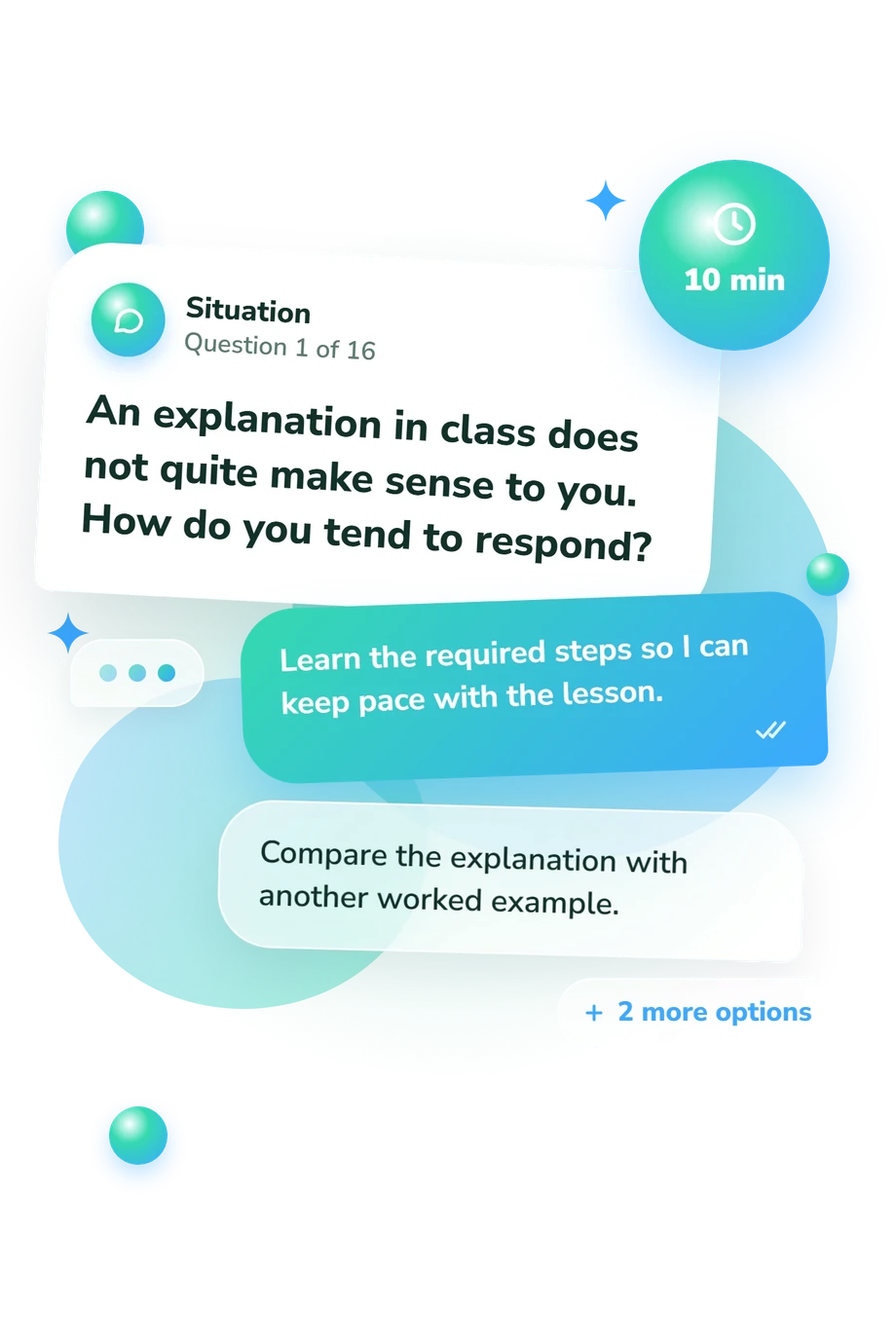
Example Questions From the Test
- Learn the required steps so I can keep pace with the lesson.
- Compare the explanation with another worked example.
- Ask what underlying idea makes the explanation work.
- Mark the confusing part and return to it if it becomes important.
- Time by myself with minimal conversation.
- A relaxed conversation with one trusted person.
- An easygoing activity with a small group.
- A lively setting where I can interact with many different people.
- Keep my attention on the material I am expected to learn.
- Make a note in case I want to revisit it another time.
- Ask a quick question before the lesson moves on.
- Look for a source that lets me investigate it further.
What Am I in School Quiz - Description and methodology of the test
Students can use this profile to examine how they approach lessons, projects, deadlines, and peer settings. The What Am I in School Quiz turns everyday choices into a picture of how a person may contribute, explore, organize, and connect. It also works as a who are you in school quiz, emphasizing school preferences rather than grades, talent, popularity, or personal worth. The result describes tendencies without assigning a fixed identity.
What This Assessment Explores
This assessment examines four ways of experiencing school. It suits anyone seeking preferences across learning, creativity, organization, and social contact, not a ranking. This school personality quiz uses situations involving explanations, projects, deadlines, free time, and unfamiliar classmates.
These four result dimensions are:
- Creative Contributor (0-12) measures creative preference, not artistic talent: Clear-Cut Maker (0-4) favors direct formats; Adaptive Creator (5-8) adds touches; Creative Contributor (9-12) seeks originality.
- Curious Explorer (0-12) measures exploratory learning, not intelligence: Focused Learner (0-4) follows clear routes; Selective Explorer (5-8) pursues questions; Curious Explorer (9-12) investigates further.
- Reliable Organizer (0-12) measures organization, not responsibility: Flexible Improviser (0-4) keeps plans light; Practical Planner (5-8) uses structure; Reliable Organizer (9-12) follows timelines.
- Social Connector (0-12) measures social preference, not popularity or skill: Independent Participant (0-4) prefers limited involvement; Selective Connector (5-8) joins familiar groups; Social Connector (9-12) links classmates.
Methodology and Scientific Basis
Each item presents a school situation and four response options. The choices describe contrasting ways to handle learning, planning, creativity, and social contact; none is correct. As a school learning style quiz, it treats preferences in context, so results are patterns across situations.
Responses are combined into four dimension scores. Exact point contributions belong to the questionnaire’s scoring design and should not be inferred from wording. Results summarize tendencies, and mixed profiles are possible.
The framework is conceptually consistent with the Big Five Inventory-2 (Soto & John, 2017), which organizes broad traits and narrower aspects. DeYoung, Quilty, and Peterson (2007) provide a related aspect-level reference, while the Curiosity and Exploration Inventory-II (Kashdan et al., 2009) is relevant to exploration. This questionnaire is not presented as an adaptation of those instruments.
Poropat’s (2009) meta-analysis places personality traits in academic context but does not validate this questionnaire. The bands are descriptive categories, not published norms or clinical cutoffs; responses may vary with mood, context, self-awareness, and reporting bias. Use the profile to reflect on school preferences, not to forecast achievement.
- Soto, C. J., & John, O. P. (2017). The next Big Five Inventory (BFI-2): Developing and assessing a hierarchical model with 15 facets to enhance bandwidth, fidelity, and predictive power. Journal of Personality and Social Psychology, 113(1), 117-143. 10.1037/pspp0000096
- DeYoung, C. G., Quilty, L. C., & Peterson, J. B. (2007). Between facets and domains: 10 aspects of the Big Five. Journal of Personality and Social Psychology, 93(5), 880-896. 10.1037/0022-3514.93.5.880
- Kashdan, T. B., Gallagher, M. W., Silvia, P. J., Winterstein, B. P., Breen, W. E., Terhar, D., & Steger, M. F. (2009). The curiosity and exploration inventory-II: Development, factor structure, and psychometrics. Journal of Research in Personality, 43(6), 987-998. 10.1016/j.jrp.2009.04.011
- Poropat, A. E. (2009). A meta-analysis of the five-factor model of personality and academic performance. Psychological Bulletin, 135(2), 322-338. 10.1037/a0014996
Updated: