
Why Is He Ignoring Me Quiz
How the Scales are Structured
Who Usually Takes This Test?
See How You Compare
Below is a preview of how scores are typically distributed across each scale.
Example Questions From the Test
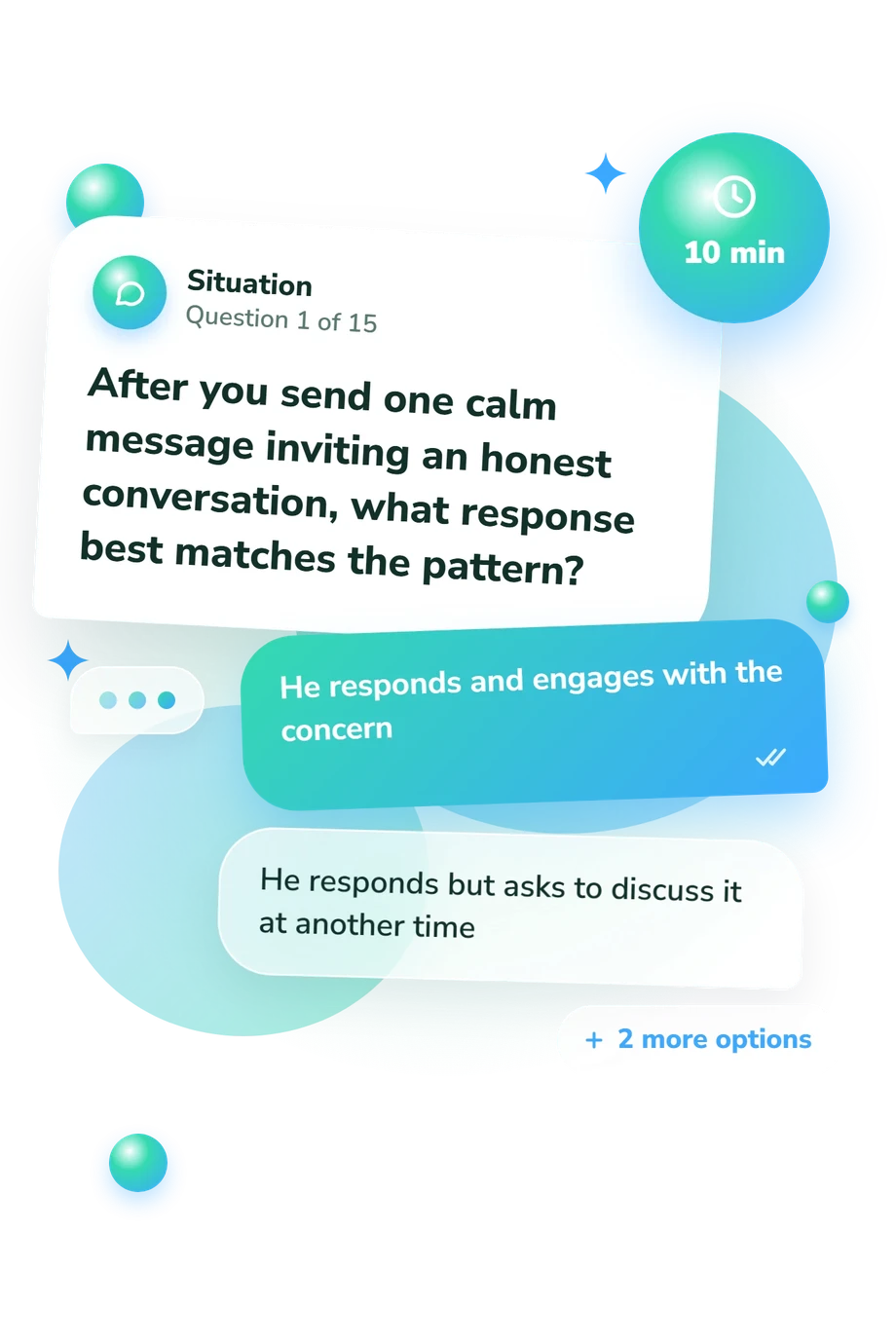
- He responds and engages with the concern
- He responds but asks to discuss it at another time
- He acknowledges neutral parts of the message but not the concern
- He ignores the invitation while still responding to unrelated topics
- He explains the gap and makes a clear effort to reconnect
- He replies warmly but leaves the next contact uncertain
- He gives a minimal response and does not continue the conversation
- He does not respond, and the broader decline in effort continues
- He is willing to address the issue directly
- He is friendly but hesitant about beginning the difficult conversation
- He is warm only while the unresolved subject is avoided
- He withdraws or ends contact whenever the conversation approaches the issue
Why Is He Ignoring Me Quiz - Description and methodology of the test
When contact suddenly changes, the Why Is He Ignoring Me All of a Sudden Quiz helps organize observable patterns rather than guess at private motives. It is intended for someone reflecting on dating or relationship communication, including anyone using the Why Is My Boyfriend Ignoring Me Quiz when replies, warmth, plans, or follow-through have shifted. Three scales separately show support; several patterns may fit, but none establishes his motive.
What This Assessment Explores
Rather than infer intention, the assessment examines whether a communication gap aligns with broader disengagement, discomfort avoidance, or outside demands. A sudden relationship silence is read alongside changes in initiative, warmth, responsiveness, planning, availability, and tone. Each scale’s pattern shows how strongly it is supported, so more than one pattern may be supported at once.
The three displayed scales are:
- Broader Relationship Disengagement (0-15) measures a sustained decline in initiative, warmth, planning, and responsiveness: Little support (0-5), Some support (6-10), Strong pattern match (11-15).
- Conflict or Discomfort Avoidance (0-15) measures contact dropping around concerns, boundaries, difficult subjects, or unresolved disagreement: Little support (0-5), Some support (6-10), Strong pattern match (11-15).
- External Pressure or Overload (0-15) measures reduced contact alongside specific demands and broader unavailability: Little support (0-5), Some support (6-10), Strong pattern match (11-15).
Methodology and Scientific Basis
Each prompt presents a concrete communication situation and offers four response choices. The situations cover replies to calm invitations, serious topics, unresolved conflict, outside demands, social availability, plans, and changes in warmth or initiative. The selected answers are summarized in the displayed scale results and bands.
Its closest conceptual anchor is the Conflict Disengagement Inventory (Nichols et al., 2015), which distinguishes withdrawal-related responses during couple conflict. The framework also connects with Barry et al. (2008) on disengagement in romantic relationships, Christensen and Heavey (1990) on demand/withdraw dynamics, and King and DeLongis (2014) on withdrawal under everyday stress. This questionnaire is conceptually consistent with those works, not an adaptation of them.
For relationship communication problems, the cited studies provide conceptual context for these themes but do not validate or independently standardize this online questionnaire. Because responses are self-reported, current emotion, incomplete information, and selective attention can shape the pattern; no band establishes his private feelings, intention, or a clinical category. Use the result to decide which observations merit a direct conversation and what level of clarity or reciprocity you need.
- Nichols, N. B., Backer-Fulghum, L. M., Boska, C. R., & Sanford, K. (2015). Two types of disengagement during couples' conflicts: Withdrawal and passive immobility. Psychological Assessment, 27(1), 203-214. 10.1037/pas0000045
- Barry, R. A., Lawrence, E., & Langer, A. (2008). Conceptualization and assessment of disengagement in romantic relationships. Personal Relationships, 15, 297-315. 10.1111/j.1475-6811.2008.00200.x
- Christensen, A., & Heavey, C. L. (1990). Gender and social structure in the demand/withdraw pattern of marital conflict. Journal of Personality and Social Psychology, 59(1), 73-81. 10.1037/0022-3514.59.1.73
- King, D. B., & DeLongis, A. (2014). When couples disconnect: Rumination and withdrawal as maladaptive responses to everyday stress. Journal of Family Psychology, 28(4), 460-469. 10.1037/a0037160
Updated: