
Quiz Anchoring Script
How the Scales are Structured
Who Usually Takes This Test?
See How You Compare
Below is a preview of how scores are typically distributed across each scale.
Example Questions From the Test
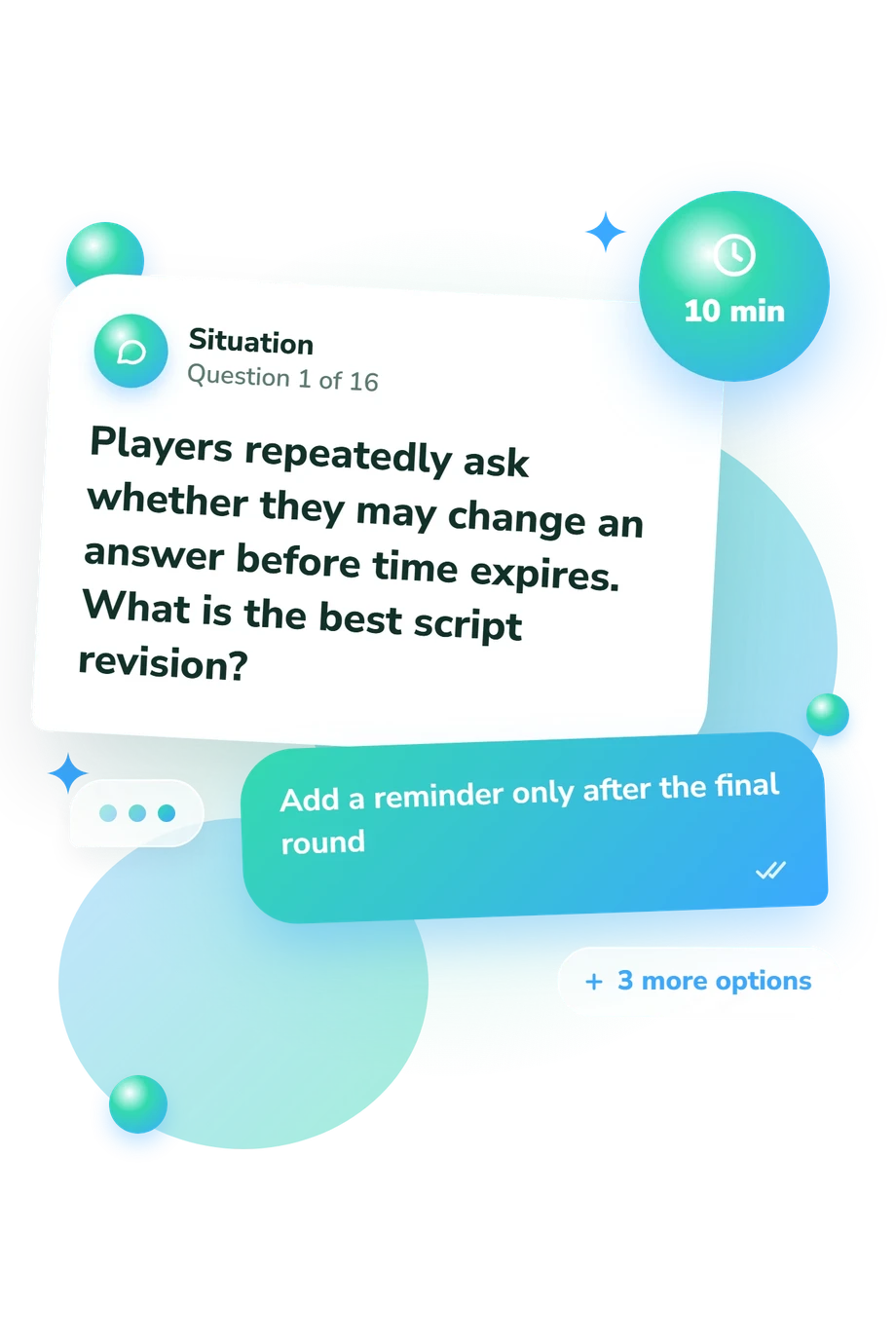
- Add a reminder only after the final round
- Let the host decide differently for each question
- Remove the time limit so the issue cannot arise
- State the answer-change rule clearly before the first scored question
- Writing directions and spoken lines in one uninterrupted paragraph
- Removing timing notes so the page looks less crowded
- Visually separating spoken wording from stage, timing, and technical cues
- Using abbreviations that only the original writer understands
- Define each necessary term briefly when it first becomes relevant
- Assume players will infer every meaning from context
- Place all definitions in the closing remarks
- Replace the terms with jokes, even if precision is lost
Quiz Anchoring Script - Description and methodology of the test
Before a rehearsal or a handoff, a quiz writer can use quiz anchoring to check whether an event plan will remain clear when someone else has to deliver it. That check can make preparation more deliberate before the audience arrives. In live quiz hosting, the result gives a broad indication of command and suggests general areas for review.
What This Assessment Explores
The questions examine how a live event is guided rather than what trivia it contains. A script used to anchor a quiz must make instructions, timing, reveals, transitions, challenges, and contingency cues usable in the moment. The scenarios focus on decisions that protect fairness, pacing, clarity, and continuity when conditions change.
It suits quiz writers, hosts, producers, and reviewers checking practical judgment before an event. A stronger result suggests command of usable quiz script design; a lower result identifies topics for rehearsal.
Results are reported on the script knowledge scale, ranging from 0-16, with three descriptive bands:
- Foundations to Build (0-6) indicates that hosting basics and script structure need review.
- Developing Command (7-12) shows understanding of core principles while consistency in transitions and audience guidance can improve.
- Strong Command (13-16) reflects a well-rounded grasp of clear, engaging, usable script design.
Methodology and Scientific Basis
Each of the 16 items presents a live-event situation with four answer choices and asks for the response that best reflects sound anchoring practice. The questions test applied judgment: selecting a workable action, wording, or sequence rather than recalling trivia. A quiz-anchoring script is an operational tool, so clarity, timing, and recoverability matter alongside energy.
The questionnaire reports a catalogue result interpreted through descriptive bands. This gives an overall indication of command while leaving room to review the hosting situations represented by the questions.
Conceptually, the questionnaire is consistent with Varley's quizmaster guidance on rules, pacing, presentation, and event control; it is not an adaptation of that book. National Speakers Association guidance supports its focus on emcee communication, transitions, audience guidance, and recovery when plans change. Multiple-choice item-writing guidance from Haladyna, Downing, and Rodriguez supplies principles for clear stems and answer options.
Interpretation depends on familiarity with quiz hosting, understanding scenarios, and attention to wording; guessing can affect the result. The bands are descriptive catalogue levels, so use them to choose what to rehearse, review, or clarify in a script.
- Varley, Joe. The Ultimate Quiz Book Guide: Containing Questions and Advice on How to Become a Quizmaster. Foreword by Kyle Hamilton. Apex Publishing Ltd, 2016. ISBN 9781911476221.
- National Speakers Association. A Guide for Event Planners: Leveraging an Emcee for Event Success. National Speakers Association, 2025.
- Haladyna, Thomas M., Steven M. Downing, and Michael C. Rodriguez. “A Review of Multiple-Choice Item-Writing Guidelines for Classroom Assessment.” Applied Measurement in Education, vol. 15, no. 3, 2002, pp. 309-333. 10.1207/S15324818AME1503_5
Updated: