
Respiratory Emergencies EMT Quiz
How the Scales are Structured
Who Usually Takes This Test?
See How You Compare
Below is a preview of how scores are typically distributed across each scale.
Example Questions From the Test
- Acute bronchitis
- Tension pneumothorax
- Hyperventilation syndrome
- Uncomplicated asthma
- Inspiratory stridor with drooling
- Unilateral absent breath sounds after chest trauma
- Prolonged exhalation with diffuse wheezing
- Fine crackles heard mainly at the lung bases
- Stridor
- Fine crackles
- Diffuse expiratory wheezing
- Pleural friction rub
Respiratory Emergencies EMT Quiz - Description and methodology of the test
EMT learners, instructors, and practicing responders can use the Respiratory Emergencies EMT Quiz to connect patient findings with safe first priorities. It suits review before skills practice, classroom discussion, or protocol study, especially when the goal is to recognize deterioration rather than recall disease names alone. As an EMT respiratory quiz, this assessment can also show which reasoning areas deserve closer attention.
What This Assessment Explores
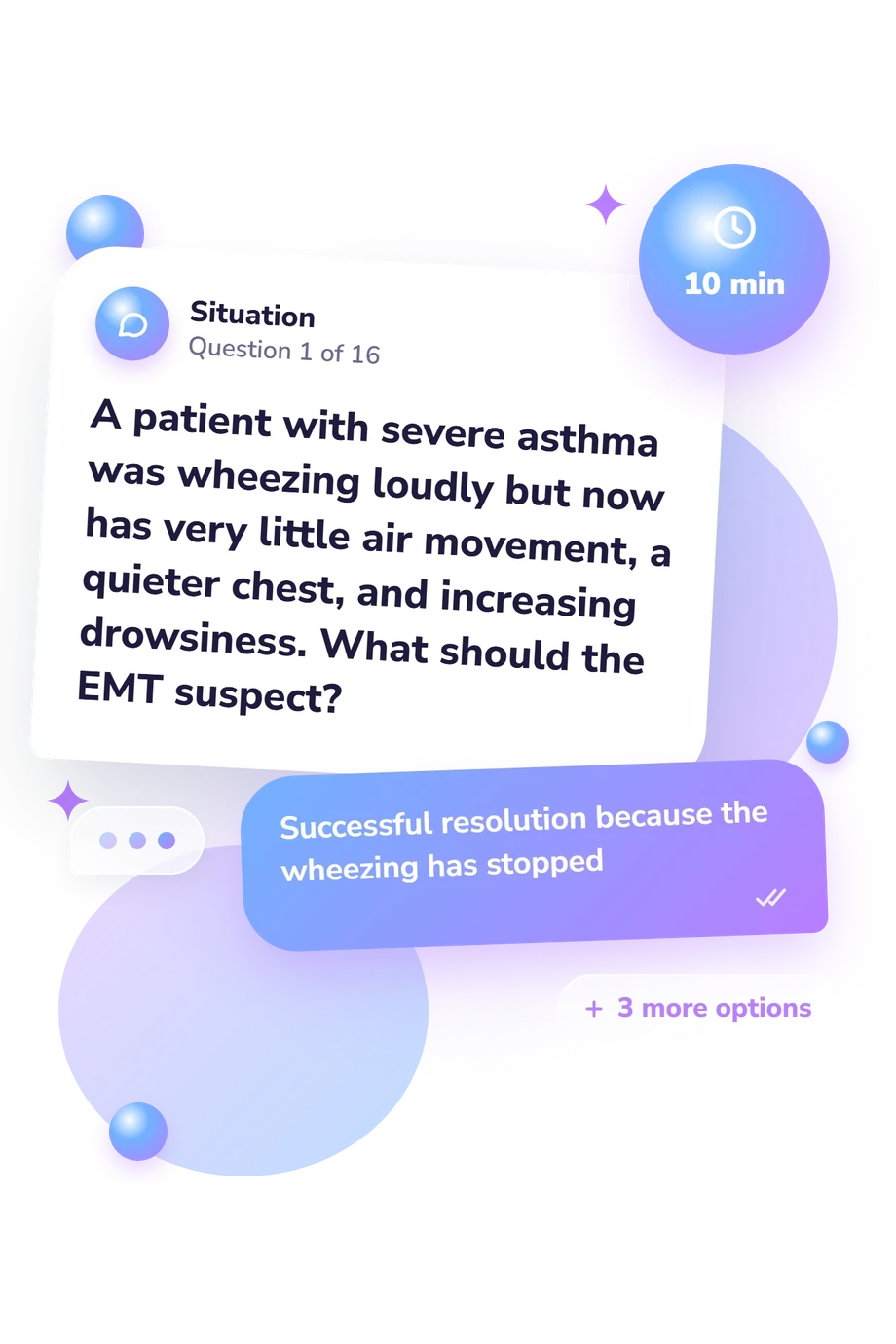
These scenarios examine airway and breathing threats, especially signs that distinguish a manageable problem from impending failure. They cover upper-airway obstruction, bronchospasm, chest trauma, pulmonary embolism, opioid-related hypoventilation, respiratory distress, and respiratory failure. The respiratory emergencies quiz asks learners to connect breath sounds, mental status, work of breathing, capnography, oxygen saturation, and position with an EMT-level priority.
The displayed scale is Respiratory Emergencies EMT Knowledge (0-16). It reflects educational knowledge of common EMT-level respiratory presentations, assessment clues, and immediate priorities represented by the scenarios and response choices. The result bands are:
- Foundation to reinforce (0-6) indicates that respiratory assessment, signs of failure, and basic airway or ventilation priorities need review.
- Developing knowledge (7-12) indicates recognition of many major patterns, while missed concepts identify useful targets for focused study.
- Strong knowledge (13-16) indicates a solid grasp of common EMT-level respiratory presentations and priorities.
Methodology and Scientific Basis
Each item presents a short emergency vignette with four answer choices. The respondent selects the best interpretation or immediate action, covering recognition of physiology, airway clearance, oxygenation, ventilation, positioning, CPAP, and escalation. The questionnaire reports one total on the displayed knowledge scale; its item-to-point calculation is not defined, so no more specific scoring rule should be inferred.
Methodologically, the content is conceptually consistent with Hodroge et al. (2020), which addresses assessment and prehospital management of adult respiratory distress. NASEMSO (2022), NHTSA (2021), and Davis et al. (2022) support its emphasis on airway management, oxygenation, ventilation, and protocol-aware care. These sources frame the topics but do not make this online questionnaire a validated adaptation of a published instrument.
Interpret the result as educational feedback for study planning. Because the score is unvalidated, performance may vary with recent instruction, wording familiarity, and current context; it does not establish clinical competence or replace practical training, medical direction, or local protocols. This respiratory assessment quiz is most useful when missed answers lead to targeted review and supervised practice.
- Sammy S. Hodroge, Melody Glenn, Amelia Breyre, et al. Adult Patients with Respiratory Distress: Current Evidence-based Recommendations for Prehospital Care. Western Journal of Emergency Medicine. 2020;21(4):849-857. 10.5811/westjem.2020.2.43896
- National Association of State EMS Officials. National Model EMS Clinical Guidelines, Version 3.0. March 2022.
- National Highway Traffic Safety Administration. 2021 National Emergency Medical Services Education Standards. 2021.
- Daniel P. Davis, Nichole Bosson, Francis X. Guyette, et al. Optimizing Physiology During Prehospital Airway Management: An NAEMSP Position Statement and Resource Document. Prehospital Emergency Care. 2022;26(sup1):72-79. 10.1080/10903127.2021.1992056
Updated: