
Am I Going to Jail Quiz
How the Scales are Structured
Who Usually Takes This Test?
See How You Compare
Below is a preview of how scores are typically distributed across each scale.
Example Questions From the Test
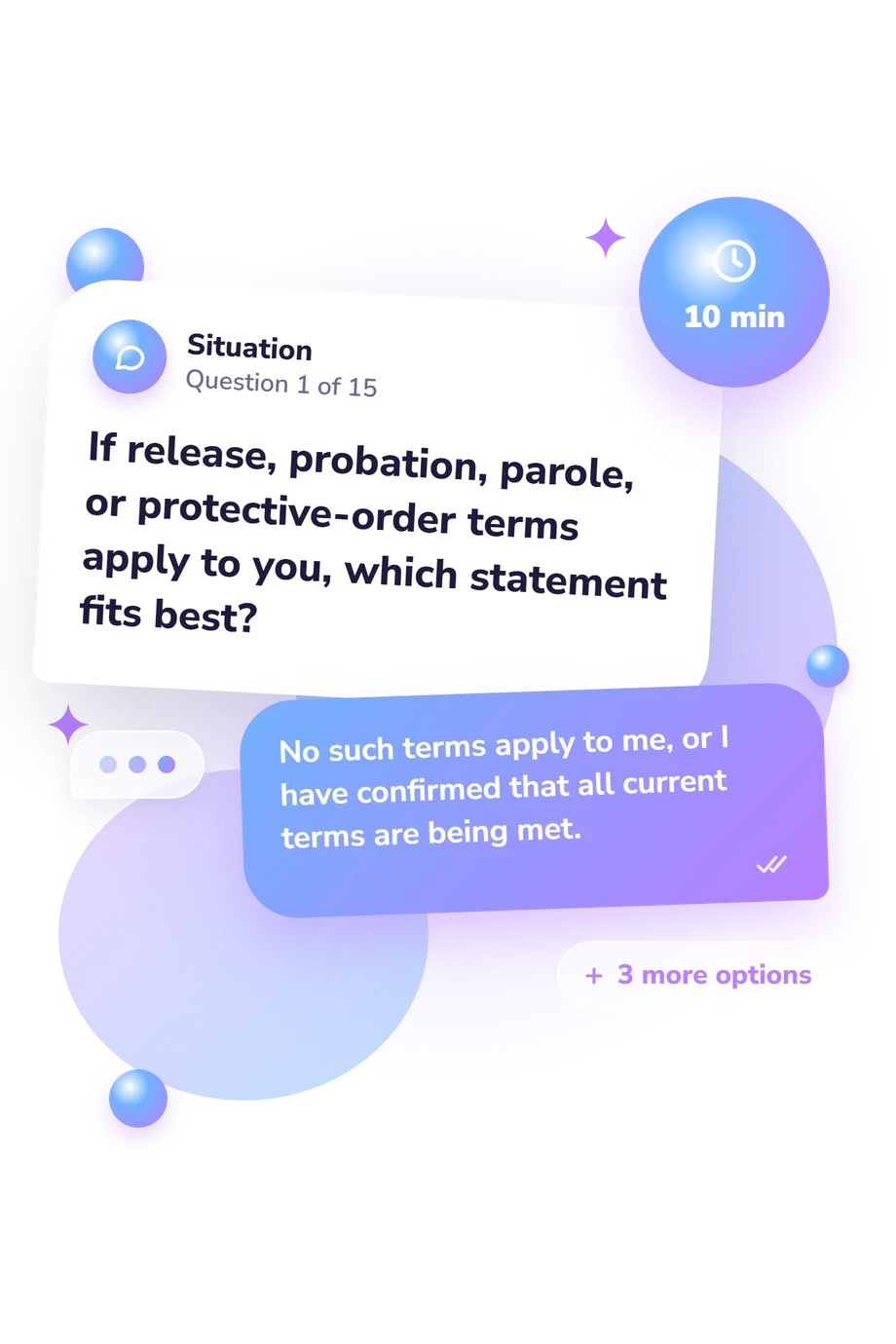
- No such terms apply to me, or I have confirmed that all current terms are being met.
- The terms apply, and I have one detail I need to clarify before it becomes urgent.
- I believe a possible violation may have occurred, but I have not received a formal violation notice.
- I received an official allegation of violation, revocation notice, arrest warning, or related warrant.
- No deadline applies, or every current requirement has been completed and confirmed.
- A deadline is approaching, and I have a workable plan to meet it.
- A deadline is close or recently passed, but I have contacted the appropriate office or my lawyer to address it.
- I missed a required deadline or check-in and do not have confirmed approval or a new arrangement.
- I have no known mandatory appearance connected with this concern.
- I have an upcoming appearance, and its date and instructions are confirmed.
- I have an upcoming appearance, but an important detail such as the date, location, or required response is unresolved.
- I missed a mandatory appearance, or expect to miss one without confirmed court approval.
Am I Going to Jail Quiz - Description and methodology of the test
For people facing uncertainty about a police contact, court requirement, supervision condition, or custody notice, the Am I Going to Jail Quiz organizes the facts that deserve attention. It suits readers who need to separate documented events from assumptions and decide what to verify with local legal help. For readers approaching this as a will i go to jail quiz, the questionnaire addresses uncertainty about possible jail consequences by focusing on current, verifiable signals rather than a prediction.
What This Assessment Measures
The questions examine violations, deadlines, appearances, allegations, official notices, custody events, and barriers involving transport, medication, dependents, or legal contact. They ask whether fear or overwhelm contributes to delayed communications, missed deadlines, or difficulty seeking help.
The three dimensions separate concerns; they do not predict incarceration:
- Case Escalation Signals (0-15) reflects compliance or case-development events: No signals reported (0), Check details promptly (1-2), or Act now (3-15).
- Legal Information and Support Gaps (0-15) reflects information access and workable planning: No current gap endorsed (0), Strengthen support (1-2), or Act now (3-15).
- Official Custody Signals (0-15) reflects direct custody steps: No direct signal (0-0), Clarify promptly (1-2), or Act now (3-15).
For someone using this what would i go to jail for quiz, it identifies the official fact or requirement needing verification, not a court's action.
Methodology and Evidence Base
Each item uses four ordered self-report choices, moving from no known issue or confirmed compliance through uncertainty, unresolved requirements, and increasingly urgent circumstances. Topics include supervision terms, deadlines, appearances, allegations, documents, custody language, contact attempts, planning, legal guidance, and case-status verification.
The questionnaire reports separate dimension totals, not one incarceration probability. A concerning answer matters independently of the total, and one red-flag response can override the overall band, especially for a warrant, missed appearance, surrender instruction, or immediate safety need.
As an online self-report questionnaire, this going to jail self-assessment is conceptually consistent with Hickman and colleagues' study of appearance barriers and Spohn's work on failure to appear. ABA standards on pretrial release support attention to conditions, communication, and defense assistance. They do not validate this online version or make it an adaptation.
These bands are unvalidated reflective summaries, not legal cutoffs, predictions, or norms. Fear, incomplete records, or secondhand information can affect self-report; verify notices, dates, warrants, and custody instructions with an authorized local source. Use emergency services for immediate danger.
- Hickman, Jess, Mei Yang, Andy Tisdel, Charlie Riccardelli, Ashley Neufeld, and Amanda Coscia. 2025. What Really Prevents Court Appearance? Survey Findings From People Who Failed to Appear in Two Counties. Crime and Justice Institute.
- American Bar Association, Criminal Justice Standards Committee. 2007. ABA Standards for Criminal Justice, Pretrial Release. 3rd ed. Washington, DC: American Bar Association.
- American Bar Association. 2017. Criminal Justice Standards for the Defense Function. 4th ed. Washington, DC: American Bar Association.
- Spohn, Cassia. 2023. What Predicts Failure to Appear for Court Hearings? Criminal Justice Policy Review 34(4): 387-410. 10.1177/08874034231180806
Updated: