
Which Riverdale Character Am I Quiz
How the Scales are Structured
Who Usually Takes This Test?
See How You Compare
Below is a preview of how scores are typically distributed across each scale.
Example Questions From the Test
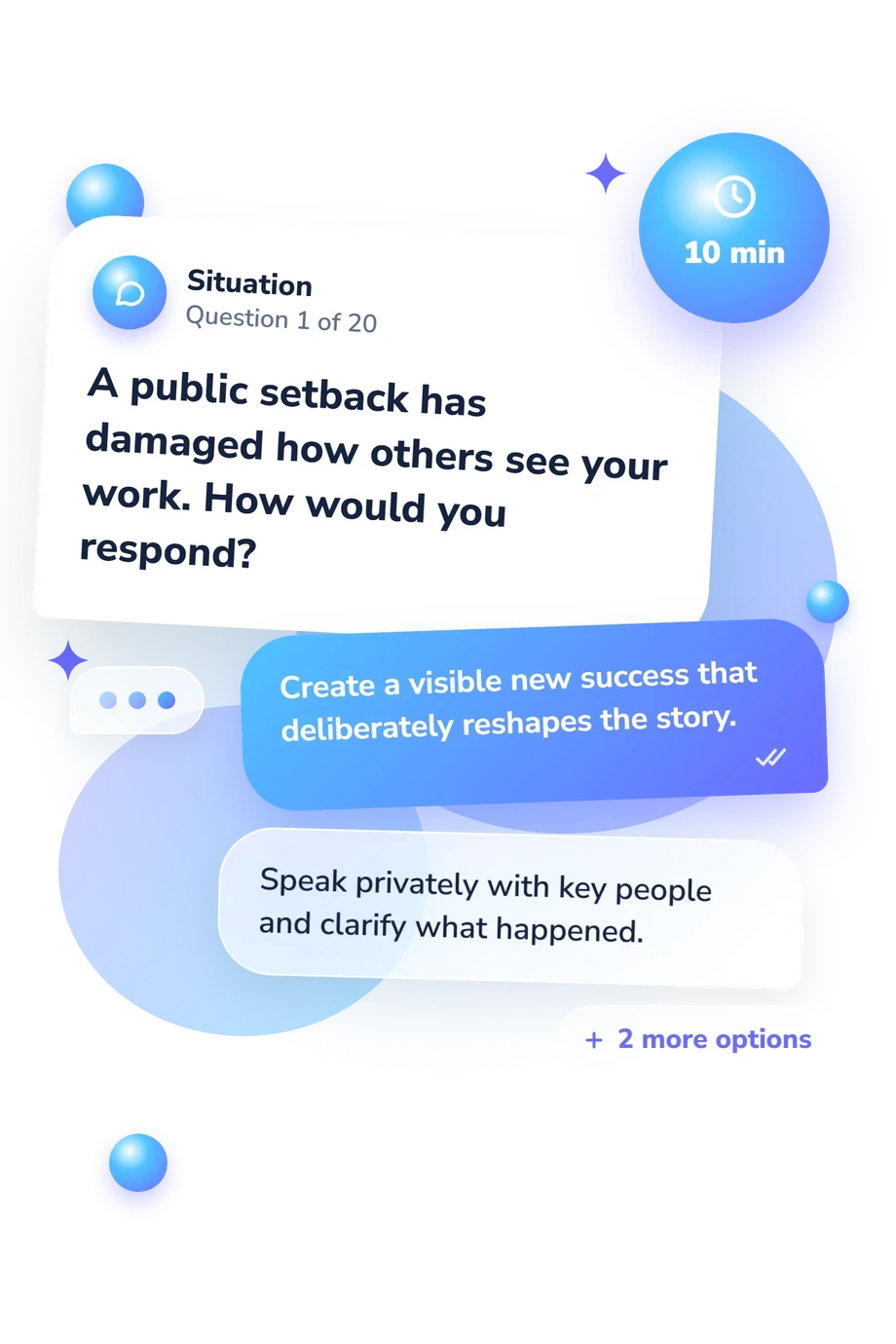
- Create a visible new success that deliberately reshapes the story.
- Speak privately with key people and clarify what happened.
- Focus on doing excellent work and let your reputation recover gradually.
- Ignore the public reaction and redirect your energy elsewhere.
- Step in beside them and handle the most urgent physical tasks.
- Organize the remaining work so everyone knows what to do.
- Introduce them to someone with the right experience or resources.
- Give them room to decide whether they want assistance.
- Move between them and try to stop the confrontation immediately.
- Pull one person aside and work out what triggered the conflict.
- Find another trusted person who can help defuse the situation.
- Wait until emotions settle before getting involved.
Which Riverdale Character Am I Quiz - Description and methodology of the test
For fans who want to compare their everyday instincts with Riverdale personalities, the Riverdale Quiz Who Am I turns choices about conflict, loyalty, evidence, belonging and ambition into a character-affinity profile. A Riverdale personality quiz like this offers playful self-reflection for fans considering how they approach relationships, pressure and difficult choices.
What This Assessment Explores
Items explore responses to loyalty, investigation, expression, observation, influence and responsibility rather than plot recall. This Riverdale character test highlights the closest character pattern, with a near-tie creating a blend.
The five displayed scales describe these affinities:
- Archie Andrews (0-12) reflects hands-on loyalty, community commitment and direct action: Different Rhythm (0-4), Shared Streak (5-8), Strong Affinity (9-12).
- Betty Cooper (0-12) reflects investigative focus, pattern-finding and truth-seeking persistence: Different Method (0-4), Curious Parallel (5-8), Strong Affinity (9-12).
- Cheryl Blossom (0-12) reflects commanding self-expression, dramatic presence and defiance of inherited expectations: Different Presence (0-4), Bold Spark (5-8), Strong Affinity (9-12).
- Jughead Jones (0-12) reflects independent observation, narrative thinking and outsider comfort: Different Lens (0-4), Outsider Streak (5-8), Strong Affinity (9-12).
- Veronica Lodge (0-12) reflects social intelligence, strategic reinvention and opportunity-making: Different Style (0-4), Strategic Spark (5-8), Strong Affinity (9-12).
Methodology and Scientific Basis
Each item presents a Riverdale situation with four response options covering setbacks, belonging, conflict, creative control, evidence, family tradition, community work and competing commitments. The choices sample practical, investigative, expressive, reflective and strategic responses. Because exact point values are not stated, this character affinity quiz is read by comparing scores rather than applying a diagnostic threshold.
Conceptually, the format is consistent with Sorting Quiz (Crysel et al., 2015), which linked fictional-group preferences with personality patterns, and with Jakob et al. (2019), who examined a themed sorting quiz alongside personality and human values. This questionnaire is not an adaptation of either study.
Cohen (2001) frames audience identification with media characters, while Huang and Fung (2024) address identification with narrative characters. The questionnaire has no documented standardization, validation, or population norms; the cited studies did not evaluate this Riverdale questionnaire.
The highest score is the strongest affinity; every character score within one point of the highest score joins the blended result. Displayed bands describe questionnaire ranges, not population cutoffs. Self-report can shift with mood, self-awareness and familiarity with the series, so the result is a fictional-character reflection rather than a clinical conclusion.
- L. C. Crysel, C. L. Cook, T. O. Schember, and G. D. Webster (2015). Harry Potter and the measures of personality: Extraverted Gryffindors, agreeable Hufflepuffs, clever Ravenclaws, and manipulative Slytherins. Personality and Individual Differences, 83, 174-179. 10.1016/j.paid.2015.04.016
- L. Jakob, E. Garcia-Garzon, H. Jarke, and F. Dablander (2019). The Science Behind the Magic? The Relation of the Harry Potter “Sorting Hat Quiz” to Personality and Human Values. Collabra: Psychology, 5(1), Article 31, 1-12. 10.1525/collabra.240
- K. Y. Huang and H. H. Fung (2024). Measuring identification with narrative characters: the development and validation of a new scale. Current Psychology, 43, 24835-24849. 10.1007/s12144-024-06191-2
- Jonathan Cohen (2001). Defining Identification: A Theoretical Look at the Identification of Audiences With Media Characters. Mass Communication and Society, 4(3), 245-264. 10.1207/S15327825MCS0403_01
Updated: