
Pre-Workout Quiz
How the Scales are Structured
Who Usually Takes This Test?
See How You Compare
Below is a preview of how scores are typically distributed across each scale.
Example Questions From the Test
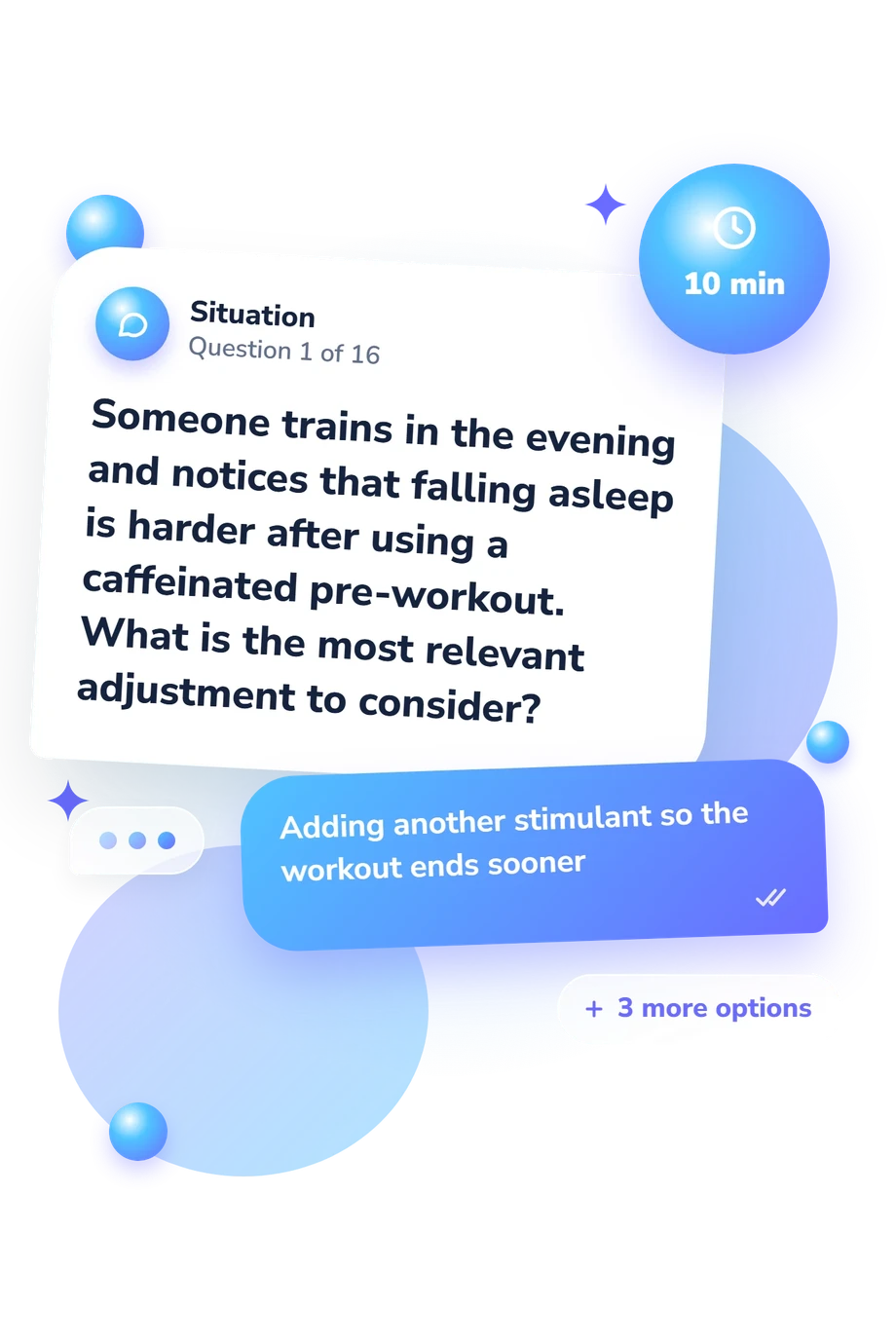
- Adding another stimulant so the workout ends sooner
- Taking the same serving immediately before bed instead
- Choosing an earlier training time, reducing caffeine, or using a stimulant-free option
- Using less water so the caffeine clears faster
- It may list the blend’s total amount without disclosing each ingredient’s dose
- It always contains ingredients that are prohibited in sport
- It indicates that every ingredient is present in an effective amount
- It means the formula cannot contain caffeine
- Two scoops always contain fewer active ingredients than one scoop
- The powder will no longer mix with water
- Doubling a serving only changes the flavor, not ingredient exposure
- It can double exposure to caffeine and other ingredients beyond the directed starting amount
Pre-Workout Quiz - Description and methodology of the test
People comparing formulas, labels, or stimulant habits can use this assessment to check whether their practical knowledge supports safer decisions around training. The preworkout quiz is intended for readers who want to understand what common ingredients, serving directions, and certification claims do-and do not-tell them. As a pre-workout knowledge quiz, it offers a structured starting point for reviewing choices and understanding label information.
What This Assessment Explores
Questions test label literacy and common decisions: serving directions, proprietary blends, ingredient roles, stimulant exposure, independent testing, and responses to severe symptoms.
These themes describe the knowledge areas represented by the overall result:
- Label and ingredient literacy shows how well you interpret serving directions, blend disclosures, ingredient amounts, and common ingredient roles.
- Stimulant awareness shows whether you account for caffeine across products, drinks, foods, and medicines.
- Responsible-use judgment shows whether you recognise exposure risks and respond appropriately.
The result uses the Pre-Workout Knowledge scale (0-16): Foundations to Build (0-6) calls for reviewing serving sizes, stimulant totals, ingredient purposes and basic safety; Developing Knowledge (7-12) shows many essentials with some label-comparison or safety gaps; Strong Knowledge (13-16) shows a well-rounded grasp of labels, ingredients, realistic benefits and responsible decisions. This pre-workout safety quiz highlights topics worth revisiting.
Methodology and Scientific Basis
Each item presents a label-reading problem or training situation with four answer choices. This structured knowledge assessment asks respondents to select the option that best reflects sound knowledge across calculations, ingredient purpose, stimulant exposure, product-quality signals and safety responses. The score is answer-based: selected options are summarized into one displayed result; the named bands provide interpretation, while no further conversion rule is stated.
The ingredient and formulation questions are conceptually consistent with the ingredient profiles discussed by Jagim et al. (2019). Vento and Wardenaar (2020) supports third-party testing knowledge when athletes assess supplement quality and prohibited-substance risk. Guest et al. (2021) provides the caffeine-and-exercise framework for total exposure, timing and tolerance. The questionnaire is conceptually consistent with these works, not a standardized adaptation, and supplies no population norms or diagnostic cutoffs.
Answer selection, guessing, label familiarity and current knowledge can affect the educational score. This pre-workout supplement quiz can guide label review, but its educational band cannot determine whether a particular formula or serving suits one individual.
- Andrew R. Jagim, Patrick S. Harty, and Clayton L. Camic (2019). Common Ingredient Profiles of Multi-Ingredient Pre-Workout Supplements. Nutrients, 11(2), 254. 10.3390/nu11020254
- Kaila Ann Vento and Floris Cornelis Wardenaar (2020). Third-Party Testing Nutritional Supplement Knowledge, Attitudes, and Use Among an NCAA I Collegiate Student-Athlete Population. Frontiers in Sports and Active Living, 2, Article 115. 10.3389/fspor.2020.00115
- Nanci S. Guest, Trisha A. VanDusseldorp, Michael T. Nelson, Jozo Grgic, Brad J. Schoenfeld, Nathaniel D. M. Jenkins, Shawn M. Arent, Jose Antonio, Jeffrey R. Stout, Eric T. Trexler, Abbie E. Smith-Ryan, Erica R. Goldstein, Douglas S. Kalman, and Bill I. Campbell (2021). International society of sports nutrition position stand: caffeine and exercise performance. Journal of the International Society of Sports Nutrition, 18(1), 1. 10.1186/s12970-020-00383-4
Updated: