
What Bra Size Will I Be When I'm Older Quiz
How the Scales are Structured
Who Usually Takes This Test?
See How You Compare
Below is a preview of how scores are typically distributed across each scale.
Example Questions From the Test
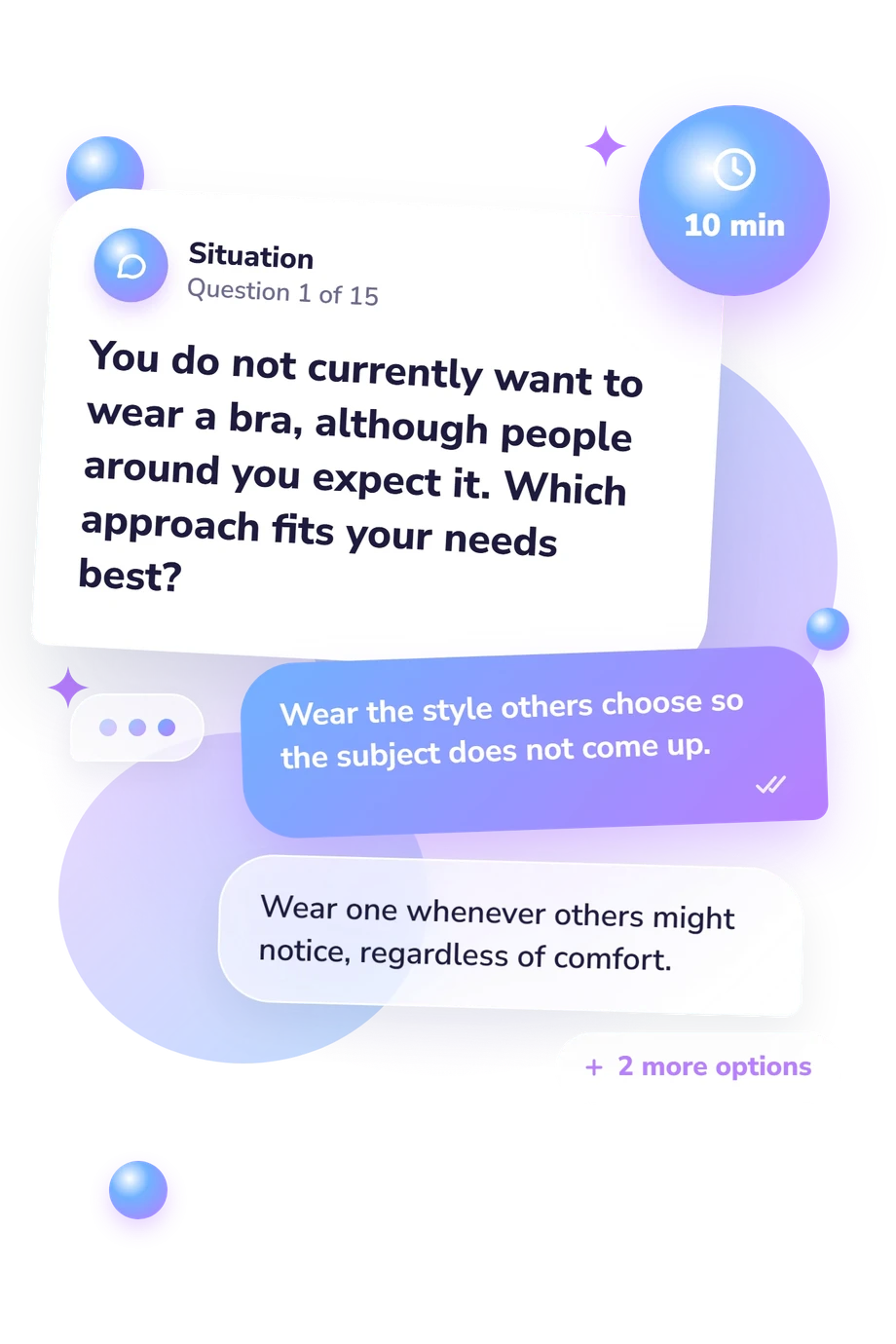
- Wear the style others choose so the subject does not come up.
- Wear one whenever others might notice, regardless of comfort.
- Use a soft layer or bra only in situations where I personally find it useful.
- Choose whether and when to wear one based on my comfort, clothing needs, activities, and any relevant rules.
- Keep it if the front looks smooth under clothing.
- Shorten the straps so they hold the back down.
- Try another style in the same labeled size and compare.
- Remeasure and test a more secure band with an appropriately adjusted cup size.
- Fit the smaller side tightly so both sides look identical.
- Choose by appearance from the front and ignore differences in comfort.
- Try a flexible style that accommodates the difference reasonably well.
- Fit the fuller side comfortably and use adjustable straps or an optional insert if I want balance.
What Bra Size Will I Be When I'm Older Quiz - Description and methodology of the test
Curious readers who want to reflect on bra decisions, fit skills, comfort, and boundaries can use this bra size questionnaire when future development feels uncertain. The What Bra Size Will I Be When I'm Older Quiz does not calculate a final cup or band label; it helps clarify which expectations and next steps deserve attention. A result can support self-reflection before buying, changing, or discussing bras.
What This Assessment Explores
Rather than promising a future label, the assessment explores responses to development uncertainty, comfort needs, social pressure, and everyday fitting problems. Rather than treating what will my bra size be when im older quiz as a forecast, the assessment redirects attention to choices that can be made now. Items also address brand variation, movement, asymmetry, painful pressure, and the difference between current fit and eventual development.
The result is organized around three complementary dimensions:
- Comfort-Led Choices (0-15) show whether comfort and personal boundaries guide decisions: Outside cues lead (0-5), Growing self-direction (6-10), or Body-led flexibility (11-15).
- Future-Size Understanding (0-15) reflects how cautiously development and labels are interpreted: Starting framework (0-5), Developing perspective (6-10), or Grounded perspective (11-15).
- Present-Fit Skills (0-15) indicate how systematically current fit is checked: Fit basics to build (0-5), Practical foundation (6-10), or Strong fit process (11-15).
Methodology and Scientific Basis
Each item offers four response options for the same situation, ranging from outside expectations or simplified assumptions to choices grounded in comfort, context, measurements, and boundaries. Responses are grouped into three separate scale scores. The displayed bands classify the resulting pattern; the ranges do not reveal a points-per-answer rule, and a higher score is not a forecast of cup or band size.
The questionnaire’s content is conceptually consistent with studies by McGhee and Steele on support and comfort, McGhee, Steele, and Munro on bra knowledge and support, White and Scurr on fitting criteria, and Biro and colleagues on variation in breast development. These studies are comparison points for its themes, not validation of the online questionnaire’s response design or scoring; the online version is not the published instrument or a standardized adaptation of it.
Interpret results as an educational profile of present reasoning. The bands are unvalidated, and no family comparison or online formula can produce a reliable future bra size prediction. Responses may also shift with context, self-awareness, or social pressure; persistent pain, skin injury, a new lump, discharge, or sudden change calls for qualified health support.
- Deirdre E. McGhee and Julie R. Steele. Optimising breast support in female patients through correct bra fit. A cross-sectional study. Journal of Science and Medicine in Sport. 2010;13(6):568-572. DOI 10.1016/j.jsams.2010.03.003
- Deirdre E. McGhee, Julie R. Steele, and Bridget J. Munro. Education improves bra knowledge and fit, and level of breast support in adolescent female athletes: a cluster-randomised trial. Journal of Physiotherapy. 2010;56(1):19-24. DOI 10.1016/S1836-9553(10)70050-3
- Jenny White and Joanna Scurr. Evaluation of professional bra fitting criteria for bra selection and fitting in the UK. Ergonomics. 2012;55(6):704-711. DOI 10.1080/00140139.2011.647096
- Frank M. Biro, Louise C. Greenspan, Maida P. Galvez, Susan M. Pinney, Susan Teitelbaum, Gayle C. Windham, Julianna Deardorff, Robert L. Herrick, Paul A. Succop, Robert A. Hiatt, Lawrence H. Kushi, and Mary S. Wolff. Onset of Breast Development in a Longitudinal Cohort. Pediatrics. 2013;132(6):1019-1027. DOI 10.1542/peds.2012-3773
Updated: