
Which Cullen Am I Quiz
How the Scales are Structured
Who Usually Takes This Test?
See How You Compare
Below is a preview of how scores are typically distributed across each scale.
Example Questions From the Test
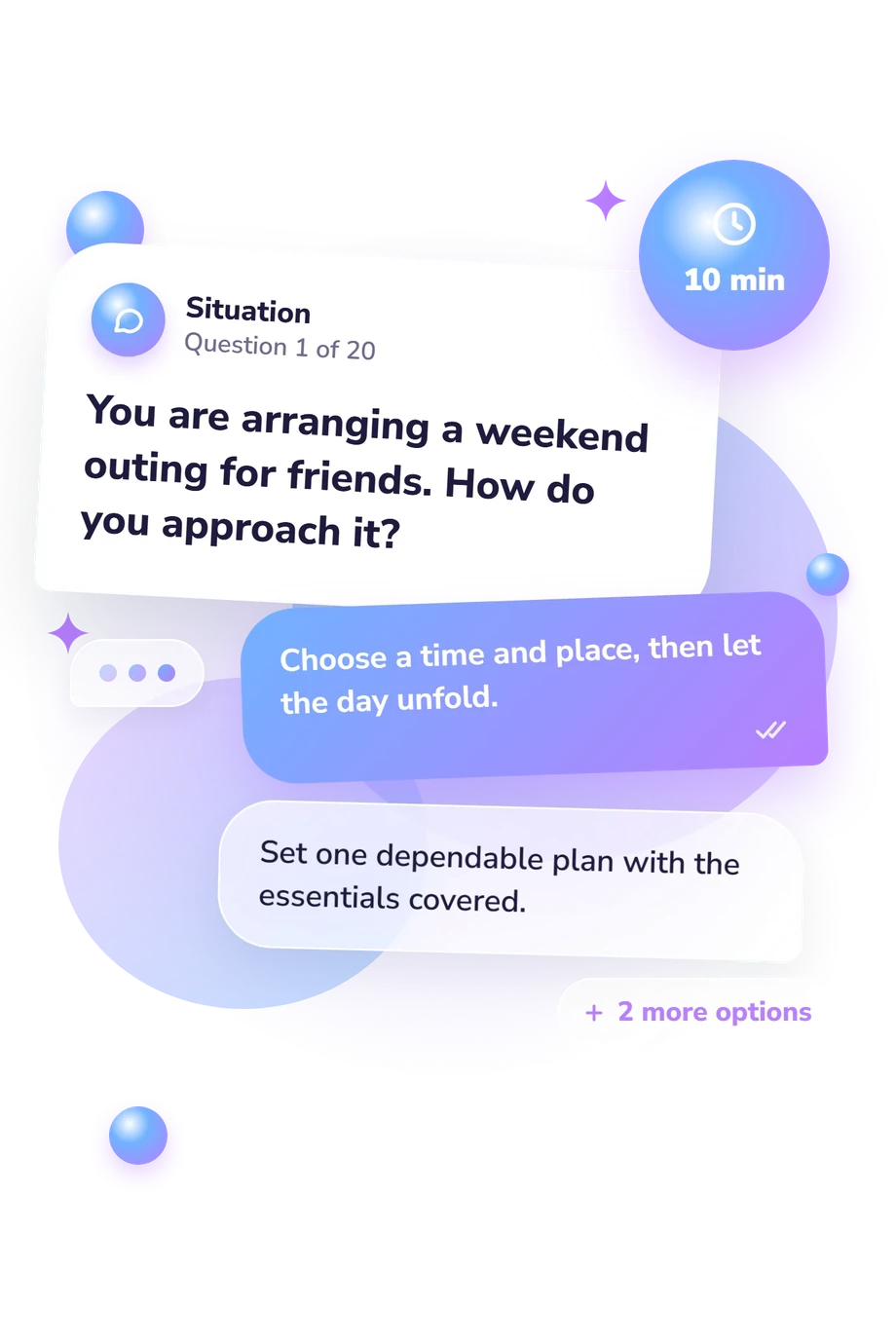
- Choose a time and place, then let the day unfold.
- Set one dependable plan with the essentials covered.
- Prepare a main plan plus a sensible backup.
- Imagine several possible turns and make each one sound exciting.
- I would rather choose a mental or creative challenge.
- I am happy to watch and encourage the group.
- I will join because sharing the experience sounds worthwhile.
- I am immediately ready for a friendly contest.
- Turn it into a joke and avoid dwelling on it.
- Seek support from someone who already recognizes my ability.
- Address their assumption directly in conversation.
- Let an unmistakably polished result prove what I can do.
Which Cullen Am I Quiz - Description and methodology of the test
Fans who want to connect everyday choices with the Cullen family’s contrasting personalities can use the Which Cullen Am I Quiz as a playful narrative-character reflection. It suits readers curious about their responses to planning, pressure, loyalty, boundaries, conflict, and emotional intensity. As a Cullen personality quiz, it turns those situations into a profile that highlights the character qualities most prominent in the respondent.
What This Assessment Explores
The questionnaire uses fictional patterns to examine planning, challenge, social awareness, boundaries, loyalty, conflict, and emotional intensity. As a quiz asking which Cullen you are, it describes affinity rather than a fixed identity. The dimensions are:
- Alice Cullen (0-12) reflects imaginative optimism and creative support, with Faint affinity (0-4), Noticeable affinity (5-8), or Strong affinity (9-12).
- Edward Cullen (0-12) reflects introspection, restraint, vigilance, and devotion, with Faint affinity (0-4), Noticeable affinity (5-8), or Strong affinity (9-12).
- Emmett Cullen (0-12) reflects playful boldness, confidence, humor, and loyalty, with Faint affinity (0-4), Noticeable affinity (5-8), or Strong affinity (9-12).
- Jasper Cullen (0-12) reflects observation, sensitivity, composure, and caution, with Faint affinity (0-4), Noticeable affinity (5-8), or Strong affinity (9-12).
- Rosalie Cullen (0-12) reflects assertiveness, independence, candor, and self-possession, with Faint affinity (0-4), Noticeable affinity (5-8), or Strong affinity (9-12).
Methodology and Evidence Base
Each item presents an everyday scenario with four self-report responses. The options contrast spontaneity with preparation, directness with restraint, active encouragement with quiet support, and practical problem-solving with imaginative anticipation. No item-level scoring key is presented, so choices are not fixed personality categories.
The result compares five separate scores. The highest is the strongest affinity, while any score within one point of that maximum contributes to a blended result. The displayed bands are descriptive categories for this questionnaire, not population norms or clinical cutoffs.
Research gives conceptual context: audience-character similarity and identification; this quiz uses its own character-affinity scoring. Cohen (2001) describes imaginative involvement with media characters; Huang and Fung (2024) offer a later measure of that process. Huang, Fung, and Sun (2024) link audience-character similarity with identification across studies, while Meyer’s official guide provides the fictional character context. The questionnaire is conceptually consistent with this work, not an adaptation or validation of those instruments. As a Twilight character quiz, it is most useful when answers reflect honest reactions, since self-report can shift with mood, context, and remembered character details.
- Huang, Kate Y., Helene H. Fung, and Peifeng Sun. (2024). The effect of audience-character similarity on identification with narrative characters: A meta-analysis. Current Psychology, 43(8), 7026-7043. 10.1007/s12144-023-04842-4
- Meyer, Stephenie. (2011). The Twilight Saga: The Official Illustrated Guide. Little, Brown Books for Young Readers.
- Huang, Kate Y., and Helene H. Fung. (2024). Measuring identification with narrative characters: The development and validation of a new scale. Current Psychology, 43, 24835-24849. 10.1007/s12144-024-06191-2
- Cohen, Jonathan. (2001). Defining identification: A theoretical look at the identification of audiences with media characters. Mass Communication and Society, 4(3), 245-264. 10.1207/S15327825MCS0403_01
Updated: