
Werewolf Name Quiz
How the Scales are Structured
Who Usually Takes This Test?
See How You Compare
Below is a preview of how scores are typically distributed across each scale.
Example Questions From the Test
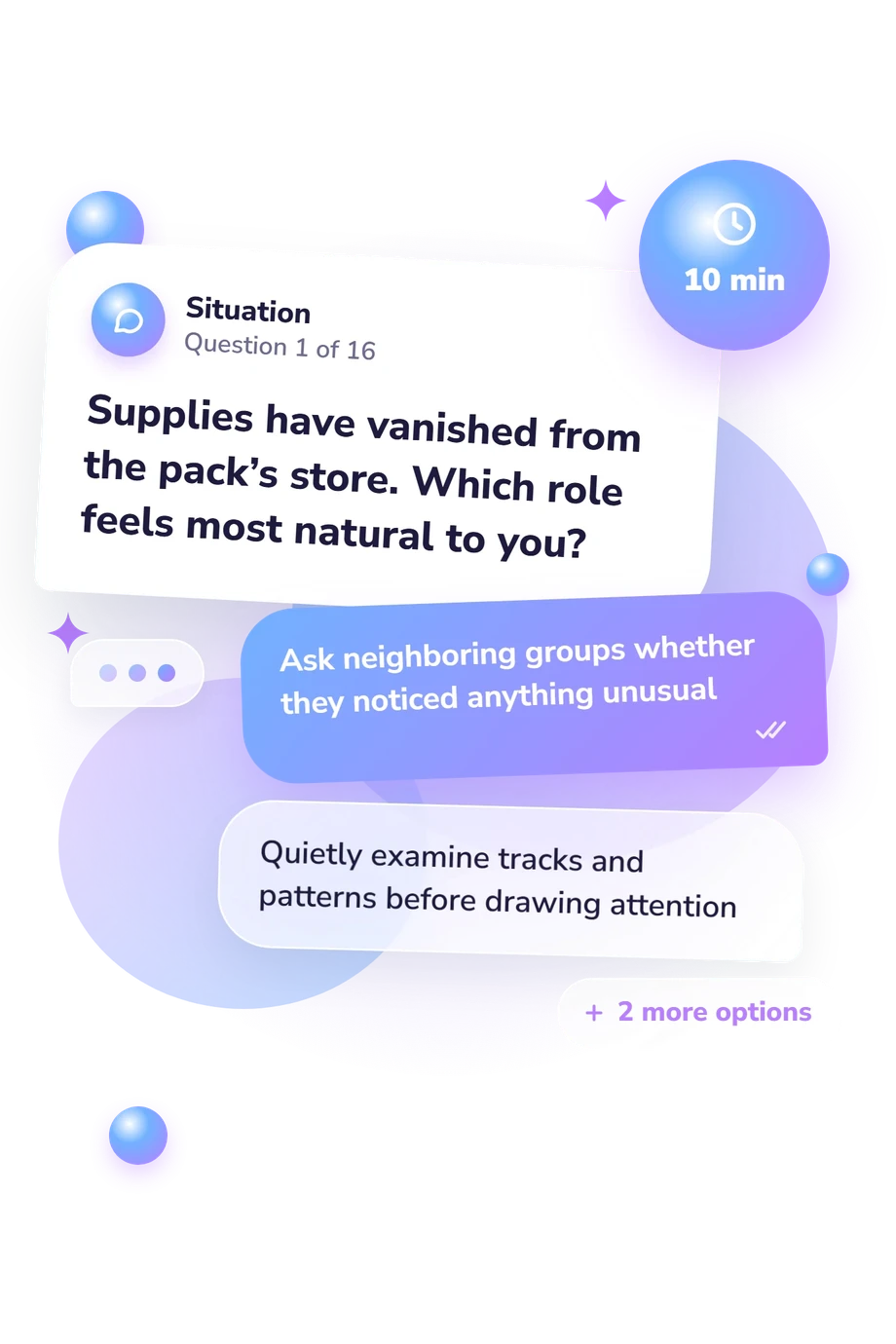
- Ask neighboring groups whether they noticed anything unusual
- Quietly examine tracks and patterns before drawing attention
- Keep everyone’s spirits up while others investigate
- Organize a watch so the remaining supplies stay protected
- State the boundary plainly and stand ready to defend the decision
- Look for an unspoken concern that could soften the confrontation
- Observe first and reveal as little as possible
- Defuse the stiffness with warmth and an unexpected invitation
- A welcoming wanderer who follows instinct rather than plans
- A thoughtful presence who understands what remains unsaid
- A formidable figure who acts decisively when the moment arrives
- A watchful guardian whose strength stays partly concealed
Werewolf Name Quiz - Description and methodology of the test
For readers who enjoy fantasy, role-play, or playful self-reflection, this werewolf name quiz explores which imagined identity feels most natural. It turns choices about pack life, names, symbols, and challenges into a profile of preferred strengths rather than a judgment of real-world ability. The result offers a creative prompt for considering which werewolf name suits the persona you would like to express.
What This Assessment Explores
The questionnaire suits anyone exploring an imagined pack identity through choices about conflict, responsibility, travel, symbols, and landscapes. In practice, it offers a playful way to choose a werewolf character name, linking preferences with four named affinities. The four result dimensions are:
- Fenris Nightclaw (0-12) measures guarded nocturnal strength: Open Trail (0-4) favors brightness; Shadow Stirring (5-8) shows partial resonance; Nightclaw Calling (9-12) signals quiet power.
- Lyra Moonveil (0-12) measures mystical sensitivity: Earthward Gaze (0-4) favors direct energy; Veil Glimmer (5-8) shows partial resonance; Moonveil Calling (9-12) signals empathy and magic.
- Rowan Wildheart (0-12) measures adventure and pack fellowship: Settled Path (0-4) leans elsewhere; Wild Spark (5-8) shows partial resonance; Wildheart Calling (9-12) signals warmth and freedom.
- Silas Stormfang (0-12) measures bold leadership: Quiet Horizon (0-4) favors gentler energies; Gathering Thunder (5-8) shows selected resonance; Stormfang Calling (9-12) signals decisive intensity.
Methodology and Evidence Base
Each item presents an imagined scenario or naming choice with four answer choices. Options evoke warmth, intuition, watchfulness, decisiveness, freedom, or symbolism. Choosing what feels natural makes this a self-report exercise, not a knowledge test. The result compares the four displayed affinity scores: the highest is strongest, while scores within one point form a blended result.
Conceptually, the questionnaire works as a fantasy identity quiz and is consistent with Park and Henley (2007), whose work links personality preferences with fictional game-character choices. Guitton (2010) addresses how names contribute to avatar identity, while Cheetham, Hänggi, and Jäncke (2014) examine identification with fictive characters and fantasy. Markus and Nurius (1986) provide the possible-selves framework for imagined identities. These sources offer conceptual context; this questionnaire is not an adaptation or validation of their instruments.
Because the scoring is affinity-based, responses may reflect current mood, aesthetic preference, and the persona a respondent wants to try on; its affinity scoring has no established population standardization or norms, so displayed bands are descriptive, not validated clinical cutoffs, and the profile is imaginative self-reflection rather than a diagnostic assessment.
- Anna E. Park and Tracy B. Henley. Personality and Fantasy Game Character Preferences. Imagination, Cognition and Personality, 27(1), 37-46, 2007. 10.2190/IC.27.1.d
- Matthieu J. Guitton. Cross-modal compensation between name and visual aspect in socially active avatars. Computers in Human Behavior, 26(6), 1772-1776, 2010. 10.1016/j.chb.2010.07.004
- Marcus Cheetham, Jürgen Hänggi, and Lutz Jäncke. Identifying with fictive characters: structural brain correlates of the personality trait ‘fantasy’. Social Cognitive and Affective Neuroscience, 9(11), 1836-1844, 2014. 10.1093/scan/nst179
- Hazel Markus and Paula Nurius. Possible selves. American Psychologist, 41(9), 954-969, 1986. 10.1037/0003-066X.41.9.954
Updated: