
Which Anime Dilf Quiz
How the Scales are Structured
Who Usually Takes This Test?
See How You Compare
Below is a preview of how scores are typically distributed across each scale.
Example Questions From the Test
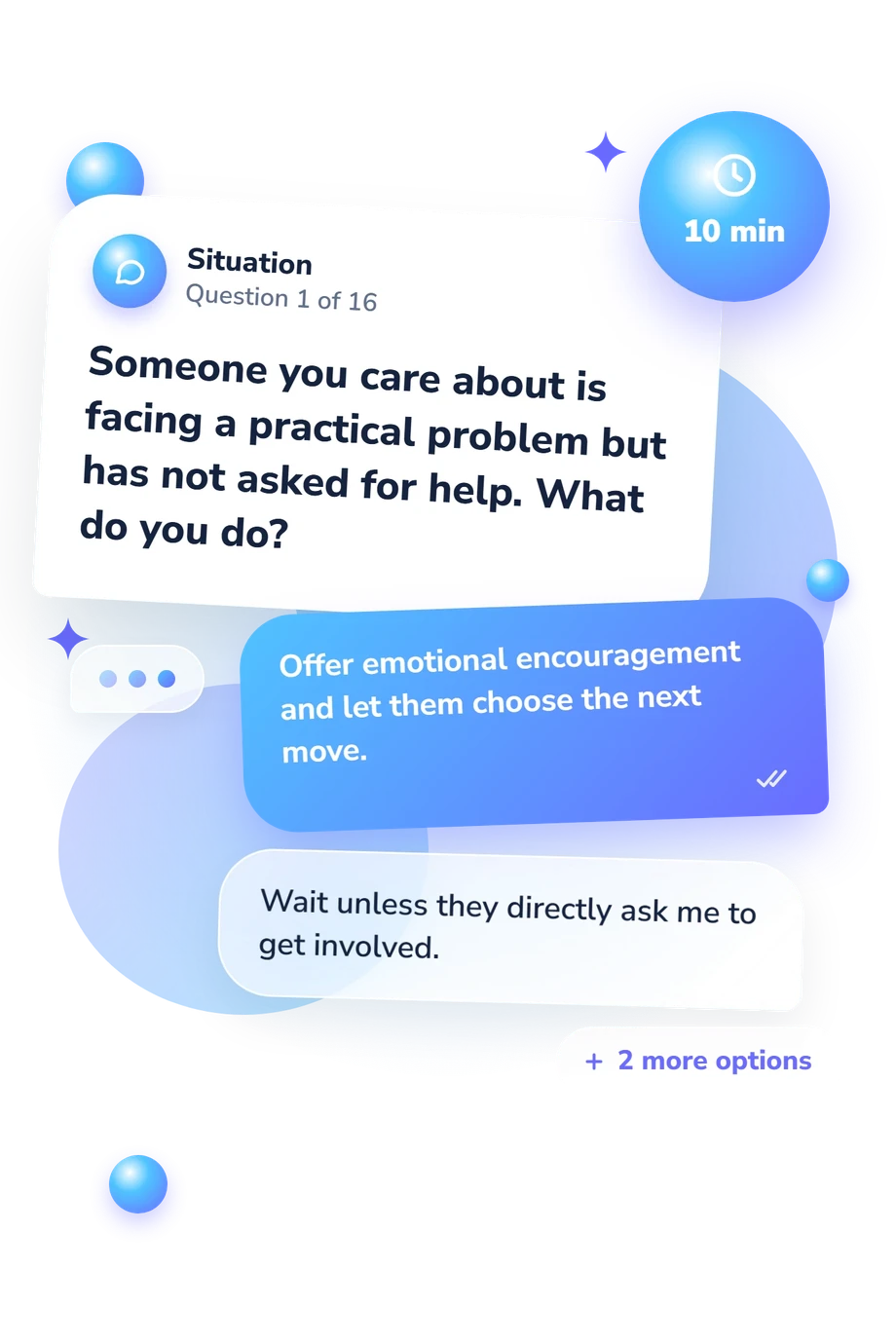
- Offer emotional encouragement and let them choose the next move.
- Wait unless they directly ask me to get involved.
- Research possible solutions, then casually offer the most useful one.
- Ask a few focused questions and help if they seem receptive.
- Challenge them immediately so the disrespect does not stand.
- Reply firmly without escalating beyond what is necessary.
- Use humor to shift the mood and move on.
- Refuse the contest entirely unless someone’s safety requires action.
- Light up and share stories or pictures if others seem interested.
- Mention a recent story that shows why they matter to me.
- Answer warmly but keep most personal details private.
- Redirect toward a topic that does not center on my personal life.
Which Anime Dilf Quiz - Description and methodology of the test
Fans who enjoy anime archetypes can use this playful assessment to reflect on the kinds of care, confidence, guidance, and moral steadiness they find compelling. The Which Anime DILF Quiz turns those preferences into a character-affinity profile rather than a right-or-wrong verdict. It suits readers who want a light result from an anime archetype quiz, with enough detail to explain why one fictional style stands out.
What This Assessment Explores
Items ask about care, attention, planning, feedback, mentorship, conflict, recovery, and principles. The audience is fans comparing their responses with four fictional character styles, not testing anime knowledge. The profile functions as an anime character affinity quiz by showing the strongest or blended style.
The four affinity scales are:
- Loid Forger (0-12) measures affinity with strategic adaptability and quietly protective care: Different wavelength (0-4), Shared instincts (5-8), or Strong affinity (9-12).
- Maes Hughes (0-12) measures affinity with sociable warmth and openly devoted connection: Different wavelength (0-4), Shared warmth (5-8), or Strong affinity (9-12).
- Shota Aizawa (0-12) measures affinity with low-key independence and practical mentorship: Different wavelength (0-4), Shared instincts (5-8), or Strong affinity (9-12).
- Thors Snorresson (0-12) measures affinity with restrained strength, peaceful de-escalation, and values-led simplicity: Different wavelength (0-4), Shared principles (5-8), or Strong affinity (9-12).
Methodology and Evidence Base
Each prompt describes a social, relational, or values-based situation and offers four response options. There are no right answers; choices represent different ways of handling care, attention, planning, feedback, mentorship, conflict, and principles. The result combines selections into four comparable affinity scores: the highest is the strongest affinity, while scores within one point form a blended result.
The four response patterns have limited conceptual parallels with the Managerial Conflict Adaptivity Assessment (Coleman & Kugler, 2014), particularly its attention to flexible responses to tension. The questionnaire is not an adaptation of that measure, and this parallel does not establish the displayed character-affinity scales. Wiggins’s Interpersonal Adjective Scales and Coleman and colleagues (2012) offer additional ideas for describing interpersonal behavior in context, not evidence that these four scales reproduce those instruments.
In this anime character quiz, answers connect practical support, visible warmth, competence, independence, restraint, protection, and guidance with fictional archetypes. The result should therefore be read through the named bands and highest-score or blended rule. Self-report responses can vary with mood, self-awareness, and how a scenario is interpreted.
- Coleman, Peter T., and Katharina G. Kugler. Tracking managerial conflict adaptivity: Introducing a dynamic measure of adaptive conflict management in organizations. Journal of Organizational Behavior, 35(7), 945-968, 2014. 10.1002/job.1935
- Wiggins, Jerry S. Interpersonal Adjective Scales: Professional Manual. Odessa, FL: Psychological Assessment Resources, 1995.
- Coleman, Peter T., Katharina G. Kugler, Lan Bui-Wrzosinska, Andrzej Nowak, and Robin Vallacher. Getting Down to Basics: A Situated Model of Conflict in Social Relations. Negotiation Journal, 28(1), 7-43, 2012. 10.1111/j.1571-9979.2011.00324.x
Updated: