
What Should I Write a Song About Quiz
How the Scales are Structured
Who Usually Takes This Test?
See How You Compare
Below is a preview of how scores are typically distributed across each scale.
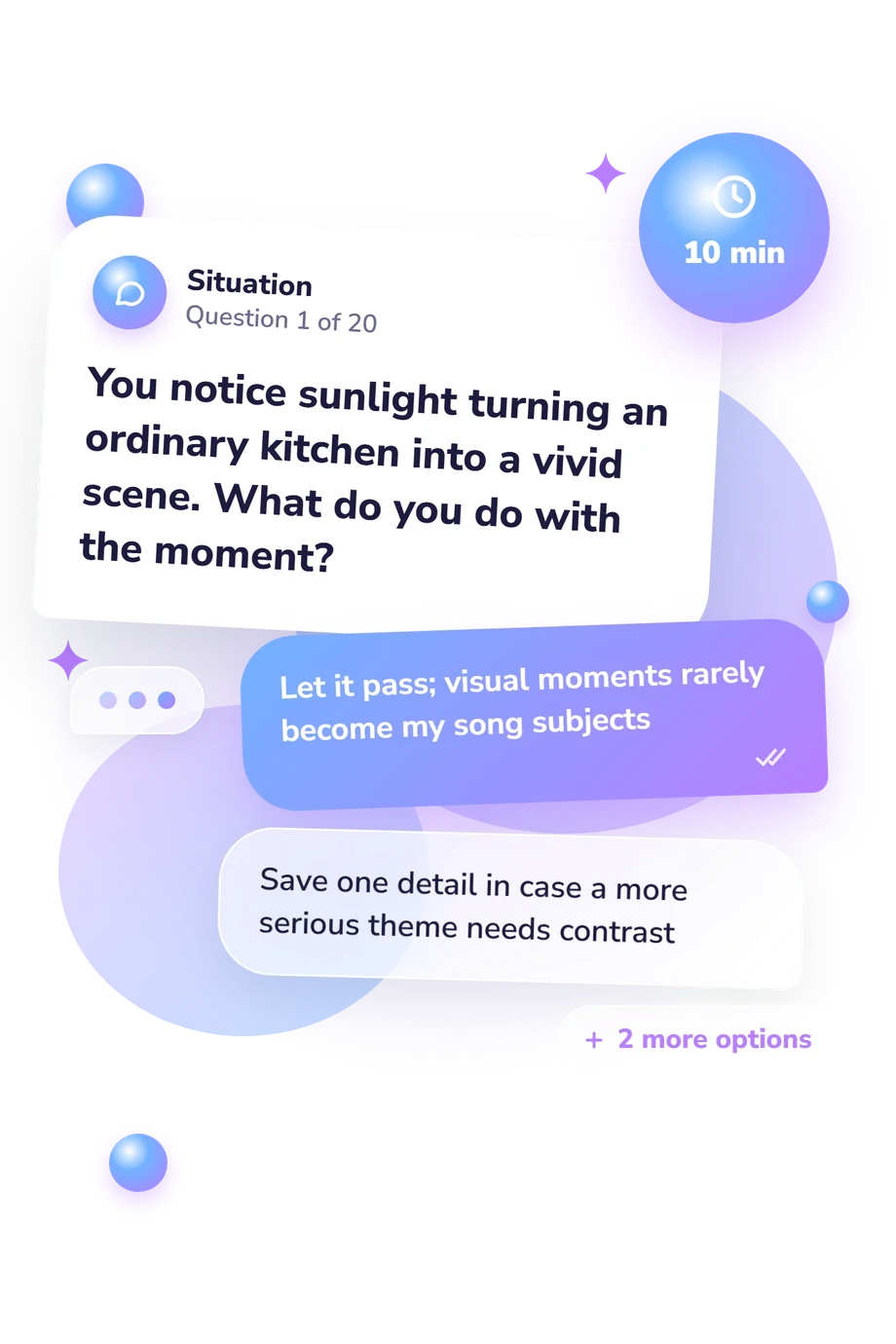
Example Questions From the Test
- The way I changed once the conversation was over
- A fictionalized scene that only borrows the tension
- The tenderness that survived despite the disagreement
- What each person said, avoided, or needed the other to understand
- A familiar route that feels different on a perfect morning
- An ordinary object connected to one meaningful memory
- A brief comic mishap that could fill a verse
- None of these; I am more drawn to subjects with larger stakes
- “That gave me a vivid character to picture.”
- “I could hear you working through something real.”
- “One line made me reconsider a choice in my own life.”
- “The mood was personal even though the meaning stayed open.”
What Should I Write a Song About Quiz - Description and methodology of the test
Musicians facing a blank page can use the What Should I Write a Song About Quiz to explore which kinds of material feel most compelling, from intimate memories to invented scenes and public questions. It turns creative hesitation into a clearer direction for drafting. As a song topic quiz, it helps you choose a starting subject without dictating the finished lyric.
What This Assessment Explores
Readers seeking a quiz about what to write a song about can use the profile to find the creative territory with the most current energy. It suggests a subject or viewpoint, not a finished premise.
The five directions are:
- Everyday Joy (0-12) shows whether daily pleasures can anchor a song: Light Accent (0-4), Bright Possibility (5-8), Strong Affinity (9-12).
- Fictional Story (0-12) shows the pull of characters and plot: Occasional Device (0-4), Story Seed (5-8), Strong Affinity (9-12).
- Love & Relationships (0-12) reflects romance, friendship, distance, or repair: Background Thread (0-4), Open Heart (5-8), Strong Affinity (9-12).
- Personal Change (0-12) reflects transition and identity: Supporting Theme (0-4), Reflective Direction (5-8), Strong Affinity (9-12).
- Social Commentary (0-12) reflects shared choices and public concerns: Private Lens (0-4), Questioning Voice (5-8), Strong Affinity (9-12).
Methodology and Evidence Base
Each prompt presents a songwriting situation, image, memory, or decision with four responses. No option is correct; choose the response that feels most natural. This song idea quiz is clearest when answers reflect genuine instincts.
Responses create five separate 0-12 profiles, while bands describe relative affinity rather than clinical thresholds. A near-highest result can blend with the leading direction, so a personal experience might use a fictional frame or a social question unfold through a character.
Christenson et al. (2019) is the closest thematic precedent because it examines recurring subjects in popular songs. Thomas et al. (2021) supports viewing songwriting as narrative problem-solving, and Baker and MacDonald (2013) adds context on creative identity, ownership, and satisfaction. The questionnaire is conceptually consistent with these studies, not an adaptation of their instruments. Its custom online format is a self-reflection exercise rather than a standardized or diagnostic instrument.
Scores may vary with mood, recent experience, musical influence, and self-awareness; use them to choose and develop ideas, not to label fixed traits.
- Christenson, Peter G., Silvia de Haan-Rietdijk, Donald F. Roberts, and Tom F. M. ter Bogt. “What has America been singing about? Trends in themes in the U.S. top-40 songs: 1960-2010.” Psychology of Music, 47(2), 2019, 194-212. 10.1177/0305735617748205
- Thomas, Phil Crockett, Fergus McNeill, Lucy Cathcart Frödén, Jo Collinson Scott, Oliver Escobar, and Alison Urie. “Re-writing punishment? Songs and narrative problem-solving.” Incarceration, 2(1), 2021, 1-19. 10.1177/26326663211000239
- Baker, Felicity A., and Raymond A. R. MacDonald. “Flow, identity, achievement, satisfaction and ownership during therapeutic songwriting experiences with university students and retirees.” Musicae Scientiae, 17(2), 2013, 131-146. 10.1177/1029864913476287
Updated: