
Which Sway Boy Is Your Boyfriend Quiz
How the Scales are Structured
Who Usually Takes This Test?
See How You Compare
Below is a preview of how scores are typically distributed across each scale.
Example Questions From the Test
- Funny stories about the people we both know.
- Plans for a trip we might take someday.
- How online culture shapes entertainment and public opinion.
- A big idea, why it might work, and how we could test it.
- Watching and encouraging everyone without caring who wins.
- Participating casually while keeping the mood relaxed.
- Trying hard but laughing when the other person gains an edge.
- Trading bold challenges and fully committing to the rivalry.
- A relaxed movie marathon with snacks at home.
- A café visit followed by an unplanned walk.
- A scenic hike with time to stop and talk.
- A playful workout or sport, followed by a good meal together.
Which Sway Boy Is Your Boyfriend Quiz - Description and methodology of the test
Fans of creator culture who want a light way to reflect on dating preferences can use the Which Sway Boy Is Your Boyfriend Quiz to compare the public-facing qualities they find appealing. For anyone wanting a who is my sway house boyfriend quiz, it produces one strongest or blended profile, connecting choices about plans, humor, style, teamwork, activity, and ambition with a creator-style result.
What This Assessment Measures
These scenarios examine which public-facing styles appeal to you, not a creator’s private character. The resulting Sway Boy style affinity profile helps fans identify whether relaxed visual creativity, sociability, humor, ambition, athletic warmth, or teamwork feels most appealing.
Each scale moves from contrasting to moderate to strong affinity:
- Blake Gray (0-12) measures relaxed, stylish creativity: Practical Contrast (0-4), Casual Compatibility (5-8), Effortless-Style Match (9-12).
- Bryce Hall (0-12) measures bold, competitive sociability: Quieter Contrast (0-4), Situational Spark (5-8), Bold-Energy Match (9-12).
- Griffin Johnson (0-12) measures playful, witty expressiveness: Sincere Contrast (0-4), Playful Possibility (5-8), Comedy-Chemistry Match (9-12).
- Josh Richards (0-12) measures ambitious, idea-driven energy: Different Priorities (0-4), Supportive Alignment (5-8), Power-Pair Potential (9-12).
- Noah Beck (0-12) measures composed, athletic warmth: Contrasting Pace (0-4), Easy Connection (5-8), Steady-Team Match (9-12).
Methodology and Evidence Base
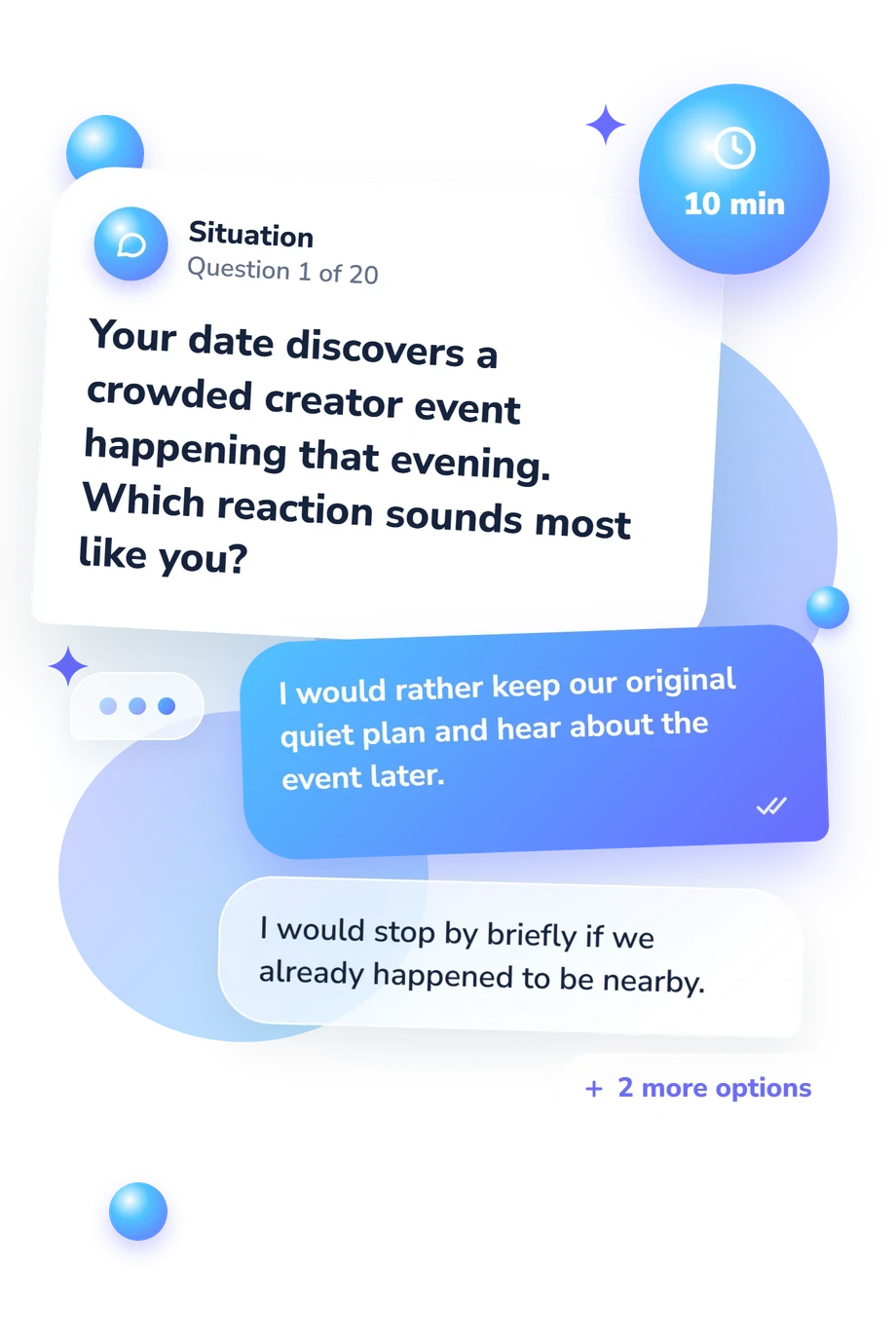
Every item presents a dating or social situation with four options. Choices have no right answer; they convert preferences about plans, humor, directness, style, and teamwork into five totals. The highest total signals strongest affinity; results within one point form a blended result. Because per-answer weights are unstated, use the displayed ranges as catalogue bands rather than infer a formula.
The item themes are conceptually consistent with Sedmak and Svetina (2024), which examines attraction to YouTubers and perceived qualities. Stein, Breves, and Anders (2024) address perceived similarity and human-likeness in influencer interactions. Horton and Wohl’s parasocial framework and Schramm and Hartmann’s PSI-process scales provide background on mediated public-figure experiences, not this questionnaire’s scoring. These sources do not provide scoring, adaptation, or validation.
As an online self-report, this questionnaire describes Sway Boy affinity through imagined plans, humor, social energy, visual expression, activity, and ambition. Its result is descriptive: it organizes creator-style preferences rather than measuring parasocial intensity or relationship outcomes. It is a current preference profile; mood, creator familiarity, self-awareness, and response style can shift the snapshot.
- Sedmak, A., & Svetina, M. (2024). Components of adolescents’ attraction with YouTubers. Current Psychology, 43, 6167-6179. 10.1007/s12144-023-04784-x
- Stein, J.-P., Breves, P. L., & Anders, N. (2024). Parasocial interactions with real and virtual influencers: The role of perceived similarity and human-likeness. New Media & Society, 26(6), 3433-3453. 10.1177/14614448221102900
- Horton, D., & Wohl, R. R. (1956). Mass Communication and Para-Social Interaction: Observations on Intimacy at a Distance. Psychiatry, 19(3), 215-229. 10.1080/00332747.1956.11023049
- Schramm, H., & Hartmann, T. (2008). The PSI-process scales: A new measure to assess the intensity and breadth of parasocial processes. Communications, 33(4), 385-401. 10.1515/COMM.2008.025
Updated: