
Care/of Vitamin Quiz
How the Scales are Structured
Who Usually Takes This Test?
See How You Compare
Below is a preview of how scores are typically distributed across each scale.
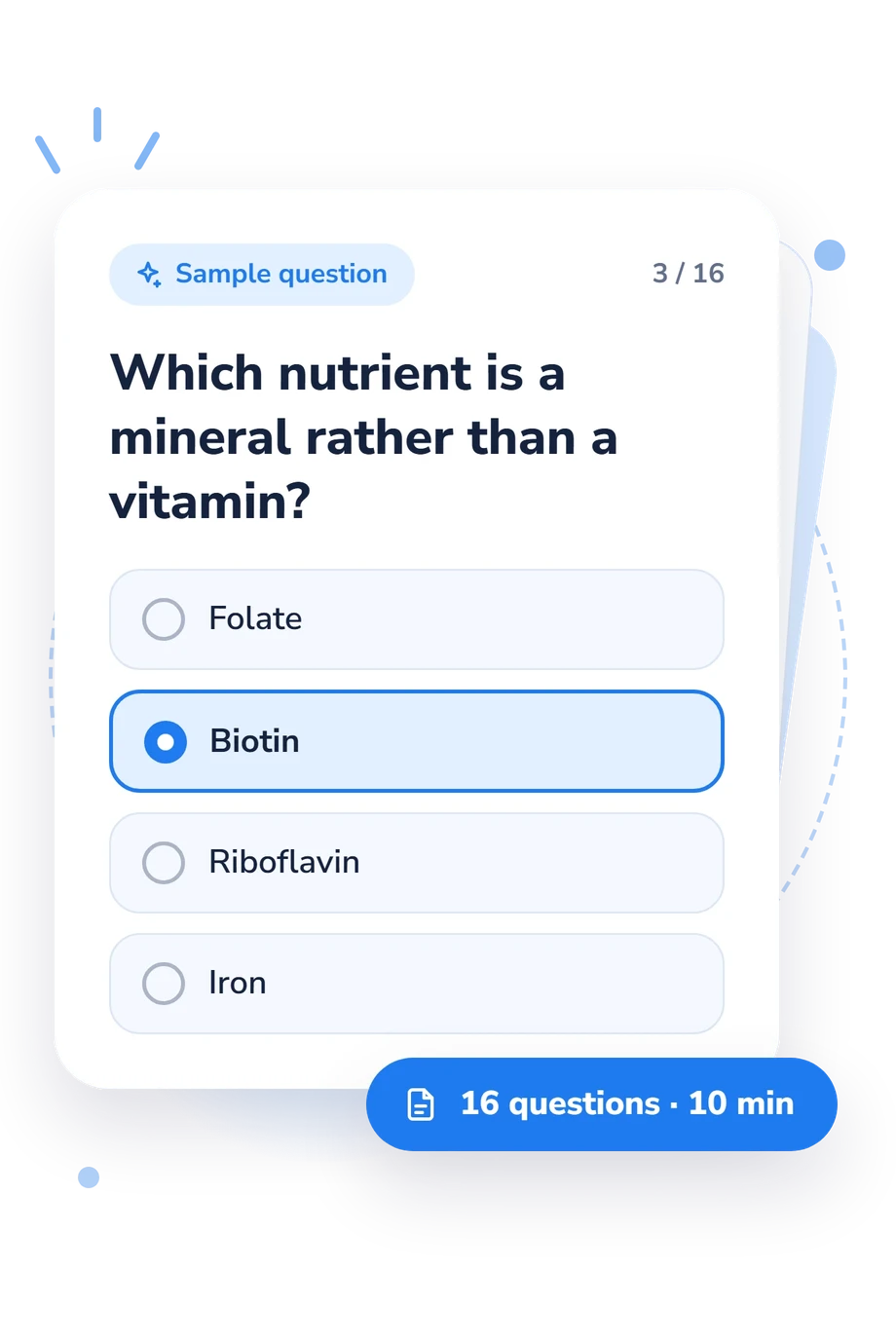
Example Questions From the Test
- Vitamin D
- Vitamin K
- Vitamin C
- Vitamin B12
- Folate
- Biotin
- Riboflavin
- Iron
- A glass of plain water
- A spoonful of table sugar
- An olive-oil dressing
- A serving of fat-free broth
Care/of Vitamin Quiz - Description and methodology of the test
Readers seeking a broad educational snapshot may find the Care/of Vitamin Quiz useful when they want to take care of quiz questions thoughtfully rather than rely on assumptions. This online vitamin quiz is intended for general self-reflection, and its overall score and band can guide broad review without claiming separate strengths or weaknesses. It suits readers who want an educational view of their current understanding.
What This Assessment Explores
The questions test vitamin literacy through functions, deficiency associations, food sources, absorption, cooking losses, fat-soluble storage, laboratory precautions, and supplement decisions. Examples involve vegan eating, pregnancy planning, impaired fat absorption, or warfarin use.
The main knowledge areas reflected in the items are:
- Vitamin functions and deficiency signs link nutrients with roles such as collagen formation and vision.
- Food sources and dietary patterns show whether useful sources are recognized.
- Absorption and storage connect fat, digestion, cooking, and fat-soluble vitamins.
- Supplement safety and interactions test awareness of laboratory issues and medication-related consistency.
The displayed scale is Vitamin Knowledge: 0-16. As a vitamin knowledge quiz, it places results in three bands: Foundations to build (0-6) signals review of basics, sources, absorption, and precautions; Developing knowledge (7-12) shows understanding with room to strengthen application; Strong knowledge (13-16) reflects solid knowledge and informed use.
Methodology and Scientific Basis
Each item presents one best answer among four options, checking recognition and practical application. The result summarizes performance across the answers, but the questionnaire does not state how individual responses are converted into points; the bands describe performance on these questions.
The methodology is conceptually consistent with Vitamin Literacy Questionnaire (Alhur et al., 2024), a close comparison for knowledge about vitamin information and use. Research by Pareek et al. (2024), Parmenter and Wardle (1999), and Dickson-Spillmann et al. (2011) likewise supports attention to factual recall, everyday choices, and applied understanding. These sources provide context, but this online questionnaire is not presented as a validated adaptation of any one of them.
The safety-focused questions make this a useful vitamin safety quiz for checking practical precautions. Scores may vary with prior education, recent reading, guessing, wording preferences, self-awareness, and current concerns. The questionnaire has no stated normative sample or clinical standardization. Its score cannot identify a deficiency or determine a safe supplement dose when symptoms, pregnancy, medicines, or major dietary changes are involved.
- Anas Alhur, Afrah A. Alhur, Suha Alqahtani, et al. (2024). Measuring Vitamin Literacy and Information-Seeking Behavior. Cureus, 16(5), e60704. 10.7759/cureus.60704
- Priyanka Pareek, Aparna Thorat, Chethana Chandrasekar, Poonam Khanna, and Rashmi Kulkarni. (2024). Development and Validation of a Micronutrients Knowledge, Attitudes, and Practices Questionnaire for Adolescents Using Psychometric Analysis. Cureus, 16(7), e65628. 10.7759/cureus.65628
- Katherine Parmenter and Jane Wardle. (1999). Development of a general nutrition knowledge questionnaire for adults. European Journal of Clinical Nutrition, 53(4), 298-308. 10.1038/sj.ejcn.1600726
- Maria Dickson-Spillmann, Michael Siegrist, and Carmen Keller. (2011). Development and validation of a short, consumer-oriented nutrition knowledge questionnaire. Appetite, 56(3), 617-620. 10.1016/j.appet.2011.01.034
Updated: