
What Sing 2 Character Am I Quiz
How the Scales are Structured
Who Usually Takes This Test?
See How You Compare
Below is a preview of how scores are typically distributed across each scale.
Example Questions From the Test
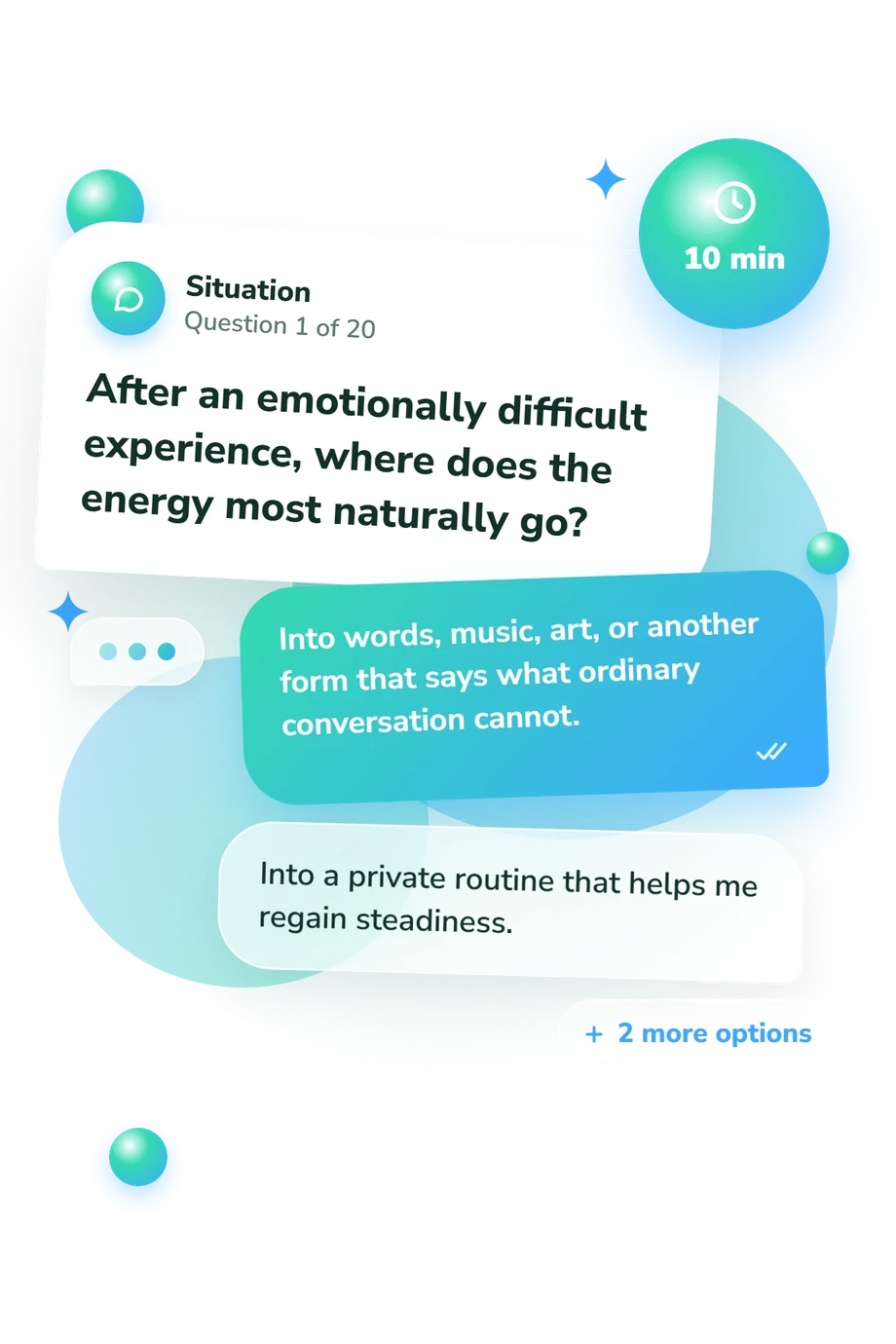
- Into words, music, art, or another form that says what ordinary conversation cannot.
- Into a private routine that helps me regain steadiness.
- Into talking through the experience with people I trust.
- Into a new activity that redirects my attention elsewhere.
- I listen for the common ground behind everyone’s different ideas.
- I let the person with the deepest technical expertise set the direction.
- I translate the possibilities into a practical sequence of steps.
- I paint a vivid picture of what the project could become and invite people into it.
- Return to the parts that already showcase what I do naturally well.
- Find a demanding practice routine and keep working until the weak points improve.
- Experiment independently and keep whichever techniques feel intuitive.
- Seek targeted coaching while adjusting the routine to suit how I learn.
What Sing 2 Character Am I Quiz - Description and methodology of the test
For viewers who enjoy character-based self-reflection, this assessment turns familiar animated personalities into a framework for thinking about creative choices, ambition, teamwork, persistence, and self-expression. The What Sing 2 Character Am I Quiz offers a structured comparison for anyone curious about how their responses align with the characters in the film. A quiz about which Sing 2 character you are can be playful without reducing personality to a single fixed label.
What This Assessment Explores
Creative, social, and performance situations explore authenticity, ambition, teamwork, persistence, spontaneity, and courage. Results compare five character affinities and show whether your Sing 2 character match is concentrated or blended.
These bands are:
- Ash Affinity (0-12) shows Collaborative Counterpoint (0-4), Independent Spark (5-8), or Ash Energy (9-12), from adaptation to original self-expression.
- Buster Moon Affinity (0-12) shows Grounded Counterpoint (0-4), Emerging Showrunner (5-8), or Moon-Level Dreamer (9-12), from structure to expansive vision.
- Johnny Affinity (0-12) shows Self-Directed Route (0-4), Committed Learner (5-8), or Johnny Drive (9-12), from independence to disciplined growth.
- Porsha Crystal Affinity (0-12) shows Understated Style (0-4), Playful Spotlight (5-8), or Porsha Presence (9-12), from restraint to theatrical confidence.
- Rosita Affinity (0-12) shows Different Rhythm (0-4), Courage in Motion (5-8), or Rosita Resonance (9-12), from flexibility to brave responsibility.
Methodology and Evidence Base
Each item presents a creative, social, or performance situation with four response options. Selecting the most natural reaction makes the questionnaire a forced-choice self-report exercise: the alternatives contrast authenticity, guidance, ambition, responsibility, improvisation, persistence, and teamwork rather than testing musical knowledge.
The result displays five affinity scores; the highest is strongest, while scores within one point indicate a blended result. The bands are descriptive labels, and this Sing 2 character quiz is a character-affinity self-reflection questionnaire rather than a standardized psychological instrument; the result does not rate talent or maturity.
Its interpretive logic is conceptually consistent with Assumed similarity (Webster & Campbell, 2023), and with work on audience-character similarity by Huang, Fung, and Sun (2024) and character identification by Cohen (2001). Those sources do not validate this exact questionnaire or establish norms, reliability, or clinical use. Self-report, current mood, self-awareness, and the wish to resemble a favorite character can all influence the outcome.
- Webster, Gregory D., and Jessica T. Campbell. "Personality perception in Game of Thrones: Character consensus and assumed similarity." Psychology of Popular Media, 12(2), 207-218 (2023). 10.1037/ppm0000398
- Huang, Kate Y., Helene H. Fung, and Peifeng Sun. "The effect of audience-character similarity on identification with narrative characters: A meta-analysis." Current Psychology, 43(8), 7026-7043 (2024). 10.1007/s12144-023-04842-4
- Cohen, Jonathan. "Defining identification: A theoretical look at the identification of audiences with media characters." Mass Communication and Society, 4(3), 245-264 (2001). 10.1207/S15327825MCS0403_01
Updated: