
Supreme Court Case Quiz
How the Scales are Structured
Who Usually Takes This Test?
See How You Compare
Below is a preview of how scores are typically distributed across each scale.
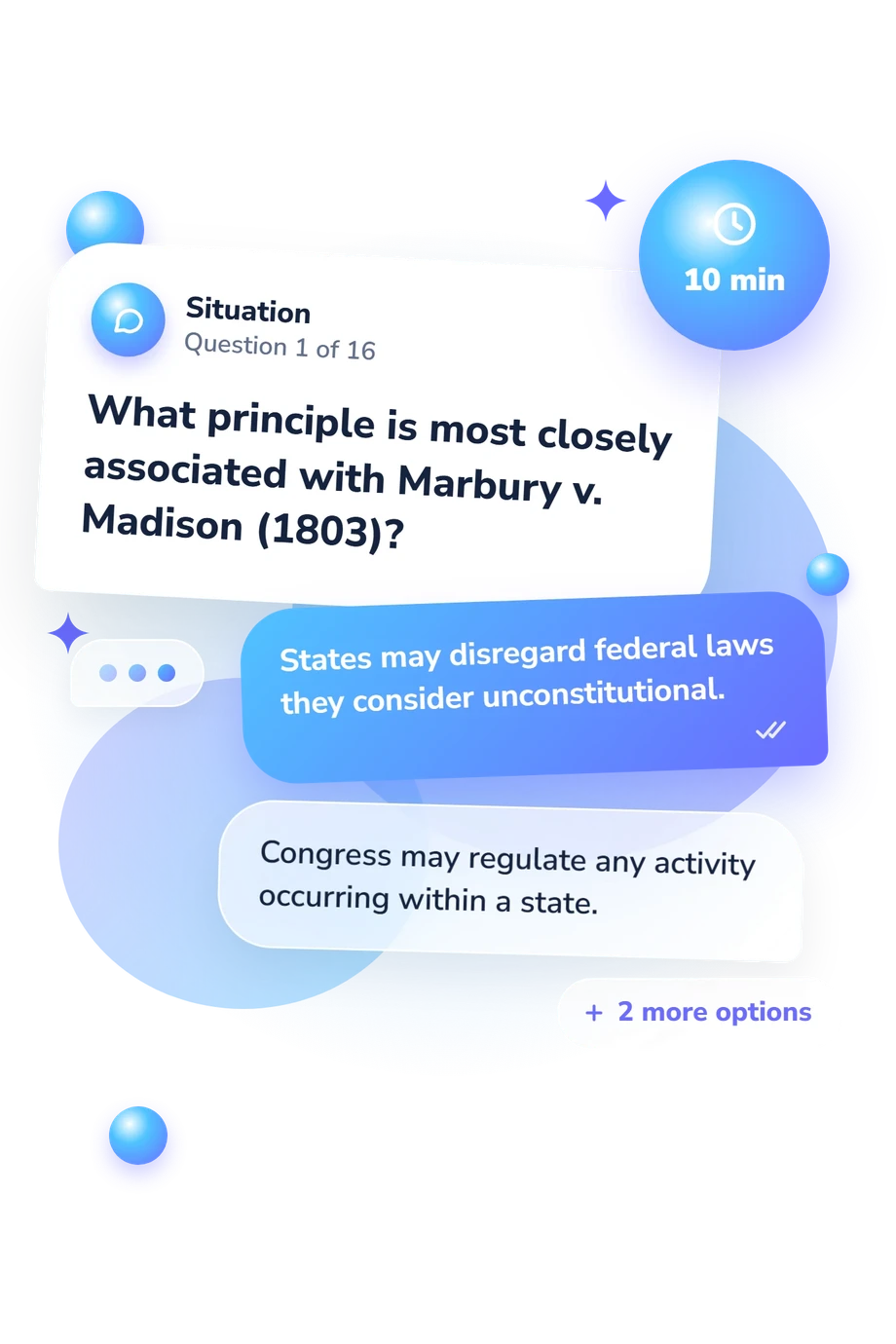
Example Questions From the Test
- Black people of African descent could not be U.S. citizens under the Court's interpretation, and Congress could not ban slavery in the territories.
- Congress could prohibit slavery in every federal territory under the Commerce Clause.
- States were required to grant citizenship to every person born within their borders.
- Enslaved people became free whenever they entered a free territory.
- States may disregard federal laws they consider unconstitutional.
- Congress may regulate any activity occurring within a state.
- Federal courts may review laws and invalidate those that conflict with the Constitution.
- The president may remove federal judges for political disagreement.
- Brown v. Board of Education
- Engel v. Vitale
- New York Times Co. v. Sullivan
- Loving v. Virginia
Supreme Court Case Quiz - Description and methodology of the test
Designed for students, civics learners, and anyone revisiting American constitutional history, the supreme court case quiz asks you to connect landmark rulings with the principles they established. It is especially useful for readers who want a focused Supreme Court quiz that tests recognition and application rather than memorizing isolated names. The result indicates how well you recognize and distinguish major cases, holdings, constitutional doctrines, and historical significance.
What This Assessment Explores
The questions cover landmark Supreme Court cases involving judicial review, federal power, civil rights, criminal procedure, free expression, and state-national authority. They suit readers who want to connect case names with constitutional holdings, historical context, and lasting significance, not merely recognize familiar titles.
Your result uses one knowledge dimension and three descriptive bands:
- Supreme Court Case Knowledge (0-16) measures recognition of major decisions, their holdings, and their historical significance.
- Foundational (0-6) reflects recognition of some major themes while case-and-holding connections still need review.
- Developing (7-12) reflects understanding of many landmark decisions, with related doctrines needing sharper distinction.
- Strong (13-16) reflects a well-developed command of major cases, holdings, and historical significance.
Methodology and Scientific Basis
Each item presents a legal-historical prompt with four answer choices. The options ask you to identify a holding, doctrine, or constitutional application in cases such as Marbury, Mapp, Miranda, Brown, Loving, and Youngstown. This format tests recognition and transfer: you connect a case with the rule it established rather than write an essay.
The tested cases and holdings are documented in authoritative legal references, including Hall and Ely (2009), United States Reports, Constitution Annotated, and Stephenson’s discussion of Supreme Court materials. These sources document the legal content but do not establish standardization or validity for this online quiz. As a Supreme Court case test, it offers a compact review of core holdings across eras.
The result is grouped into the displayed descriptive categories, which summarize recognition of landmark cases, holdings, doctrines, and historical significance. No population norms, reliability estimates, or independent validation statistics are specified for this online quiz. Performance can reflect prior coursework, memory, and legal vocabulary, so the result is best used to choose topics for review rather than as a complete measure of constitutional understanding.
- Hall, Kermit L., and James W. Ely Jr., eds. The Oxford Guide to United States Supreme Court Decisions. 2nd ed. Oxford University Press, 2009.
- Stephenson, D. Grier Jr. "The Judicial Bookshelf." Journal of Supreme Court History, vol. 29, no. 3, 2004, pp. 346-366. 10.1111/j.1059-4329.2004.00090.x
- Supreme Court of the United States. United States Reports: Cases Adjudged in the Supreme Court of the United States. Government Printing Office, 1803-1974.
- United States. Congress. Congressional Research Service. The Constitution of the United States of America: Analysis and Interpretation (Constitution Annotated), 2022 Edition. S. Doc. 117-12. U.S. Government Publishing Office, 2023.
Updated: