
What Does God Want from Me Quiz
How the Scales are Structured
Who Usually Takes This Test?
See How You Compare
Below is a preview of how scores are typically distributed across each scale.
Example Questions From the Test
- It appears occasionally when something notable happens.
- I intentionally name several things with appreciation.
- It is present, but other concerns usually take priority.
- It has not been a significant focus for me recently.
- A reminder that slow progress still counts.
- A short break before I resume with my existing plan.
- Sustained courage to keep going when I want to withdraw.
- Usually only a practical adjustment to my approach.
- “Thank you for the steadiness I already feel.”
- “Help me pause briefly before returning to my responsibilities.”
- “Quiet the thoughts that keep pulling me away from rest.”
- “Hold what feels too heavy for me to carry alone.”
What Does God Want from Me Quiz - Description and methodology of the test
People facing a decision, emotional strain, or a desire to reconnect with faith may use this prayer guidance quiz to identify the kind of prayer that feels most relevant. The What Does God Want from Me Quiz offers a structured reflection on gratitude, guidance, peace, and strength, helping a respondent name a present need and choose a meaningful direction for personal reflection.
What This Assessment Explores
Four prayer needs shape the result. The questionnaire helps the respondent consider how strongly each prayer theme feels relevant today.
The results organise those prayer focuses as follows:
- Prayer for Grateful Connection (0-12) reflects a wish to notice goodness and respond with gratitude: Quiet Appreciation (0-4), Reopening Attention (5-8), or Connection Is Central (9-12).
- Prayer for Guidance (0-12) shows a current wish for clarity, wisdom, or direction: Clearer Ground (0-4), Seeking Perspective (5-8), or Guidance Is Central (9-12).
- Prayer for Peace (0-12) shows a need for stillness, release, or steadiness: Peace Already Present (0-4), Room to Exhale (5-8), or Peace Is Central (9-12).
- Prayer for Strength (0-12) shows a need for courage, endurance, or resolve: Strength in Reserve (0-4), Resolve Needed (5-8), or Strength Is Central (9-12).
Methodology and Evidence Base
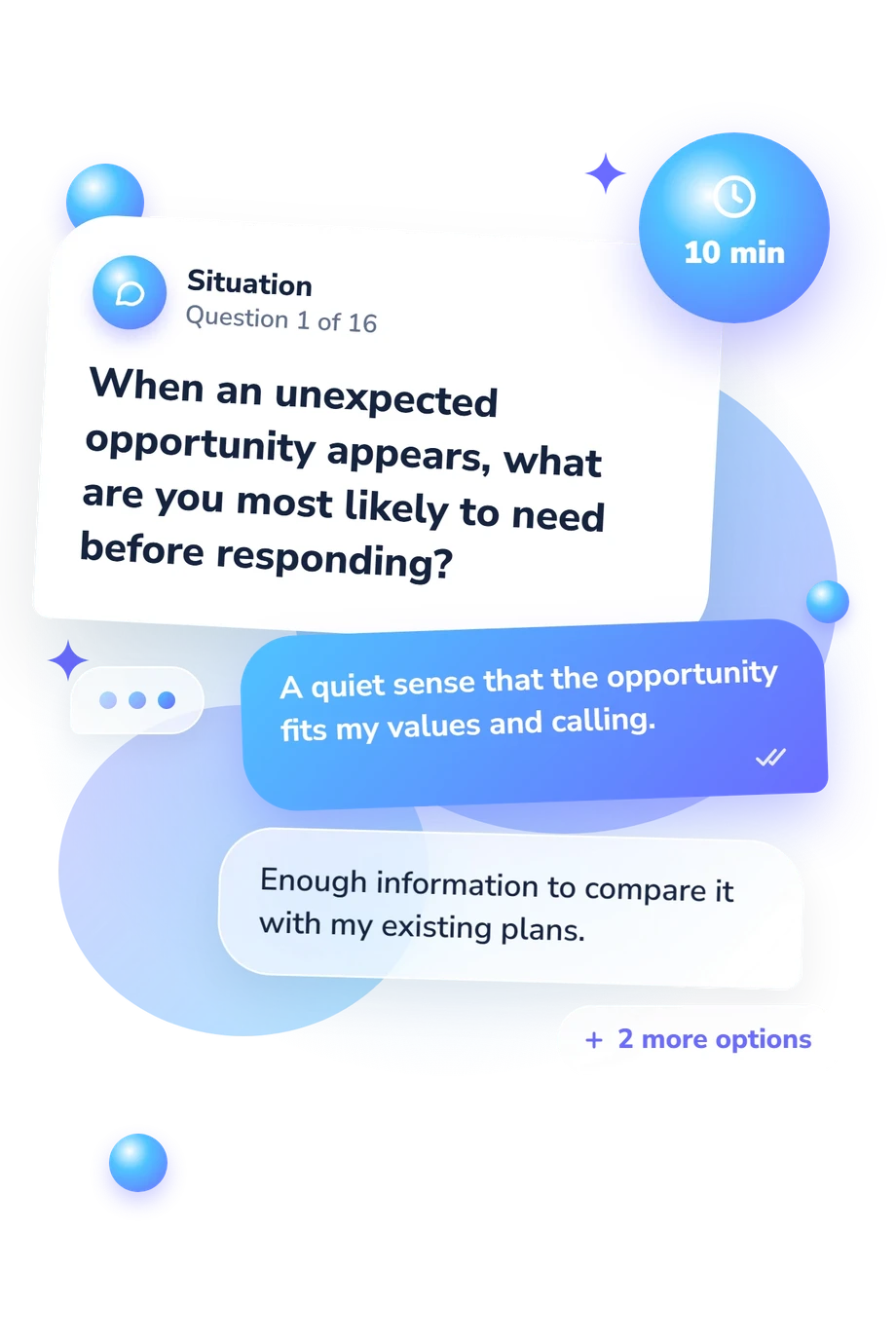
Each item presents a brief situation, feeling, decision, or prayer opening with four response options. Choices range from settled confidence and practical reflection to uncertainty, relief, gratitude, and perseverance, so the respondent selects what best fits the present moment rather than demonstrating religious knowledge.
Across the scenarios, it uses decisions, difficult conversations, ordinary gratitude, emotional tension, and demanding tasks to prompt spiritual reflection.
Responses form four thematic scores. The highest indicates the strongest current affinity, while scores within one point are read as a blended result. The bands guide reflection; they do not establish spiritual closeness, reveal God's will, or measure worth or faith.
Conceptually, this reflective questionnaire is consistent with Bade and Cook (2008), whose work distinguishes functions prayer may serve during coping. It also aligns with Laird et al. (2004) on multidimensional private prayer and Froese and Uecker (2022) on variation in prayer practices. These sources offer conceptual context; this questionnaire is not presented as an adaptation of those instruments.
Self-reported scores can be influenced by current stress, attention, honesty, and self-awareness, while the bands remain reflective rather than clinical. Read the result as a timely reflection prompt, not a fixed trait or clinical conclusion.
- Bade, Mary K., and Stephen W. Cook. 2008. "Functions of Christian Prayer in the Coping Process." Journal for the Scientific Study of Religion 47(1): 123-133. 10.1111/j.1468-5906.2008.00396.x
- Laird, Steven P., C. R. Snyder, Michael A. Rapoff, and Sam Green. 2004. "Measuring Private Prayer: Development, Validation, and Clinical Application of the Multidimensional Prayer Inventory." The International Journal for the Psychology of Religion 14(4): 251-272. 10.1207/s15327582ijpr1404_2
- Froese, Paul, and Jeremy E. Uecker. 2022. "Prayer in America: A Detailed Analysis of the Various Dimensions of Prayer." Journal for the Scientific Study of Religion 61(3-4): 663-689. 10.1111/jssr.12810
Updated: