
Who Is Your Naruto Girlfriend Quiz
How the Scales are Structured
Who Usually Takes This Test?
See How You Compare
Below is a preview of how scores are typically distributed across each scale.
Example Questions From the Test
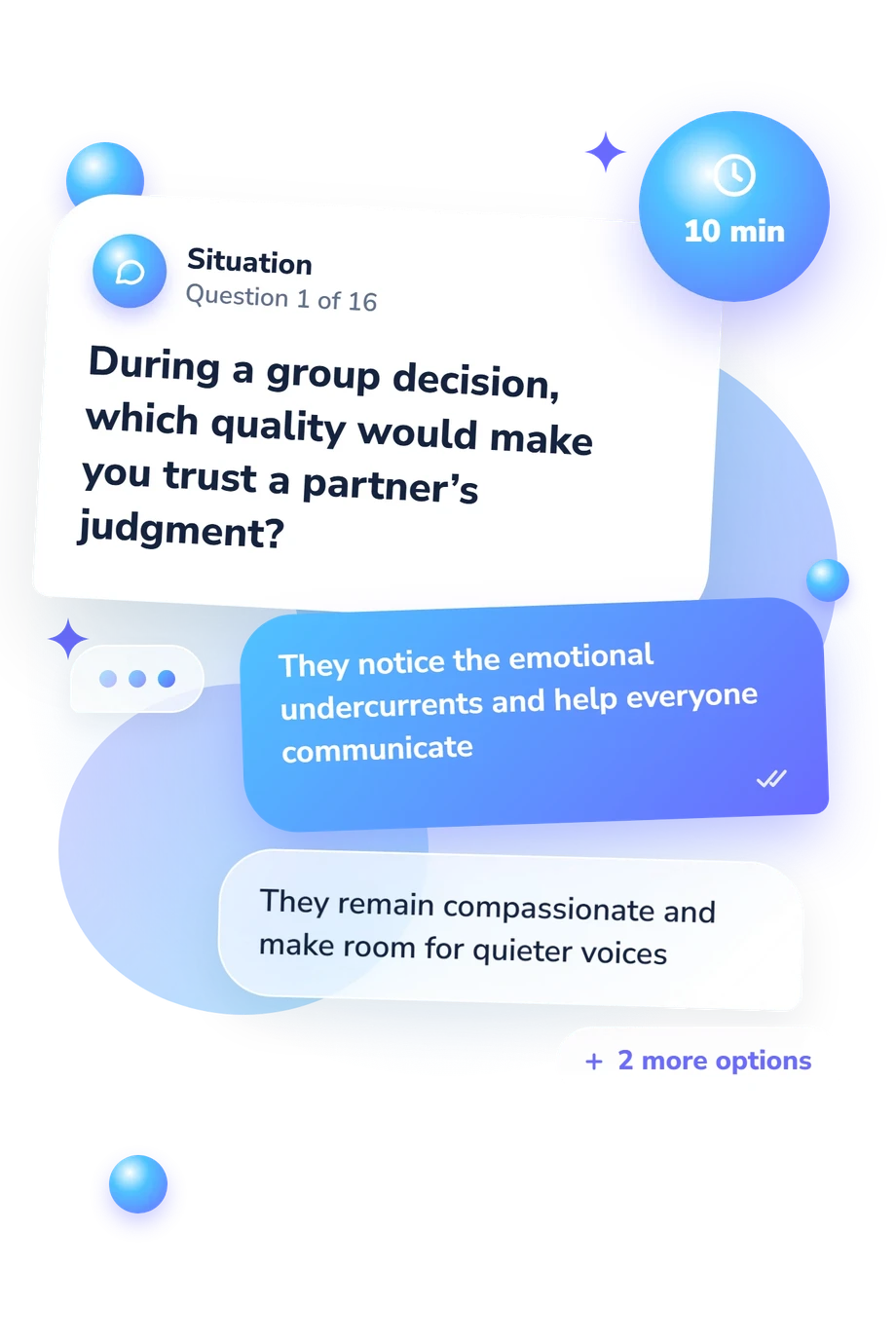
- They notice the emotional undercurrents and help everyone communicate
- They remain compassionate and make room for quieter voices
- They identify the key tradeoffs and state their conclusion without fuss
- They bring expertise, persistence, and a willingness to take responsibility
- Encourage a sincere conversation and help me understand each person’s perspective
- Remind me that loyal connections can survive periods of silence
- Help me decide whether the relationships still deserve my time and energy
- Work with me on a clear message that addresses the facts and proposes a resolution
- Space is healthy; we can reconnect when both of us have more energy
- I would respect it while sending a gentle message of support
- I would use the evening for my own goals, then suggest a concrete plan for later
- I would check whether talking briefly might help before giving them room
Who Is Your Naruto Girlfriend Quiz - Description and methodology of the test
Fans who enjoy Naruto and fictional relationship dynamics can use this playful profile to reflect on the qualities they value in a partner. The Who Is Your Naruto Girlfriend Quiz compares preferences for support, candor, independence, emotional connection, and shared effort rather than predicting a real-life match. A result from your Naruto girlfriend quiz gives those preferences a character-based frame for conversation and self-reflection.
What This Test Measures
Questions cover conflict, space, social connection, courage, and shared goals. The result compares preferred relationship dynamics rather than assigning a fixed personality label; this Naruto girlfriend test reflects relationship ideals.
The four profiles and their displayed bands are:
- Hinata Hyuga Affinity (0-12) reflects gentle encouragement, patient loyalty, quiet closeness, and steadfast courage: Different Dynamic (0-4), Shared Warmth (5-8), Strong Hinata Affinity (9-12).
- Ino Yamanaka Affinity (0-12) reflects social confidence, emotional perception, expressive affection, and vivid connection: Different Dynamic (0-4), Shared Spark (5-8), Strong Ino Affinity (9-12).
- Sakura Haruno Affinity (0-12) reflects determination, candor, competence, and mutual effort: Different Dynamic (0-4), Shared Drive (5-8), Strong Sakura Affinity (9-12).
- Temari Affinity (0-12) reflects independence, strategy, wit, and directness: Different Dynamic (0-4), Shared Edge (5-8), Strong Temari Affinity (9-12).
The highest profile is strongest; profiles within one point indicate a blended result.
Methodology and Evidence Base
This themed self-report questionnaire presents each item as a relationship situation with four possible responses. The choices group around closeness, disagreement, reassurance, independence, social connection, courage, and shared goals; respondents choose the response that best matches their preference, not a correct answer.
Results compare selections across four profiles. Higher displayed affinity means closer alignment with a character’s relationship style, but no per-answer point value is specified; the ranges are not a scoring formula.
The Ideal Standards Model and Ideal Standards Questionnaire (Fletcher et al., 1999) provide a conceptual reference for this focus on intimate-relationship ideals. This questionnaire is conceptually consistent with that framework but is not an adaptation or validated reproduction of the instrument.
Eastwick et al. (2011) supports caution: stated ideals may not predict actual responses during relationship initiation or maintenance. This Naruto relationship quiz therefore describes imagined preferences rather than observed behavior.
Scores may change with mood, current experiences, character familiarity, or momentary appeal. No stated norms, reliability estimates, or clinical cutoffs are provided, so the bands indicate relative affinity within the profile, not a standardized psychological measure.
- Fletcher, Garth J. O., Thomas, Geoff, Giles, Louise, and Simpson, Jeffry A. (1999). Ideals in intimate relationships. Journal of Personality and Social Psychology, 76(1), 72-89. 10.1037/0022-3514.76.1.72
- Eastwick, Paul W., Finkel, Eli J., and Eagly, Alice H. (2011). When and why do ideal partner preferences affect the process of initiating and maintaining romantic relationships? Journal of Personality and Social Psychology, 101(5), 1012-1032. 10.1037/a0024062
Updated: