
What Does My Future Hold Quiz
How the Scales are Structured
Who Usually Takes This Test?
See How You Compare
Below is a preview of how scores are typically distributed across each scale.
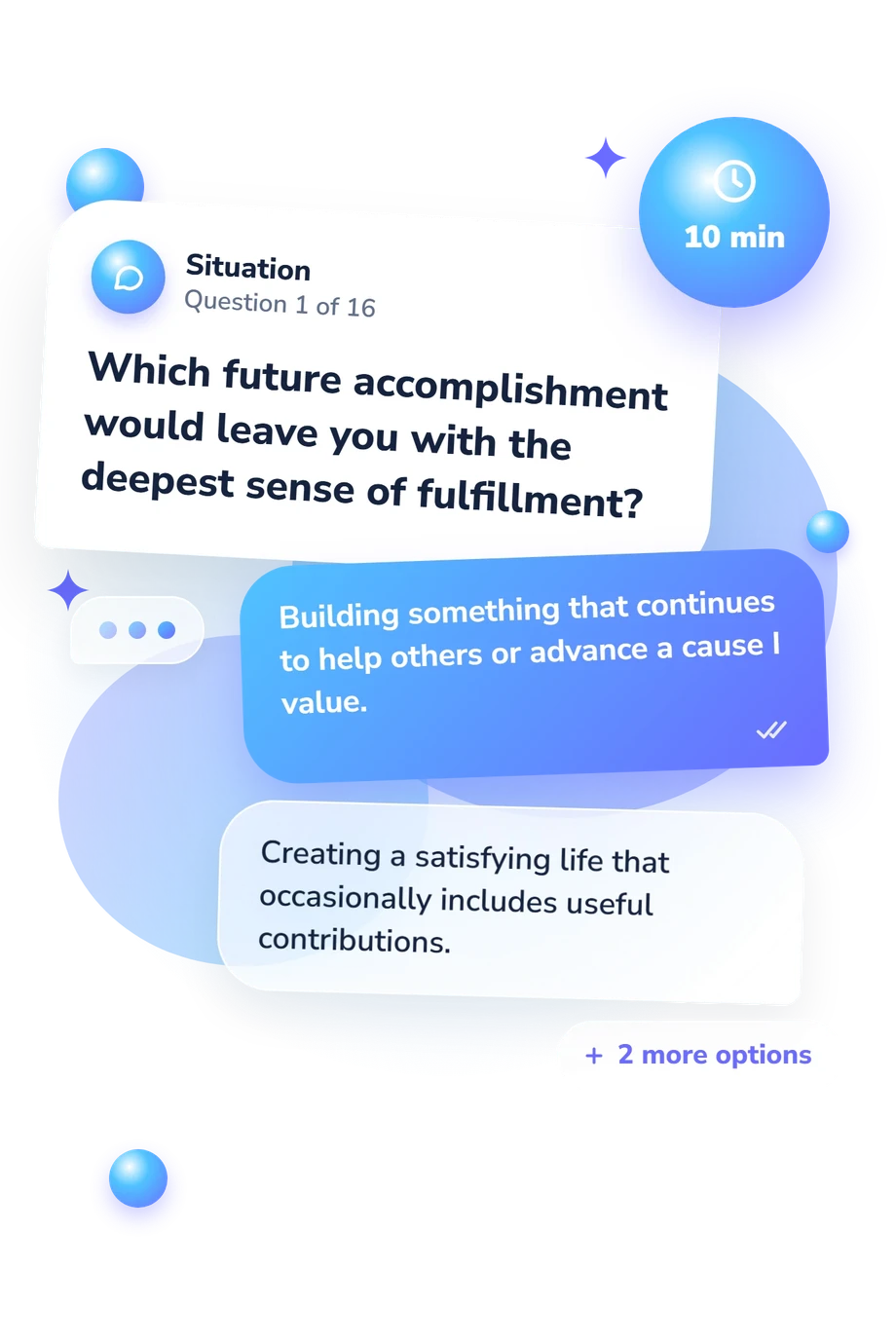
Example Questions From the Test
- Building something that continues to help others or advance a cause I value.
- Creating a satisfying life that occasionally includes useful contributions.
- Combining personal fulfillment with a consistent and meaningful benefit to others.
- Having rich experiences and the freedom to define success entirely for myself.
- Choose the comfortable option because daily fit matters more to me than mission.
- Consider the meaningful role if the sacrifices remain limited and manageable.
- Accept substantial inconvenience if I believe the contribution is genuinely worthwhile.
- Look for a comfortable role that includes a small element of positive impact.
- Keep the new situation open and see where it leads before creating another structure.
- Establish a workable replacement plan while leaving room for revision.
- Restore one or two familiar routines before deciding anything larger.
- Build a clear new framework quickly so responsibilities and next steps feel settled.
What Does My Future Hold Quiz - Description and methodology of the test
For readers who are considering the kind of life they want to build, the What Does My Future Hold Quiz offers a structured way to compare future-oriented preferences. It suits anyone reflecting on priorities rather than seeking a fixed prediction. By translating everyday choices about relationships, change, contribution, and security into a profile, this quiz about future priorities can clarify what currently feels most important.
What This Assessment Explores
The questions examine how you imagine fulfilment, change, contribution, relationships, and security through choices about work, money, home, free time, and disrupted plans. To explore what my future holds for me, this quiz turns your preferences into a current profile rather than a fixed prediction. The four result dimensions are:
- Connection & Community (0-12) shows the pull of close bonds: Independently Anchored (0-4), Connected Balance (5-8), or Community-Centered (9-12).
- Growth & Exploration (0-12) shows affinity for novelty and learning: Rooted Direction (0-4), Selective Explorer (5-8), or Expansive Explorer (9-12).
- Purpose & Contribution (0-12) reflects how strongly impact and service shape the future: Personal Priorities First (0-4), Selective Contributor (5-8), or Purpose-Led Contributor (9-12).
- Stability & Foundation (0-12) indicates preference for predictability and durable structure: Flexibility First (0-4), Balanced Foundation (5-8), or Foundation Builder (9-12).
Methodology and Evidence Base
Each of the four scales reports a score from 0 to 12. The highest score indicates the strongest affinity, while scores within one point form a blended result.
The framework is conceptually consistent with the Aspiration Index, especially its distinction between intrinsic aims and externally defined rewards. Self-Determination Theory adds a useful lens for autonomy, relatedness, and meaningful engagement. The Consideration of Future Consequences framework is relevant to choices weighing immediate convenience against distant consequences. These sources provide conceptual context for interpreting the themes, while the questionnaire organizes its own result around four future preferences.
The result is a snapshot of priorities shaped by current circumstances. It offers a view of the future direction those priorities suggest. The displayed bands describe the preference pattern at the time of answering, while mood, self-awareness, or recent experiences can influence it. Use the result to consider how relationships, exploration, contribution, and stability fit your possible directions rather than treating the pattern as a fixed trait.
- Kasser, T., & Ryan, R. M. (1996). Further Examining the American Dream: Differential Correlates of Intrinsic and Extrinsic Goals. Personality and Social Psychology Bulletin, 22(3), 280-287. 10.1177/0146167296223006
- Strathman, A., Gleicher, F., Boninger, D. S., & Edwards, C. S. (1994). The Consideration of Future Consequences: Weighing Immediate and Distant Outcomes of Behavior. Journal of Personality and Social Psychology, 66(4), 742-752. 10.1037/0022-3514.66.4.742
- Ryan, R. M., & Deci, E. L. (2000). Self-Determination Theory and the Facilitation of Intrinsic Motivation, Social Development, and Well-Being. American Psychologist, 55(1), 68-78. 10.1037/0003-066X.55.1.68
Updated: