
Smash or Pass Cartoon Characters Quiz
How the Scales are Structured
Who Usually Takes This Test?
See How You Compare
Below is a preview of how scores are typically distributed across each scale.
Example Questions From the Test
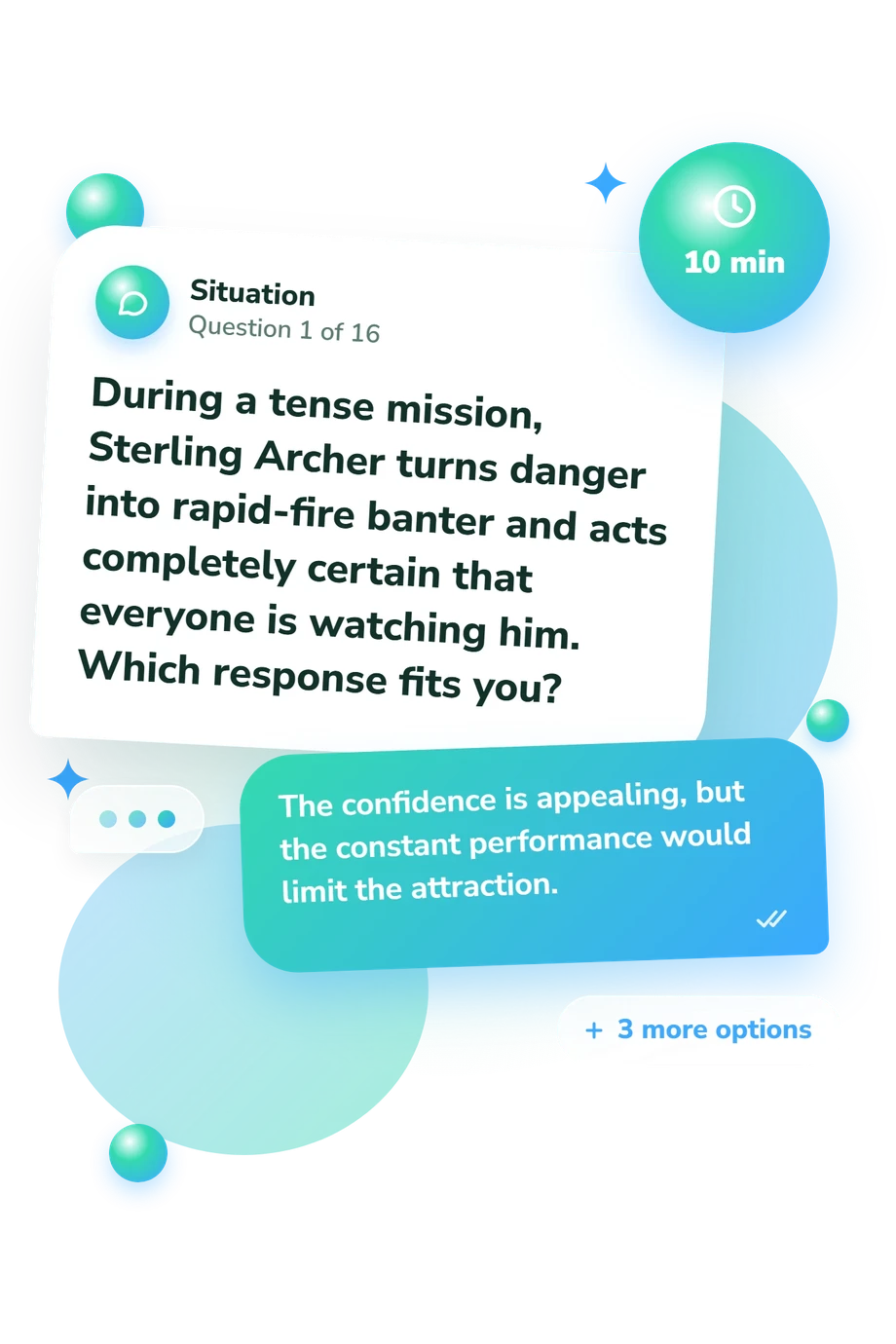
- The confidence is appealing, but the constant performance would limit the attraction.
- The wit and swagger would make him extremely hard for me to pass.
- I can enjoy the jokes without wanting to enter that fantasy.
- I would feel a definite pull toward the sharp banter and larger-than-life presence.
- The confidence is attractive, though the elusiveness keeps me from fully committing.
- I appreciate her style, but the mysterious cat-and-mouse dynamic is not for me.
- The teasing independence creates some intrigue, provided there is room for sincerity.
- The wit, danger, and total self-possession make this an easy smash.
- The big-hearted energy is lovable, though not especially my type.
- I would be charmed once the exuberance settled into a more personal connection.
- Her warmth, confidence, and wholehearted fun would strongly appeal to me.
- Someone that affectionate and joyfully committed is an immediate fictional smash.
Smash or Pass Cartoon Characters Quiz - Description and methodology of the test
For readers who enjoy fictional attraction as self-reflection, the Smash or Pass Cartoon Characters Quiz maps the qualities that make a cartoon fantasy feel compelling. It suits anyone curious about recurring preferences, imagined chemistry, or the difference between admiring a character and feeling drawn to them, including those exploring a female cartoon character quiz. The result organizes reactions into a profile of fictional attraction rather than judging real relationships.
What This Assessment Explores
The questionnaire presents cartoon scenarios that probe the appeal of mystery, mischief, social magnetism, and dependable warmth. It is a fictional character attraction test, not a measure of everyday partner choice. The four dimensions are:
- Dark Intensity (0-12) measures attraction to mystery, emotional restraint, and formidable power: Light-Seeking Taste (0-4), Mystery-Curious (5-8), Shadow Magnet (9-12).
- Playful Chaos (0-12) measures attraction to unpredictability, irreverent humor, and rule-bending energy: Calm-Side Preference (0-4), Mischief-Friendly (5-8), Wildcard Magnet (9-12).
- Polished Charm (0-12) measures attraction to confidence, glamour, social finesse, and effortless presence: Selective Observer (0-4), Charm-Curious (5-8), Charisma Magnet (9-12).
- Warm Steadiness (0-12) measures attraction to kindness, loyalty, grounded humor, and reassuring strength: Spark Elsewhere (0-4), Comfort with Chemistry (5-8), Safe-Harbor Magnet (9-12).
Methodology and Scientific Basis
Each item presents a fictional scene with four response options. The choices express graded attraction, from detached appreciation to a strong imagined pull, with middle options for conditional interest. As a cartoon crush personality quiz, the format measures preference intensity rather than sorting people into fixed personality types.
The result compares four profile scores, not one overall total. The highest score is the strongest affinity; scores within one point of it create a blended result. No point-by-point key or normative sample is provided, so the output is a structured reflection rather than a standardized psychological score.
The themes are conceptually consistent with Dragostinov and Booth (2025), whose study examines attraction to dark or socially difficult fictional personalities, but this questionnaire is not an adaptation of their instrument. Rain and Mar (2021) clarify why attachment to fictional characters matters, while Karhulahti and Välisalo (2021) document varied fictoromantic and fictophilic experiences. Together, these sources frame the subject without validating this online questionnaire.
Results can still shift with mood, relationship context, familiarity, and self-presentation. Treat close scores as overlapping preferences and the profile as a current snapshot of imaginative attraction.
- Dragostinov, Yavor, and Tom Booth. 2025. "The (Un)Attractiveness of Dark Triad Personalities: Assessing Fictitious Characters for Short- and Long-Term Relationships." Journal of Personality 93, no. 5: 1097-1111. 10.1111/jopy.12994
- Rain, Marina, and Raymond A. Mar. 2021. "Adult Attachment and Engagement with Fictional Characters." Journal of Social and Personal Relationships 38, no. 9: 2792-2813. 10.1177/02654075211018513
- Karhulahti, Veli-Matti, and Tanja Välisalo. 2021. "Fictosexuality, Fictoromance, and Fictophilia: A Qualitative Study of Love and Desire for Fictional Characters." Frontiers in Psychology 11:575427. 10.3389/fpsyg.2020.575427
Updated: