
Smash or Pass Quiz for Boys
How the Scales are Structured
Who Usually Takes This Test?
See How You Compare
Below is a preview of how scores are typically distributed across each scale.
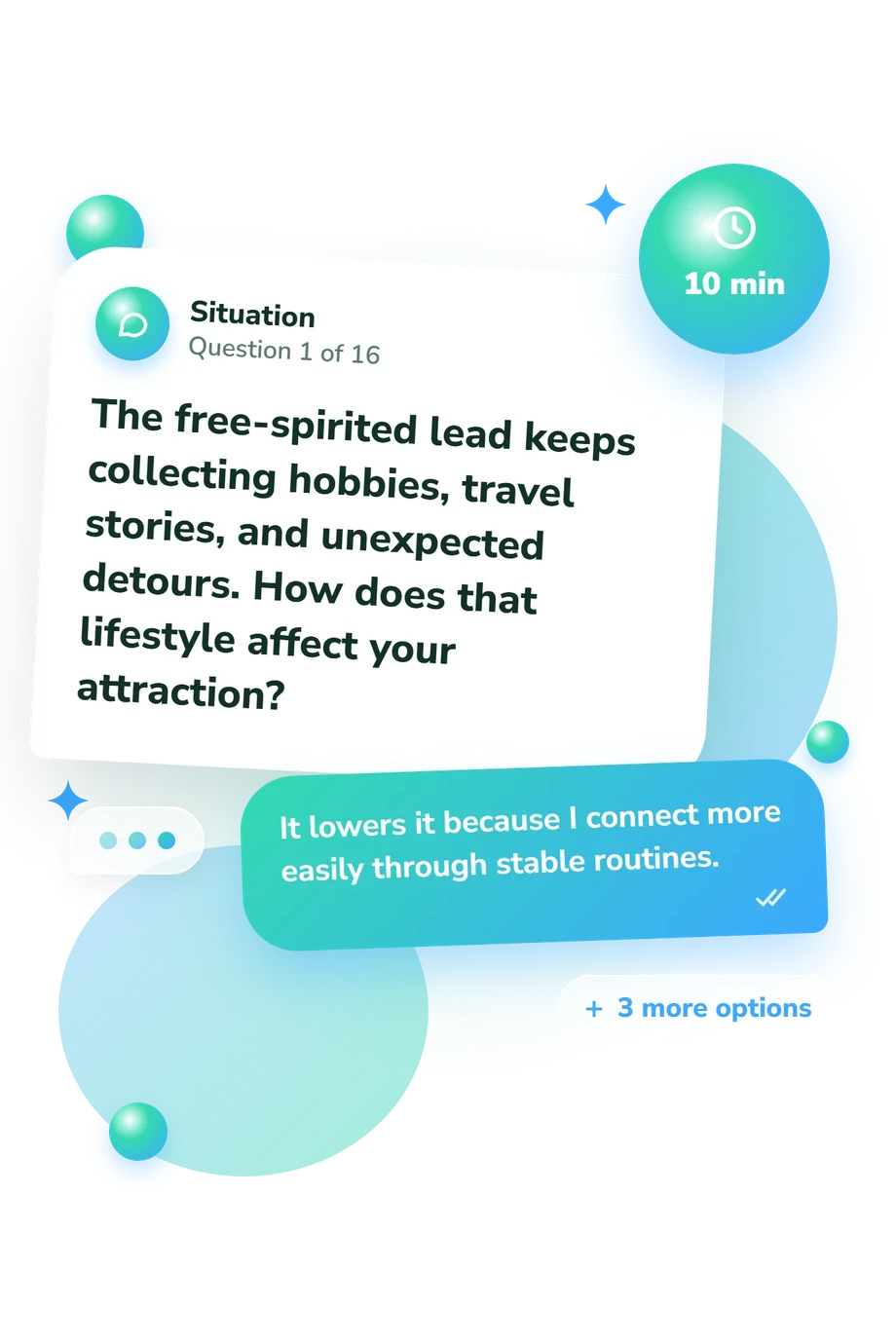
Example Questions From the Test
- It lowers it because I connect more easily through stable routines.
- The stories are entertaining, but I would not want to match his pace.
- It attracts me if he can occasionally slow down and be present.
- It strongly attracts me; his appetite for life is the main spark.
- It raises his appeal a lot; I enjoy keeping up with that energy.
- It can be fun, provided he also knows when to be sincere.
- I might enjoy a few lines before wanting a calmer conversation.
- I prefer warmth or directness to verbal sparring.
- Go—the spontaneity makes him and the day more appealing.
- Probably go after checking a few practical details.
- Suggest planning the trip for another weekend instead.
- Decline and choose a familiar local plan.
Smash or Pass Quiz for Boys - Description and methodology of the test
Readers who enjoy comparing fictional romantic archetypes can use the Smash or Pass Quiz for Boy to examine which adult male character qualities create chemistry for them. The questionnaire is a fictional character attraction quiz that keeps the focus on personal preference rather than correct answers. The result highlights whether freedom, wit, dependability, or intellect leads the profile and may show one clear preference or a closely blended pattern.
What This Assessment Explores
Across the scenarios, the questionnaire examines four character styles rather than relationship satisfaction. It asks how novelty, banter, loyalty, practical care, insight, and conversation shape attraction in romantic situations. As a male character preference test, it suits readers curious about fictional adult male archetypes.
The displayed dimensions are:
- Adventurous Free Spirit (0-12) measures affinity for novelty; Grounded Preference (0-4), Occasional Adventure (5-8), and Strong Smash (9-12) show its intensity.
- Charismatic Rogue (0-12) measures attraction to wit; Clear Pass (0-4), Selective Spark (5-8), and Strong Smash (9-12) show the result.
- Steadfast Protector (0-12) measures appeal of reliability; Different Dynamic (0-4), Reassuring Appeal (5-8), and Strong Smash (9-12) show its intensity.
- Thoughtful Intellectual (0-12) measures interest in ideas; Clear Pass (0-4), Curious Connection (5-8), and Strong Smash (9-12) indicate intensity.
Highest score means strongest affinity; scores within one point blend.
Methodology and Evidence Base
Each prompt presents an adult male character in a fictional situation with four response choices. The options span lower attraction, qualified interest, and stronger chemistry; respondents select the imagined reaction or preference that fits them best. This smash or pass quiz for guys uses scenario-based self-report to capture nuanced preferences rather than reduce every judgment to a binary.
Scores are assigned within each dimension, but the questionnaire does not state how many points an individual answer contributes. Interpret the result through the displayed labels, with the strongest dimension indicating clearest affinity.
The themes are conceptually consistent with Sprecher et al. (1994) on mate-selection preferences, Fletcher et al. (1999) on relationship ideals, and Li et al. (2002) on trade-offs between preferred qualities. The questionnaire is not adapted from them; those studies did not supply its four-part taxonomy, offering conceptual comparison, not norms for this online profile.
Self-reported scores can shift with mood, self-awareness, familiarity with fictional archetypes, or self-presentation. Treat it as a structured snapshot, not a fixed prediction: these studies provide no norms or validation for this online profile.
- Sprecher, Susan, Quintin E. Sullivan, and Elaine Hatfield. "Mate Selection Preferences: Gender Differences Examined in a National Sample." Journal of Personality and Social Psychology 66, no. 6 (1994): 1074-1080. 10.1037/0022-3514.66.6.1074
- Fletcher, Garth J. O., Geoff Thomas, Louise Giles, and Jeffry A. Simpson. "Ideals in Intimate Relationships." Journal of Personality and Social Psychology 76, no. 1 (1999): 72-89. 10.1037/0022-3514.76.1.72
- Li, Norman P., J. Michael Bailey, Douglas T. Kenrick, and Joan A. W. Linsenmeier. "The Necessities and Luxuries of Mate Preferences: Testing the Tradeoffs." Journal of Personality and Social Psychology 82, no. 6 (2002): 947-955. 10.1037/0022-3514.82.6.947
Updated: