
Recruitment Quiz
How the Scales are Structured
Who Usually Takes This Test?
See How You Compare
Below is a preview of how scores are typically distributed across each scale.
Example Questions From the Test
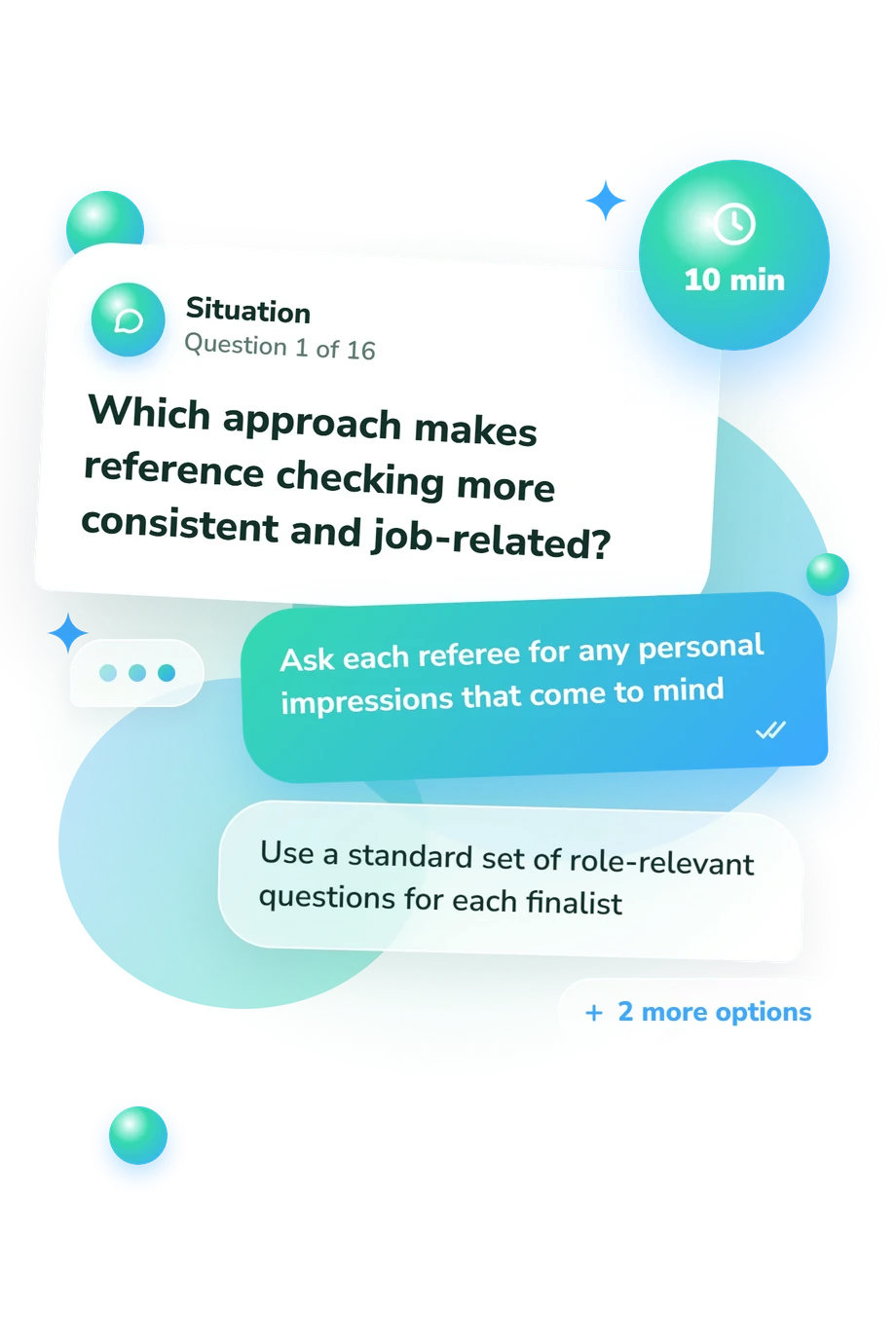
- Ask each referee for any personal impressions that come to mind
- Use a standard set of role-relevant questions for each finalist
- Use references mainly to discover protected personal information
- Treat an enthusiastic tone as sufficient proof of performance
- 25%
- 75%
- 80%
- 50%
- 10%
- 5%
- 50%
- 1%
Recruitment Quiz - Description and methodology of the test
People who recruit, manage hiring decisions, or study personnel selection can use the recruitment quiz to check how confidently they recognize sound practice in realistic workplace situations. As a hiring assessment, it emphasizes applying core concepts rather than recalling isolated definitions. The result highlights topics worth revisiting before someone designs a process, evaluates candidates, or discusses selection quality with colleagues.
What This Assessment Measures
This assessment examines whether respondents can apply core recruitment principles to common hiring scenarios. It suits recruiters, hiring managers, students, and anyone building practical knowledge of selection decisions. The focus is process judgment, not personality or preference.
The recruitment questions in the quiz cover evidence, fairness, sourcing, structured decisions, and operational metrics. Respondents may need to recognize job-related evidence, identify bias, calculate a rate, or choose a fair adjustment. The result reflects how reliably they identify sound practice.
The single scale is Recruitment Knowledge (0-16), with these educational bands:
- Selection quality shows whether evidence matches role requirements.
- Interview structure indicates whether candidates can be compared consistently.
- Recruitment metrics show whether process outcomes can be interpreted.
- Fairness and accessibility indicate whether requirements stay job-related.
Methodology and Evidence Base
Each item presents a workplace scenario with four answer choices. Respondents identify sound practice, interpret evidence, recognize bias, calculate a metric, or distinguish interview and sourcing methods. This is an applied knowledge check rather than a measure of preference or self-description.
Selected answers produce one knowledge result; stronger bands indicate closer alignment with the principles tested, but no additional weighting rule is stated. The scoring supports learning-oriented interpretation rather than a precise estimate of workplace performance.
The content is conceptually consistent with SIOP Principles (2018) on validation, fairness, and job-related evidence. Its interview coverage also aligns with Campion, Palmer, and Campion (1997), while predictive validity and selection utility are consistent with Schmidt and Hunter (1998). These sources support the concepts, but this questionnaire is not a normed, standardized adaptation or independently validated version.
Interpret the outcome as a focused learning signal. It does not establish legal compliance, job performance, or the quality of a complete hiring system. Guessing, prior training, attention, and interpretation of scenarios can affect scores, so practical judgment still requires context and broader evidence.
- Tippins, Nancy T., Paul Sackett, and Fred Oswald. (2018). Principles for the Validation and Use of Personnel Selection Procedures. Industrial and Organizational Psychology, 11(S1), 1-97. 10.1017/iop.2018.195
- Campion, Michael A., David K. Palmer, and James E. Campion. (1997). A Review of Structure in the Selection Interview. Personnel Psychology, 50(3), 655-702. 10.1111/j.1744-6570.1997.tb00709.x
- Schmidt, Frank L., and John E. Hunter. (1998). The Validity and Utility of Selection Methods in Personnel Psychology: Practical and Theoretical Implications of 85 Years of Research Findings. Psychological Bulletin, 124(2), 262-274. 10.1037/0033-2909.124.2.262
Updated: