
Robin Hood Quiz
How the Scales are Structured
Who Usually Takes This Test?
See How You Compare
Below is a preview of how scores are typically distributed across each scale.
Example Questions From the Test
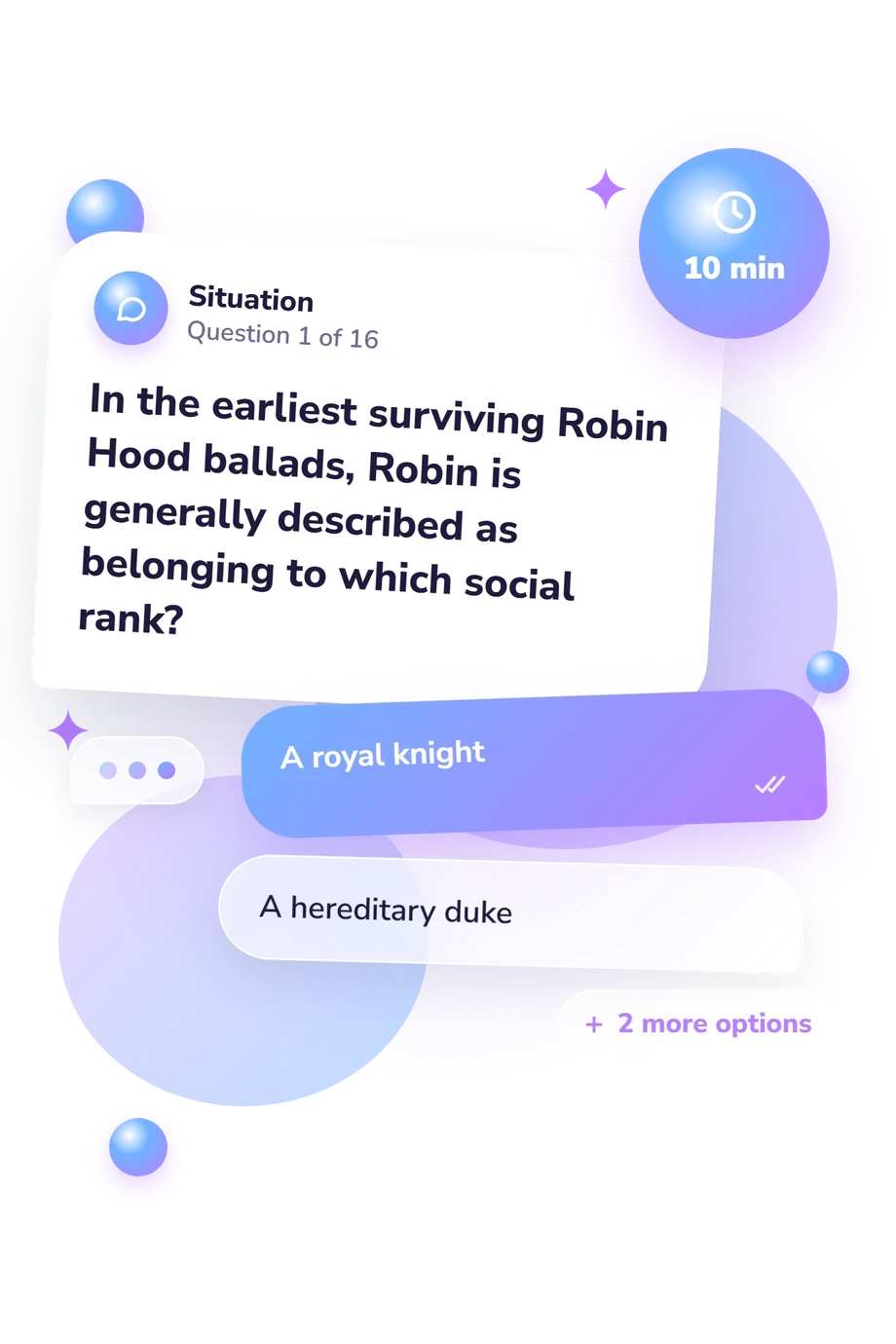
- A royal knight
- A hereditary duke
- A monk
- A yeoman
- A broadsword
- A longbow
- A throwing spear
- A crossbow
- King Richard I
- Henry II
- King John
- Edward I
Robin Hood Quiz - Description and methodology of the test
Readers meeting the legend, or returning to it after a favourite adaptation, can use this assessment to place familiar episodes within the wider tradition. The Robin Hood Quiz creates a focused pause between encountering the legend and deciding what to explore next. That overall result can orient someone taking this Robin Hood knowledge test toward a next area of exploration.
What This Test Measures
Items treat Robin Hood as a layered tradition rather than a fixed biography. They move from early ballad details to later additions and screen versions, covering social rank, weapons, settings, allies, enemies, historical uncertainty, and the tension between law and justice. Robin Hood questions in this quiz test recognition and the legend’s development.
The main themes are:
- Early tradition and characters show recognition of Robin’s rank, companions, enemies, and later additions.
- Places and episodes cover Sherwood Forest, signature weapons, archery contests, and familiar encounters.
- Themes and adaptations examine justice, authority, historical uncertainty, and changing portrayals.
The result uses Robin Hood Knowledge (0-16): Forest Newcomer (0-6) indicates partial familiarity; Growing Ballad Knowledge (7-12) shows a solid grasp with room for detail; Sherwood Scholar (13-16) reflects strong knowledge across the tradition. It is informal, not a definitive judgment of expertise.
Methodology and Evidence Base
Each item presents four answer choices and asks for a factual answer or interpretation. The format combines recall with context: prompts address names, places, weapons, adaptations, and what episodes suggest about justice, authority, or the Robin Hood archetype. As a Robin Hood trivia quiz, it tests knowledge of a cultural tradition rather than personality or personal experience.
The displayed result is interpreted through descriptive bands rather than a clinical threshold or population norm. The questionnaire does not specify how responses are converted into that score. It is an informal indication of overall familiarity and broad areas suggested by the question topics, not general literary expertise.
Historical and literary context for the quiz’s content comes from Knight and Ohlgren (2000), whose edited source places early outlaw narratives in context, and Stephen Knight (2003), who traces the legend’s changing meanings. This questionnaire is not an adaptation or validated reproduction of either work. The result is an informal knowledge assessment. Results may reflect prior reading, film exposure, memory, and differences between early ballads and later retellings.
- Stephen Knight, Thomas H. Ohlgren, and Russell A. Peck, eds. Robin Hood and Other Outlaw Tales. 2nd ed. TEAMS Middle English Texts Series. Kalamazoo, MI: Medieval Institute Publications, 2000. 10.2307/j.ctv13843cz.
- Stephen Knight. Robin Hood: A Mythic Biography. Ithaca, NY: Cornell University Press, 2003.
Updated: