
Universal Precautions Quiz
How the Scales are Structured
Who Usually Takes This Test?
See How You Compare
Below is a preview of how scores are typically distributed across each scale.
Example Questions From the Test
- Treat all human blood and specified body fluids as potentially infectious, regardless of known status.
- Use protective measures only when a person has a confirmed bloodborne infection.
- Apply the same maximum level of protective equipment during every interaction.
- Focus primarily on preventing infections spread through coughing and sneezing.
- Sweat
- Urine
- Semen
- Nasal secretions
- Urine
- Vaginal secretions
- Human blood
- Cerebrospinal fluid
Universal Precautions Quiz - Description and methodology of the test
People who handle blood or other potentially infectious materials can use the universal precautions quiz to check their readiness to recognize appropriate precautions in realistic situations. This bloodborne pathogen safety quiz examines decisions about barriers, sharps, spills, contaminated items, and exposure response, making it useful for learners and workers who want to connect classroom principles with current procedures.
What This Assessment Explores
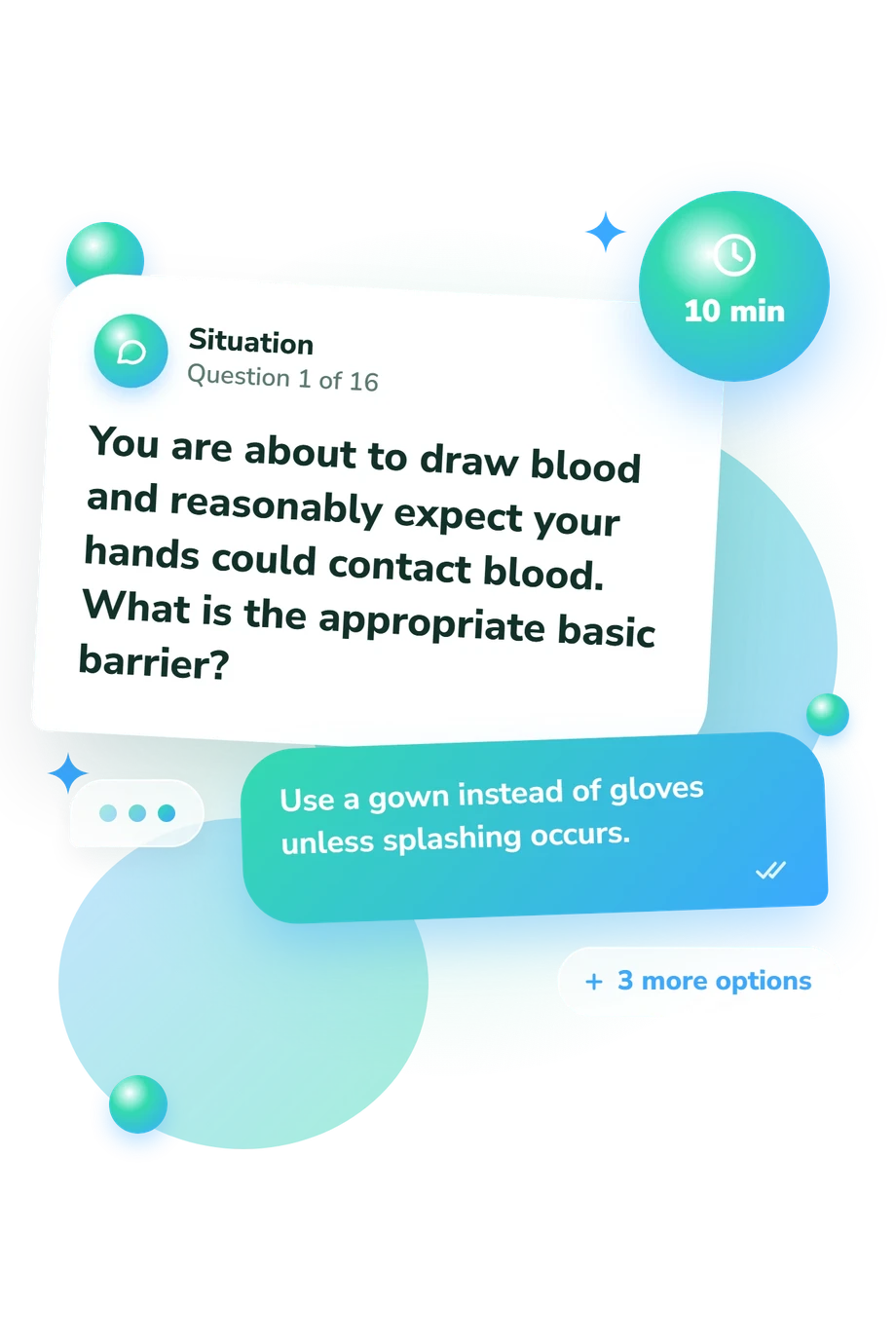
This assessment examines how well a respondent recognizes the central principle of treating human blood and specified body fluids as potentially infectious regardless of known status. Its scenarios cover the body fluids and materials addressed by the approach, PPE selection, sharps and broken-glass handling, specimen and spill control, and immediate action after exposure. The emphasis is on recognizing appropriate precautions in described situations, rather than demonstrating workplace performance.
Viewed as a universal precautions knowledge test, the result uses the Universal Precautions Knowledge scale (0-16), an educational measure of barriers, sharps, exposure response, and common applications. Its displayed bands are:
- Foundation to build (0-6) shows that a structured review of basic rules may help.
- Developing knowledge (7-12) shows that principles are understood but consistent application may need practice.
- Strong working knowledge (13-16) shows a solid grasp of principles and common applications.
Methodology and Scientific Basis
Each scenario offers four options; one best answer reflects the relevant rule, principle, or action. The themes include PPE selection, sharps and broken-glass handling, hand hygiene, ventilation barriers, specimen transport, spill disinfection, and post-exposure action. It is an online knowledge check, not an observed skills assessment.
Chan et al. (2002) is the closest source because it examined healthcare workers’ understanding of and adherence to these precautions. This questionnaire is conceptually consistent with that work, not an adaptation of its study instrument. The 1988 CDC guidance supplies the classic framework, while Siegel et al. (2007) explains the broader standard-precautions context used in modern infection control.
One point is awarded for each correct answer, producing the displayed total. The score can indicate whether review of principles may be useful. This is an unvalidated educational score, not a clinical, legal, or workplace competency cutoff. Your quiz answers on universal precautions are useful alongside local procedures and training. Attention, prior instruction, guessing, and the imagined situation can affect performance, so exposure reporting and the facility’s current procedure remain essential.
- Regina Chan, Alexander Molassiotis, Eunice Chan, Virene Chan, Becky Ho, Chit-ying Lai, Pauline Lam, Frances Shit, and Ivy Yiu. Nurses' knowledge of and compliance with universal precautions in an acute care hospital. International Journal of Nursing Studies. 2002;39(2):157-163. 10.1016/S0020-7489(01)00021-9
- Centers for Disease Control. Update: Universal Precautions for Prevention of Transmission of Human Immunodeficiency Virus, Hepatitis B Virus, and Other Bloodborne Pathogens in Health-Care Settings. MMWR Morbidity and Mortality Weekly Report. 1988;37(24):377-382, 387-388.
- Jane D. Siegel, Emily Rhinehart, Marguerite Jackson, and Linda Chiarello; Healthcare Infection Control Practices Advisory Committee. 2007 Guideline for Isolation Precautions: Preventing Transmission of Infectious Agents in Health Care Settings. American Journal of Infection Control. 2007;35(10 Suppl 2):S65-S164. 10.1016/j.ajic.2007.10.007
Updated: