
Where Will You Be in 10 Years Quiz
How the Scales are Structured
Who Usually Takes This Test?
See How You Compare
Below is a preview of how scores are typically distributed across each scale.
Example Questions From the Test
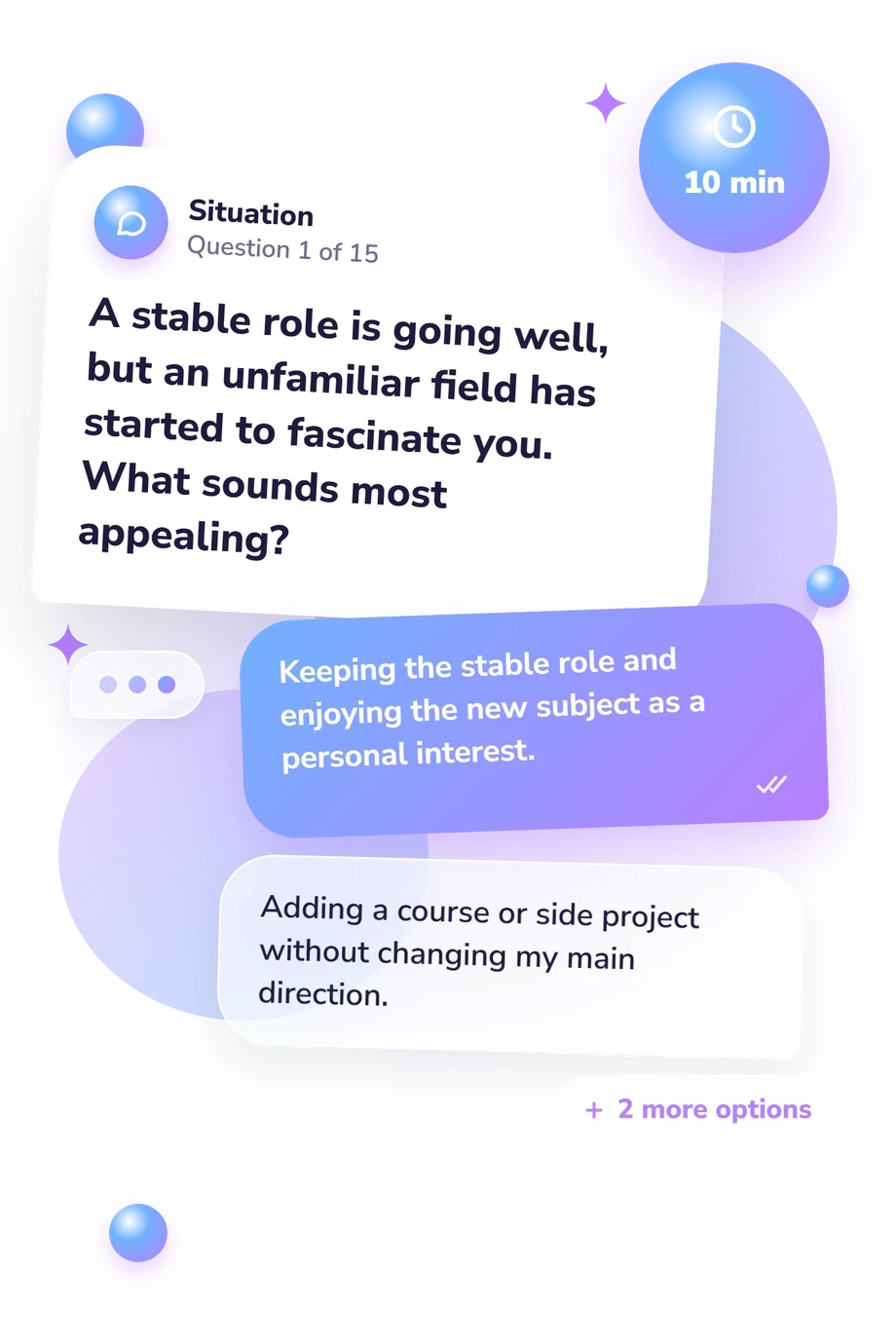
- Keeping the stable role and enjoying the new subject as a personal interest.
- Adding a course or side project without changing my main direction.
- Testing the field seriously before deciding whether to make a transition.
- Giving myself permission to begin again if the new field continues to feel alive.
- It leaves plenty of time and energy for relationships and interests outside the project.
- It introduces me to an enjoyable process, even if it leads nowhere specific.
- It builds useful capability while still allowing me to revise my direction.
- It could become a defining body of work if I steadily raise my standards.
- How I deepened a life and set of relationships that already mattered to me.
- How I made one thoughtful change while preserving most of what worked.
- How a few bold experiments expanded the life I had built.
- How several unexpected places, people, or pursuits changed my understanding of who I could become.
Where Will You Be in 10 Years Quiz - Description and methodology of the test
People considering changes in work, place, relationships, or daily priorities can use this questionnaire to examine the future they are already imagining. The Where Will You Be in 10 Years Quiz turns those intuitions into a profile. As a future self quiz, this questionnaire can reveal which values organize your choices. It is designed for reflection: the result describes preferred directions, not a fixed destiny.
What This Assessment Explores
Rather than predicting events, the assessment examines imagined choices about achievement, change, home, community, learning, and responsibility. Situations contrast stability with novelty, ambition with balance, and mobility with belonging. Its location items make it useful as a where will you live in 10 years quiz, while the wider profile shows what those choices mean.
The three displayed dimensions are:
- Accomplished & Established (0-15) shows your attraction to mastery, visible progress, responsibility, and long-term achievement. Bands: Beyond Milestones (0-5), Purposeful Progress (6-10), Mastery Driven (11-15).
- Exploring & Evolving (0-15) reflects attraction to variety, mobility, experimentation, and reinventing direction. Bands: Continuity Oriented (0-5), Flexible Explorer (6-10), Expansive Explorer (11-15).
- Rooted & Connected (0-15) indicates how strongly your future centers on a dependable home base, belonging, and enduring relationships. Bands: Open-Ended Roots (0-5), Selective Belonging (6-10), Deeply Rooted (11-15).
Methodology and Evidence Base
Each item presents a future situation with four answer choices, and the options vary by the priorities they express. Responses are converted into three profile scores. The bands describe the strength of an affinity, not a forecast or hierarchy; because the point-by-choice formula is not published, interpret the displayed profile rather than assuming how individual answers were weighted.
The approach is conceptually consistent with Markus and Nurius (1986) on imagined selves as guides for present motivation, and with Seginer (2009) on future orientation. Its attention to autonomy, growth, and connection also aligns with self-determination theory from Ryan and Deci (2000) and with Kasser and Ryan (1996) on intrinsic and extrinsic goals. Those works are theoretical reference points, not proof that this questionnaire is a standardized adaptation of any one instrument.
When approached as a future direction quiz, the result is best read alongside your actual circumstances. Self-report, current mood, and self-awareness can shape the result, and the profiles have no published norms; scores therefore describe present affinities rather than fixed predictions.
- Markus, Hazel, and Paula Nurius. “Possible selves.” American Psychologist, 41(9), 1986, 954-969. 10.1037/0003-066X.41.9.954
- Seginer, Rachel. Future Orientation: Developmental and Ecological Perspectives. Springer New York, 2009. 10.1007/b106810
- Ryan, Richard M., and Edward L. Deci. “Self-determination theory and the facilitation of intrinsic motivation, social development, and well-being.” American Psychologist, 55(1), 2000, 68-78. 10.1037/0003-066X.55.1.68
- Kasser, Tim, and Richard M. Ryan. “Further Examining the American Dream: Differential Correlates of Intrinsic and Extrinsic Goals.” Personality and Social Psychology Bulletin, 22(3), 1996, 280-287. 10.1177/0146167296223006
Updated: