
What Is My Unicorn Name Quiz
How the Scales are Structured
Who Usually Takes This Test?
See How You Compare
Below is a preview of how scores are typically distributed across each scale.
Example Questions From the Test
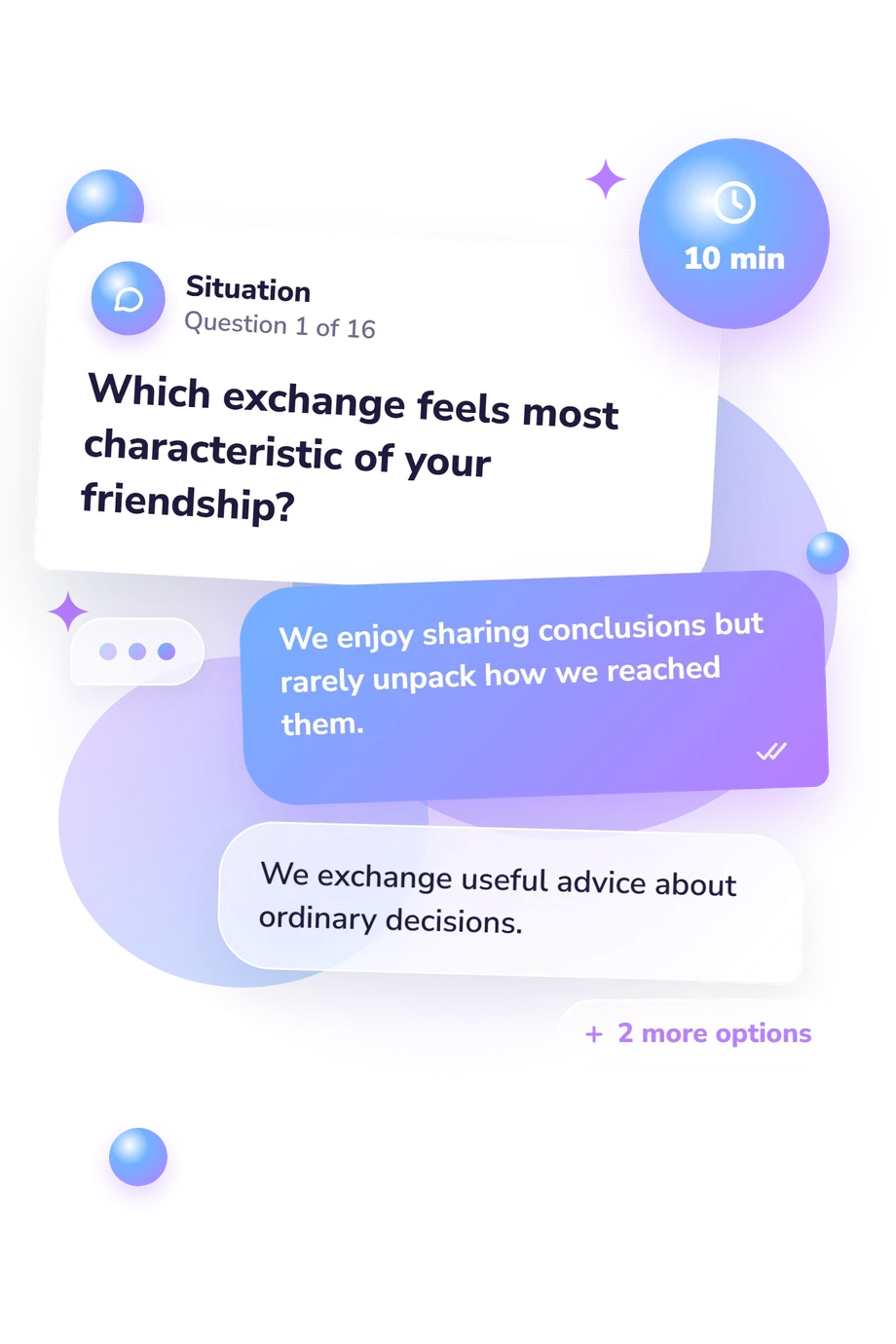
- We enjoy sharing conclusions but rarely unpack how we reached them.
- We exchange useful advice about ordinary decisions.
- We debate possibilities until a promising answer emerges.
- One person offers an unusual theory and the other grounds, challenges, or translates it.
- We set it aside unless it becomes relevant later.
- One of us searches for a straightforward explanation online.
- We discuss several possibilities and decide which one seems most realistic.
- One of us studies tiny clues while the other tests the theories against everyday logic.
- With a concise response that shows I read and understood it.
- With reassurance and a suggestion for what they might do next.
- With an equally thoughtful message about what their experience brings to mind.
- With vivid empathy, affectionate language, and an invitation to explore every emotional detail.
What Is My Unicorn Name Quiz - Description and methodology of the test
People curious about close-friendship patterns can use the What Is My Unicorn Name Quiz to notice how they and a BFF handle support, imagination, communication, and shared challenges. Readers wondering what your unicorn name is in this quiz can use this playful friendship-style profile to identify recurring ways a bond works. This profile highlights practical loyalty, complementary problem-solving, expressive closeness, and adventurous play.
What This Assessment Explores
Four styles organize choices: practical loyalty, complementary problem-solving, expressive closeness, and playful imagination. As a friendship style quiz, it describes interaction preferences, not closeness. Highest scale shows strongest affinity; scales within one point indicate a blended result.
These dimensions are:
- Moonbeam & Hearthglow - Frodo and Sam (0-12) measures steadfast, practical companionship through shared burdens, loyalty, and presence in difficulty: Independent Allies 0-4, Reliable Companions 5-8, Steadfast Sidekicks 9-12.
- Silverclue & Trueheart - Sherlock and Watson (0-12) measures a complementary partnership built on curiosity, observation, and contrasting strengths: Separate Thinkers 0-4, Curious Collaborators 5-8, Complementary Detectives 9-12.
- Starlark & Wildrose - Anne and Diana (0-12) measures an affectionate, imaginative, openly expressive bond: Quiet Kindred Spirits 0-4, Warm Confidantes 5-8, Bosom-Friend Dreamers 9-12.
- Sunskip & Stormstripe - Calvin and Hobbes (0-12) measures playful invention, spirited debate, and rule-bending adventure: Easygoing Playmates 0-4, Spirited Adventurers 5-8, Mischief-Making Philosophers 9-12.
Methodology and Evidence Base
Each scenario offers four response options about support, advice, clues, emotions, plans, goals, rituals, and imaginative play. The format asks the respondent to choose the reaction that best fits the friendship, without requiring clinical vocabulary.
In practice, this BFF quiz compares the displayed scores across four dimensions. The highest displayed scale shows the strongest affinity, while scales within one point indicate a blended result. Because the format does not specify how individual answers contribute, the profile should be read through these displayed comparisons rather than reverse-engineered into separate trait scores.
Conceptually, it is consistent with McGill Friendship Questionnaires (Mendelson & Aboud, 1999), the Friendship Qualities Scale (Bukowski, Hoza, & Boivin, 1994), and Rawlins, Leibowitz, and Bochner’s (1986) affective and instrumental dimensions of friendship. The online questionnaire is a self-reflection format with character pairings as an accessible interpretive frame rather than a standardized administration of those instruments.
Self-report results can shift with mood, recent experiences, and changing friendship dynamics. For this online format, no norms, reliability estimates, or clinical cutoffs are established, so the profile is reflective rather than diagnostic.
- Mendelson, Morton J., and Frances E. Aboud. “Measuring Friendship Quality in Late Adolescents and Young Adults: McGill Friendship Questionnaires.” Canadian Journal of Behavioural Science, vol. 31, no. 2, 1999, pp. 130-132. 10.1037/h0087080
- Bukowski, William M., Betsy Hoza, and Michel Boivin. “Measuring Friendship Quality During Pre- and Early Adolescence: The Development and Psychometric Properties of the Friendship Qualities Scale.” Journal of Social and Personal Relationships, vol. 11, no. 3, 1994, pp. 471-484. 10.1177/0265407594113011
- Rawlins, William K., Kenneth Leibowitz, and Arthur P. Bochner. “Affective and Instrumental Dimensions of Best, Equal, and Unequal Friendships.” Central States Speech Journal, vol. 37, no. 2, 1986, pp. 90-101. 10.1080/10510978609368208
Updated: