
Plumbing Quiz
How the Scales are Structured
Who Usually Takes This Test?
See How You Compare
Below is a preview of how scores are typically distributed across each scale.
Example Questions From the Test
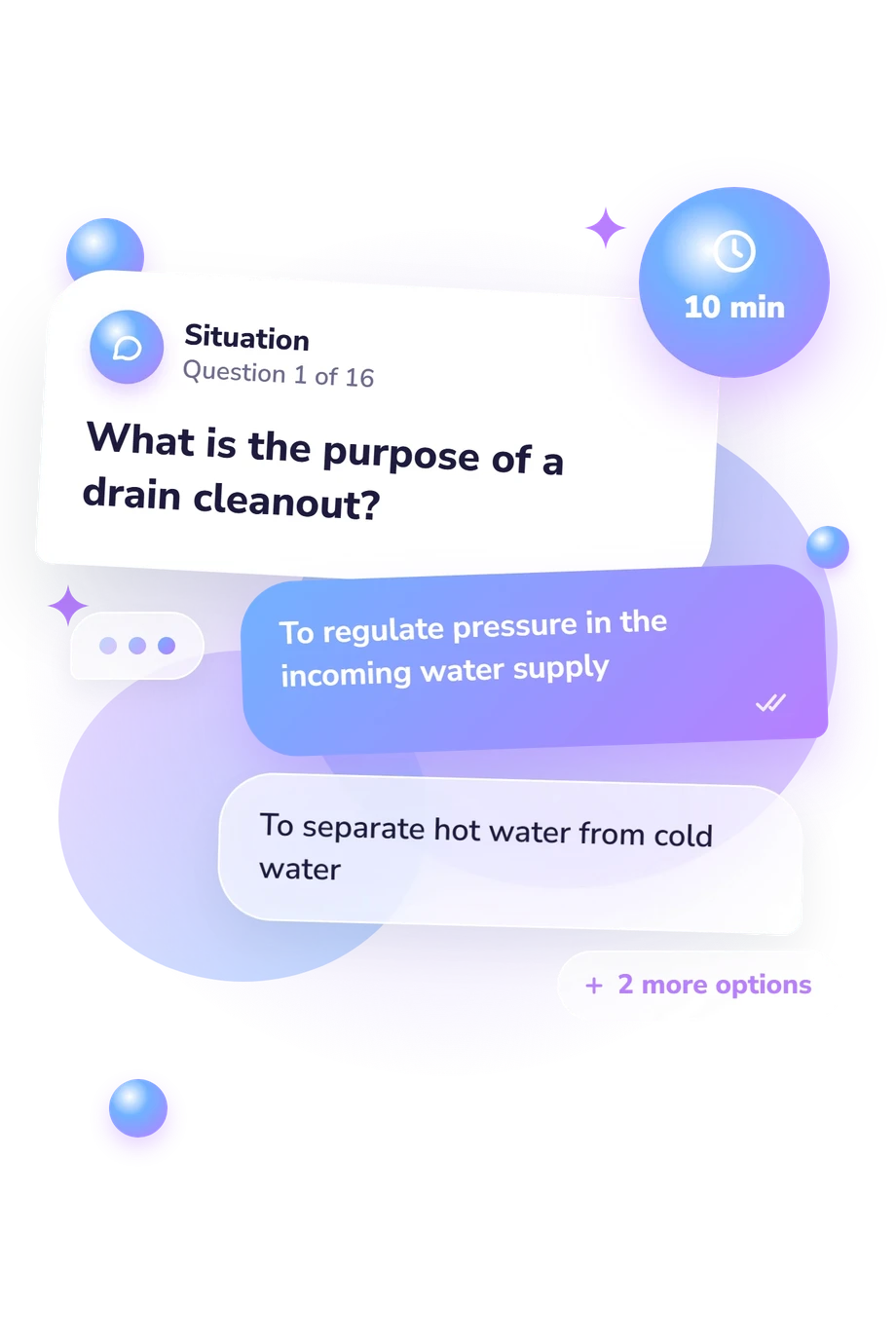
- To regulate pressure in the incoming water supply
- To separate hot water from cold water
- To maintain the water seal in every fixture trap
- To provide access for inspecting or clearing a drain line
- A blocked plumbing vent
- An overfilled water heater
- A dry P-trap beneath the sink
- A worn stem washer or damaged valve seat
- Remove the drain grate and seal the opening with concrete
- Close the building's main water valve permanently
- Add water to restore a possibly evaporated trap seal
- Increase the water heater temperature
Plumbing Quiz - Description and methodology of the test
Homeowners, renters, maintenance learners, and anyone preparing to handle basic fixtures can use this plumbing quiz to check how they reason through familiar household problems. As a basic plumbing assessment, it emphasizes practical judgment and indicates an overall knowledge level and familiarity with the material covered. It can help learners decide where further study may be useful.
What This Assessment Explores
Each question presents a plumbing situation and asks for a cause, first step, or sound principle. As a plumbing knowledge test, it suits maintenance learners and shows how well they connect symptoms with components and troubleshooting order.
The questions sample four areas:
- Fixtures and controls indicate recognition of cartridges, washers, aerators, shutoffs, flappers, and pressure-reducing valves.
- Traps, vents, and drainage indicate understanding of water seals, odors, cleanouts, slope, and sump discharge.
- Tools and materials indicate whether cutting and thread-sealing choices match the equipment’s purpose.
- Safety responses indicate whether the respondent recognizes appropriate responses to leaks, frozen pipes, water hammer, and related faults.
The Plumbing Knowledge scale runs from 0-16: Foundation to Build (0-6) signals basics to review; Developing Knowledge (7-12) reflects familiarity with common systems and room to strengthen weaker topics; Strong Knowledge (13-16) indicates solid grasp of principles and household troubleshooting.
Methodology and Evidence Base
Each item uses a brief scenario followed by four answer choices. The respondent selects the best option, so the questionnaire samples applied recognition rather than attitudes or personality traits. The questionnaire reports one overall result; its item weights and aggregation method are not defined, and it provides no separate hands-on score or licensing threshold.
Methodologically, the scenarios focus on household plumbing troubleshooting and applied recognition. Their content is conceptually consistent with the published plumbing-competence instrument, but this questionnaire is not presented as a direct adaptation, standardized replication, or validated copy of that instrument. Practical guidance on components, procedures, safety, drainage, and supply systems supports its subject matter and applied framing.
The questionnaire has no established norms or published reliability coefficients. It has no stated norm group or reliability estimate. Because it is self-administered, previous experience, attention, interpretation of wording, and confidence may affect answers, while recognizing the right response does not demonstrate safe performance under real conditions. Use the result to guide further study, not to establish trade qualification.
- Arthur, Riyan, Faruq Abdur Rouf, Henita Rahmayanti, and Arris Maulana. "Plumbing work competence instrument in the field of civil engineering." Journal of Physics: Conference Series 1402, no. 2 (2019): 022019. 10.1088/1742-6596/1402/2/022019.
- Massey, Howard C., and David M. Gans. Plumber's Handbook Revised, 6th ed. Craftsman Book Company, 2023. ISBN 978-1-57218-398-8.
- National Center for Construction Education and Research. Plumbing Level 2 Trainee Guide, 4th ed. Pearson, 2014. ISBN 978-0-13-314-850-3.
- International Code Council. 2024 International Plumbing Code. International Code Council, 2024. ISBN 978-1-959851-73-8.
Updated: