
Nintendo Character Quiz
How the Scales are Structured
Who Usually Takes This Test?
See How You Compare
Below is a preview of how scores are typically distributed across each scale.
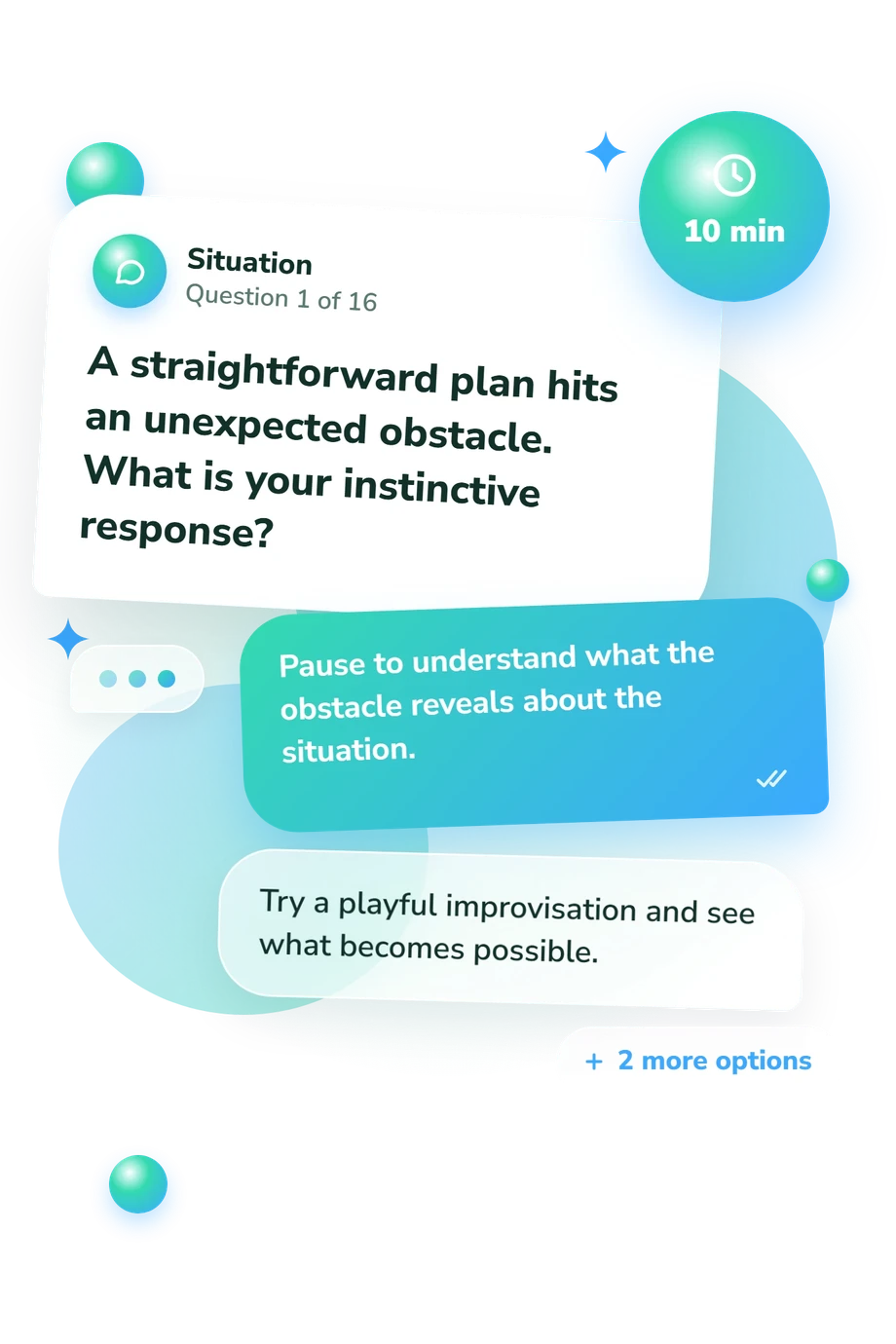
Example Questions From the Test
- I want to understand why the change is needed before agreeing.
- I quickly look for what could be fun about the new plan.
- I suggest preserving the main goal while adjusting the details.
- I check whether the new plan still respects my time and limits.
- Using humor or enthusiasm to keep the mood from becoming heavy.
- Narrowing my attention to the next precise action I can control.
- Looking around for an unconventional resource I can adapt.
- Checking in with trusted people before choosing the next move.
- Discovering a hidden detail in a place I thought I knew.
- Finishing a demanding task exactly as intended.
- Sharing a favorite treat or silly moment with someone.
- Starting an upbeat activity that gets everyone involved.
Nintendo Character Quiz - Description and methodology of the test
People who enjoy Nintendo characters but want more than a random match can use the Nintendo Character Quiz to connect everyday preferences with four recognizable styles. For readers wondering which Nintendo character they are, the result offers a concise way to compare their responses with Kirby, Link, Mario, and Samus Aran. It identifies a strongest affinity while allowing a near-tie to appear as a blended profile.
What This Assessment Explores
Responses map everyday reactions-under pressure, around boundaries, in groups, and during exploration-onto symbolic character profiles. For readers treating it as a Nintendo character test, the result shows which style feels most familiar.
The four result dimensions are:
- Kirby Affinity (0-12) measures warmth, playfulness, curiosity, and adaptability; bands are Different Flavor (0-4), Flexible Friend (5-8), and Joyful Adapter (9-12).
- Link Affinity (0-12) measures observation, courage, preparation, and quiet duty; bands are Alternate Calling (0-4), Questing Spirit (5-8), and Courageous Pathfinder (9-12).
- Mario Affinity (0-12) measures energy, sociability, optimism, and persistence; bands are Different Tempo (0-4), Shared Spark (5-8), and Buoyant Go-Getter (9-12).
- Samus Aran Affinity (0-12) measures independence, composure, competence, and mission focus; bands are Collaborative Current (0-4), Capable Operator (5-8), and Self-Directed Powerhouse (9-12).
Your highest score marks the strongest affinity; any profile within one point of it joins the blended result.
Methodology and Scientific Basis
Each item presents a short scenario with four response choices about obstacles, privacy, changing plans, demanding tasks, unfamiliar settings, groups, and exploration. Responses are combined into four character-affinity totals; no per-answer point value is stated, so interpretation should follow the displayed totals and bands rather than an invented formula.
The conceptual frame is audience-character identification. Hoffner and Buchanan (2005) connect identification with perceived similarity and character attributes, while Cohen (2001) distinguishes identifying with a media character from simply enjoying one. Huang and Fung (2024) add later measurement work on narrative-character identification. This questionnaire is conceptually consistent with that research, but is not presented as an adaptation, validation, or normed administration of those instruments.
Relative affinity across the four characters matters more than a single label, especially when a close second falls within the stated one-point margin. The Nintendo personality quiz is best used for structured self-reflection, not as a population norm. Self-reported answers can shift with mood, context, self-awareness, or the wish to choose an appealing response.
- Hoffner, Cynthia, and Martha Buchanan. "Young Adults’ Wishful Identification With Television Characters: The Role of Perceived Similarity and Character Attributes." Media Psychology 7, no. 4 (2005): 325-351. 10.1207/S1532785XMEP0704_2
- Huang, Kate Y., and Helene H. Fung. "Measuring identification with narrative characters: the development and validation of a new scale." Current Psychology 43 (2024): 24835-24849. 10.1007/s12144-024-06191-2
- Cohen, Jonathan. "Defining Identification: A Theoretical Look at the Identification of Audiences With Media Characters." Mass Communication and Society 4, no. 3 (2001): 245-264. 10.1207/S15327825MCS0403_01
Updated: