
Guess the Anime Quiz
How the Scales are Structured
Who Usually Takes This Test?
See How You Compare
Below is a preview of how scores are typically distributed across each scale.
Example Questions From the Test
- Blue Exorcist
- Bleach
- Black Clover
- Naruto
- Dororo
- Demon Slayer: Kimetsu no Yaiba
- Inuyasha
- Seraph of the End
- One-Punch Man
- Tiger & Bunny
- Fire Force
- My Hero Academia
Guess the Anime Quiz - Description and methodology of the test
For anime fans who want a focused anime trivia quiz, this assessment offers a structured way to revisit popular titles and decide whether a short recognition challenge suits their interests. The Guess the Anime Quiz suits readers who enjoy checking how widely their viewing has covered well-known series. It provides a compact challenge built around memorable fictional worlds rather than personal opinions or fandom identity.
What This Test Measures
At its core, the questionnaire measures entertainment knowledge through recognition. Each item describes a character, ability, premise, setting, or plot situation, then asks you to connect it with the correct series. As an anime character quiz, it focuses on recall of distinctive story details rather than personal taste.
The questions group into these recognition areas:
- Characters and roles show whether a figure’s identity or occupation points to the right series.
- Powers and abilities show whether signature skills or supernatural rules trigger recall.
- Premises and plots show whether a conflict, setting, or mission identifies the title.
Anime Knowledge: 0-16 reports the result: Emerging Viewer 0-6, Developing Fan 7-12, and Anime Expert 13-16. The bands move from partial recognition to broad familiarity and consistent identification of distinctive details; this remains an entertainment knowledge score, not an official measure of expertise.
Methodology and Evidence Base
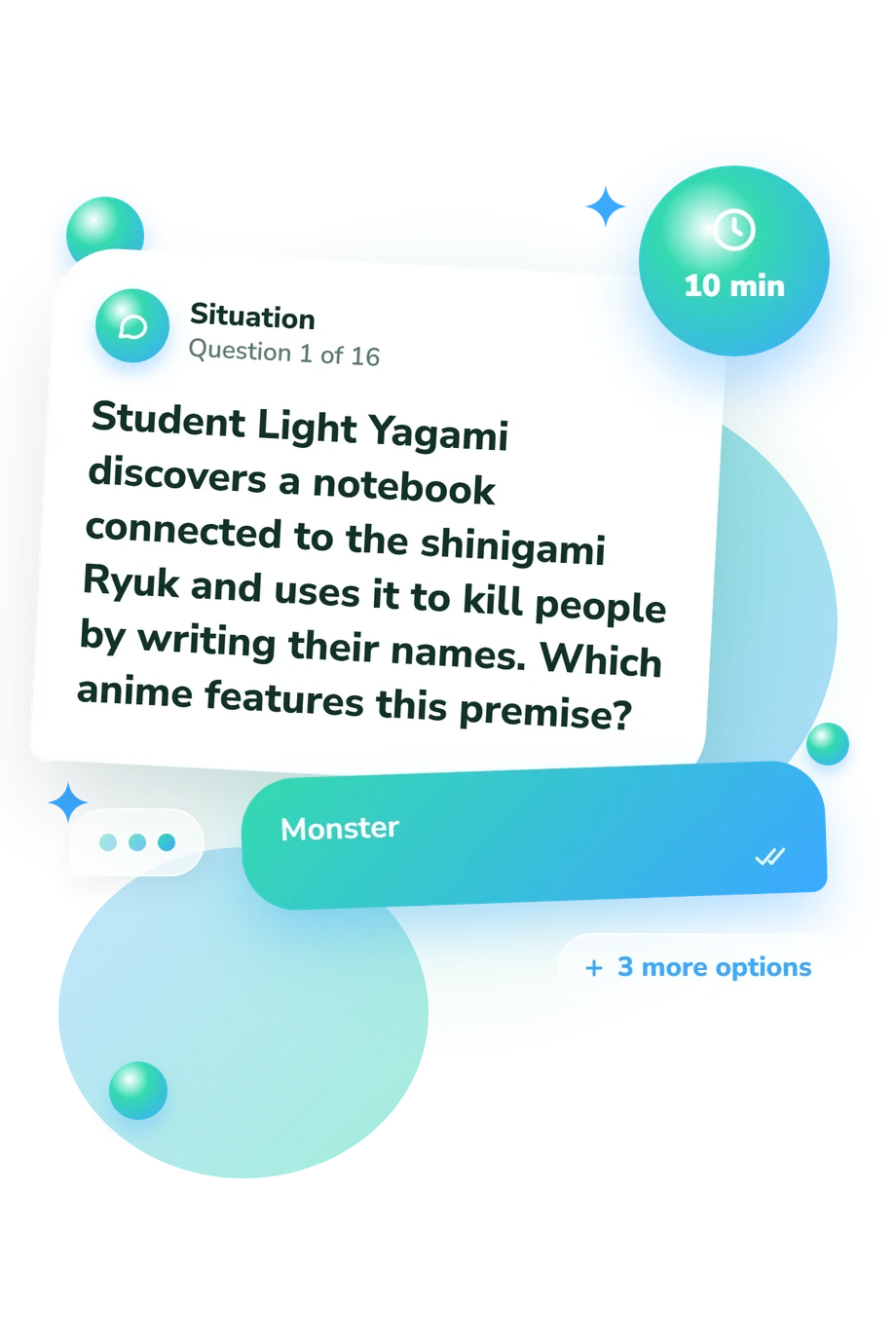
Every prompt uses a short stem and four answer choices, with one title matching the described character, premise, ability, or situation. The task is recognition-based: choose the best-supported anime rather than explain an answer or rate familiarity. Across 16 items, the total counts correct identifications, creating a direct knowledge profile.
Each clue turns the task into an anime title quiz: identify the series from a character, ability, premise, or plot situation rather than choose by broad genre alone.
Because the result is explicitly an entertainment knowledge score, its evidence is descriptive: the clues sample recognition of titles, and the answer key determines correct identification. The questionnaire is an entertainment knowledge check rather than a validated anime-recognition instrument, so the score should not be generalized beyond the items it contains. No external scale or theoretical model is used to turn the result into a psychological trait.
Interpret the total as performance on this title set. Recognition can vary with franchise familiarity, release recency, translated title conventions, and exposure to anime culture.
- Reysen, Stephen, Courtney N. Plante, Sharon E. Roberts, and Kathleen C. Gerbasi. Empirically Testing the Veracity of Otaku Stereotypes. The Phoenix Papers, 5(1), 210-233, 2022. 10.31235/osf.io/gd6pq.
- Haladyna, Thomas M., Steven M. Downing, and Michael C. Rodriguez. A Review of Multiple-Choice Item-Writing Guidelines for Classroom Assessment. Applied Measurement in Education, 15(3), 309-333, 2002. 10.1207/S15324818AME1503_5.
- Li, Jinying. Anime's Knowledge Cultures: Geek, Otaku, Zhai. University of Minnesota Press, 2024. ISBN 978-1-5179-1627-5.
Updated: