
Do I Love My Boyfriend Quiz
How the Scales are Structured
Who Usually Takes This Test?
See How You Compare
Below is a preview of how scores are typically distributed across each scale.
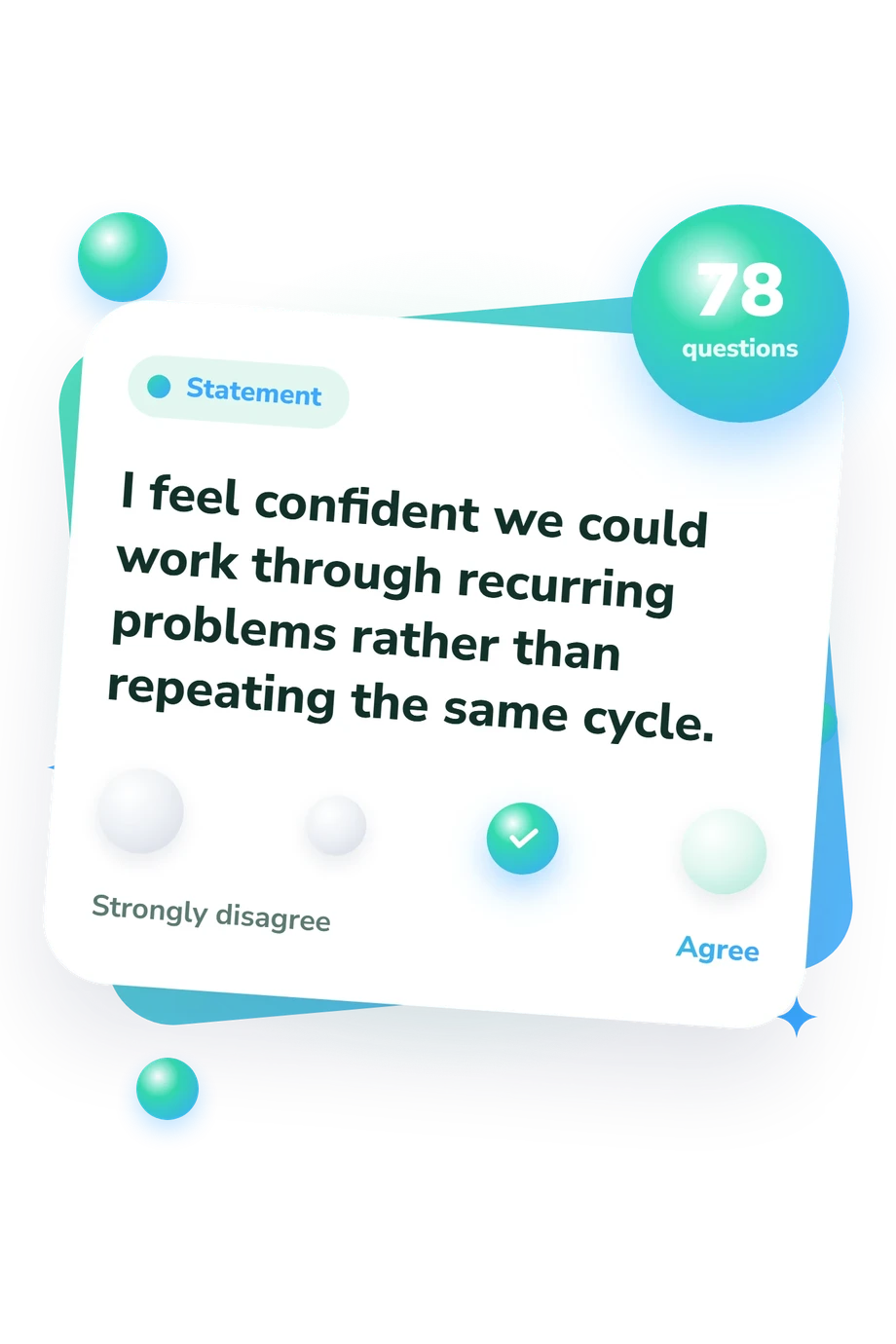
Example Questions From the Test
- Strongly disagree
- Disagree
- Not sure
- Agree
- Strongly disagree
- Disagree
- Not sure
- Agree
- Strongly disagree
- Disagree
- Not sure
- Agree
Do I Love My Boyfriend Quiz - Description and methodology of the test
For someone who is unsure whether a relationship feels loving, secure, and sustainable, this questionnaire offers a structured way to sort different parts of the experience. The Do I Love My Boyfriend Quiz is designed for personal reflection, not a forced yes-or-no verdict. The profile produced by this boyfriend love quiz can help you notice whether affection, trust, and future expectations feel aligned or uneven.
What This Assessment Explores
Love is treated as a pattern of experiences rather than one isolated emotion. Items cover closeness, affection, authenticity, care, future plans, conflict repair, honesty, reliability, loyalty, and shared commitment expectations.
These are the three dimensions shown in the result:
- Emotional Love & Closeness (0-40) measures warmth, affection, intimacy, and feeling emotionally seen; Low closeness 0-13, Moderate closeness 14-26, High closeness 27-40.
- Long-Term Compatibility & Intent (0-30) measures shared values, alignment in future goals, willingness to work through problems, and desire to build a future; Unclear or misaligned 0-12, Some alignment 13-22, Strong long-term fit 23-30.
- Trust & Security (0-30) measures safety, honesty, reliability, and confidence in intentions; Low trust 0-10, Mixed trust 11-20, High trust 21-30.
Together, the profile explores relationship compatibility alongside romantic feeling. Higher bands indicate more of the named quality; lower bands indicate distance, doubt, hesitation, or unclear alignment.
Methodology and Scientific Basis
The representative statements use four ordered responses: Strongly disagree, Disagree, Not sure, or Agree. Responses are grouped by dimension, producing a separate score and displayed band for each scale. Higher results indicate more of the measured quality; lower results indicate less security, closeness, or alignment.
The structure is conceptually consistent with the PRQC Inventory (Fletcher et al., 2000), which treats relationship quality as related components. It also aligns conceptually with Sternberg’s triangular theory of love, Rempel, Holmes, and Zanna’s account of trust in close relationships, and the Investment Model Scale from Rusbult, Martz, and Agnew. These sources provide comparison points; the statements bring those ideas into questions about emotional closeness, future alignment, and confidence in a partner’s reliability.
The questionnaire is an online self-report profile, and each result band describes a level of the relevant quality. Mood, recent events, self-awareness, and candor can influence responses, so interpret the result alongside the experiences behind each answer. It also offers a way to consider love compatibility through affection, security, and long-term intent.
- Fletcher, Garth J. O., Jeffry A. Simpson, and Geoff Thomas. (2000). The Measurement of Perceived Relationship Quality Components: A Confirmatory Factor Analytic Approach. Personality and Social Psychology Bulletin, 26(3), 340-354. 10.1177/0146167200265007
- Sternberg, Robert J. (1986). A triangular theory of love. Psychological Review, 93(2), 119-135. 10.1037/0033-295X.93.2.119
- Rempel, John K., John G. Holmes, and Mark P. Zanna. (1985). Trust in Close Relationships. Journal of Personality and Social Psychology, 49(1), 95-112. 10.1037/0022-3514.49.1.95
- Rusbult, Caryl E., John M. Martz, and Christopher R. Agnew. (1998). The Investment Model Scale: Measuring commitment level, satisfaction level, quality of alternatives, and investment size. Personal Relationships, 5(4), 357-387. 10.1111/j.1475-6811.1998.tb00177.x
Updated: