
Compass Personality Test
How the Scales are Structured
Who Usually Takes This Test?
See How You Compare
Below is a preview of how scores are typically distributed across each scale.
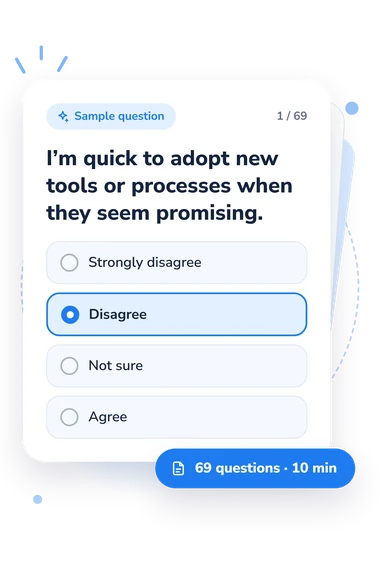
Example Questions From the Test
- Strongly disagree
- Disagree
- Not sure
- Agree
- Strongly disagree
- Disagree
- Not sure
- Agree
- Strongly disagree
- Disagree
- Not sure
- Agree
Compass Personality Test - Description and methodology of the test
For readers who want to understand the principles behind everyday choices, the compass personality test offers a structured way to examine decision preferences rather than assign a fixed label. Viewed as a north south east west personality test, the questionnaire helps compare reactions to fairness, leadership, established routines, and change. It can highlight value tensions that shape choices at work, in relationships, and in groups.
What This Assessment Explores
This assessment explores recurring preferences when compassion competes with consistency, self-direction with hierarchy, or familiar practice with reform. It suits people reflecting on choices at work, in relationships, or in groups. As a values and decision style test, it shows patterns rather than declaring one side universally correct.
The result dimensions are:
- Empathy vs. Principle (0-40) measures personal impact and harmony versus impartial rules and consistent justice. Its bands are Empathy-led (0-13), Balanced (14-26), and Principle-led (27-40).
- Independence vs. Authority (0-40) measures self-direction versus hierarchy, guidance, and coordinated leadership. Its bands are More Independent (0-16), Balanced (17-26), and More Authority-Oriented (27-40).
- Tradition vs. Change (0-40) measures continuity and proven methods versus innovation and revised rules. Its bands are Tradition-leaning (0-13), Balanced (14-26), and Change-leaning (27-40).
Methodology and Scientific Basis
The items address rules, exceptions, leadership, approval, tradition, and new approaches. You choose Strongly disagree, Disagree, Not sure, or Agree, so the profile captures direction and uncertainty. The items group around moral judgment, authority, autonomy, continuity, and openness to change.
The displayed result presents three profile dimensions, with lower and higher positions interpreted through the definitions attached to each result. This compass personality quiz is best read as a pattern: a middle band suggests balance on a tension, while an extreme band suggests a stronger preference. No single result predicts behavior in every situation.
The questionnaire is conceptually consistent with the Moral Foundations Questionnaire, which links moral judgment with care, fairness, loyalty, authority, and purity. It is not an adaptation of that instrument. A second conceptual reference is Schwartz’s theory of basic individual values, where priorities can conflict between stability, autonomy, order, and openness to change.
The displayed bands provide descriptive labels rather than population norms. Results may shift with mood, recent experiences, self-awareness, and self-presentation, especially when judging fairness, authority, tradition, or change in a current situation. Use the profile as a structured starting point for reflection rather than a complete account of personality.
- Jesse Graham, Brian A. Nosek, Jonathan Haidt, Ravi Iyer, Spassena Koleva, and Peter H. Ditto. "Mapping the Moral Domain." Journal of Personality and Social Psychology 101, no. 2 (2011): 366-385. 10.1037/a0021847
- Shalom H. Schwartz, Jan Cieciuch, Michele Vecchione, Eldad Davidov, Ronald Fischer, Constanze Beierlein, Alice Ramos, Markku Verkasalo, Jan-Erik Lönnqvist, Kursad Demirutku, Ozlem Dirilen-Gumus, and Mark Konty. "Refining the Theory of Basic Individual Values." Journal of Personality and Social Psychology 103, no. 4 (2012): 663-688. 10.1037/a0029393
- Shalom H. Schwartz. "Universals in the Content and Structure of Values: Theoretical Advances and Empirical Tests in 20 Countries." Advances in Experimental Social Psychology 25 (1992): 1-65. 10.1016/S0065-2601(08)60281-6