
Classical Conditioning Quiz
How the Scales are Structured
Who Usually Takes This Test?
See How You Compare
Below is a preview of how scores are typically distributed across each scale.
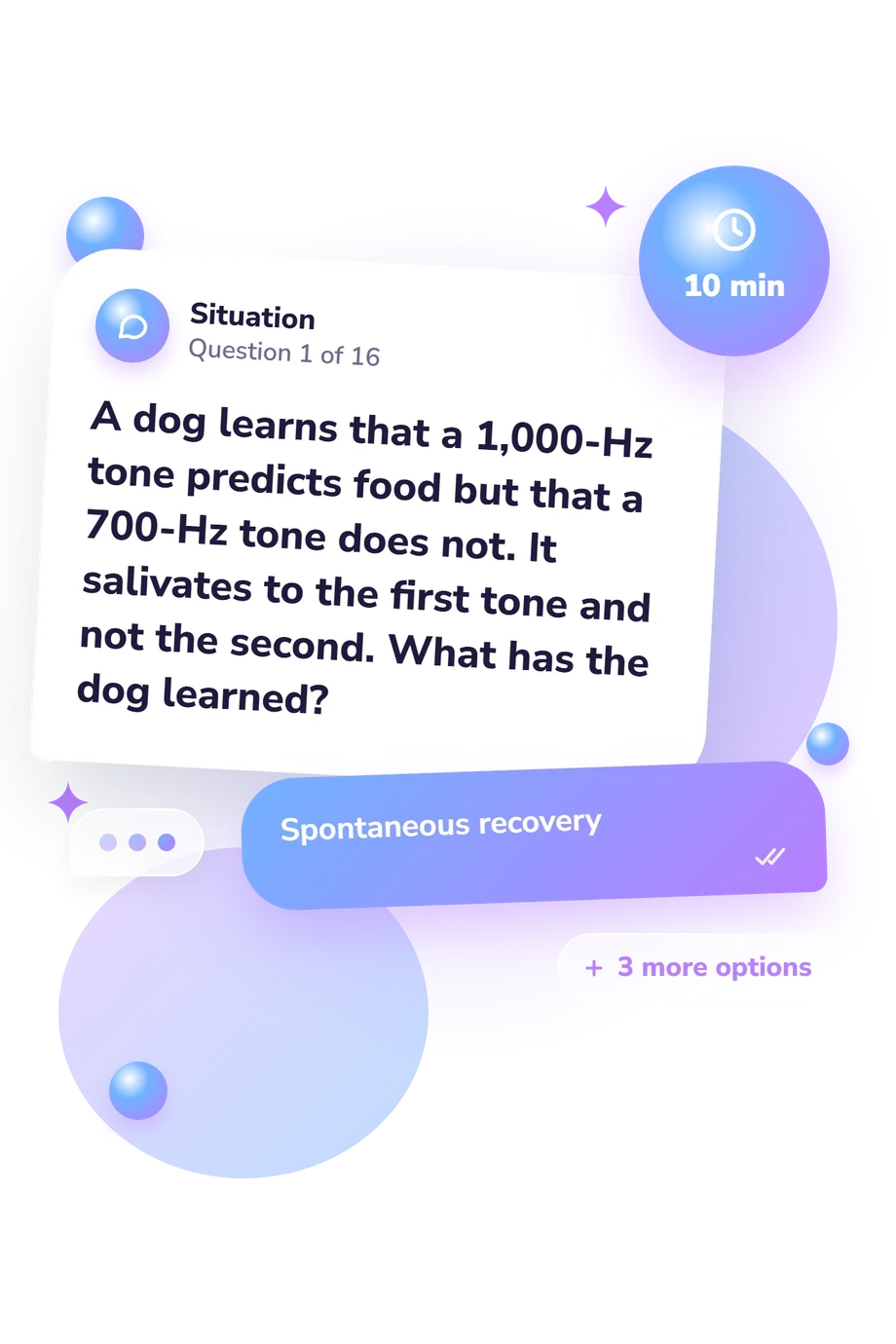
Example Questions From the Test
- Conditioned stimulus
- Conditioned response
- Unconditioned response
- Neutral stimulus
- Unconditioned stimulus
- Unconditioned response
- Conditioned stimulus
- Conditioned response
- It is any action strengthened by a reward.
- It begins as neutral and gains meaning through pairing.
- It naturally elicits a response without prior learning.
- It is a learned response that persists after extinction.
Classical Conditioning Quiz - Description and methodology of the test
Students, teachers, and psychology learners can use this classical conditioning quiz to check whether they understand how neutral cues acquire meaning and how learned responses change. It suits anyone reviewing introductory classical conditioning material or checking conceptual knowledge before further study. The result summarizes overall performance across definitions and applied scenarios and places it in the relevant displayed band.
What This Assessment Measures
Learning here is treated as a relation between cues, outcomes, and responses. The items ask readers to identify what is learned, distinguish innate from acquired reactions, and track how experience changes responding to similar or different stimuli.
The classical conditioning questions use food, fear, taste aversion, and sound scenarios. They suit learners reviewing introductory theory or checking whether they can apply concepts beyond definitions.
Classical Conditioning Knowledge runs from 0-16 and counts correct answers. The displayed bands are Foundations to build (0-6), Developing understanding (7-12), and Strong command (13-16). The items cover four areas:
- Stimulus and response labels show whether you distinguish unconditioned events from learned cues.
- Acquisition shows how a neutral stimulus becomes predictive through pairing.
- Extinction and recovery show how responding weakens and can return.
- Generalization and discrimination show whether learning spreads or becomes selective.
Methodology and Evidence Base
Each item presents a definition or brief scenario with four answer choices. The respondent identifies conditioned and unconditioned elements, names effects such as blocking or spontaneous recovery, or separates classical from operant conditioning. For learners using it as a classical conditioning practice quiz, the format emphasizes conceptual discrimination over recall of repeated wording.
The score is the number of correct selections, interpreted through the displayed performance bands. It gives one overall knowledge result across the questionnaire, summarizing performance rather than separate concept subscores.
Its framework is conceptually consistent with Rescorla and Wagner (1972), whose account emphasizes predictive relations and changes in associative strength. Bouton (2016) synthesizes acquisition, extinction, return of responding, and generalization. Kamin (1969) is relevant to blocking, while Garcia and Koelling (1966) supports cue-consequence relations and taste aversion.
The questionnaire is not an adaptation of any cited publication. Its scenarios cover cue-outcome prediction, changing responses, and distinctions between related learning effects. Because answers depend on study, attention, interpretation, and guessing, the score describes performance on these items rather than learning ability in general.
- Rescorla, R. A., & Wagner, A. R. (1972). A theory of Pavlovian conditioning: Variations in the effectiveness of reinforcement and nonreinforcement. In A. H. Black & W. F. Prokasy (Eds.), Classical conditioning II: Current research and theory (pp. 64-99). New York, NY: Appleton-Century-Crofts.
- Bouton, M. E. (2016). Learning and behavior: A contemporary synthesis (2nd ed.). Sunderland, MA: Sinauer Associates.
- Kamin, L. J. (1969). Predictability, surprise, attention, and conditioning. In B. A. Campbell & R. M. Church (Eds.), Punishment and aversive behavior (pp. 279-296). New York, NY: Appleton-Century-Crofts.
- Garcia, J., & Koelling, R. A. (1966). Relation of cue to consequence in avoidance learning. Psychonomic Science, 4(1), 123-124. 10.3758/BF03342209
Updated: