
British History Quiz
How the Scales are Structured
Who Usually Takes This Test?
See How You Compare
Below is a preview of how scores are typically distributed across each scale.
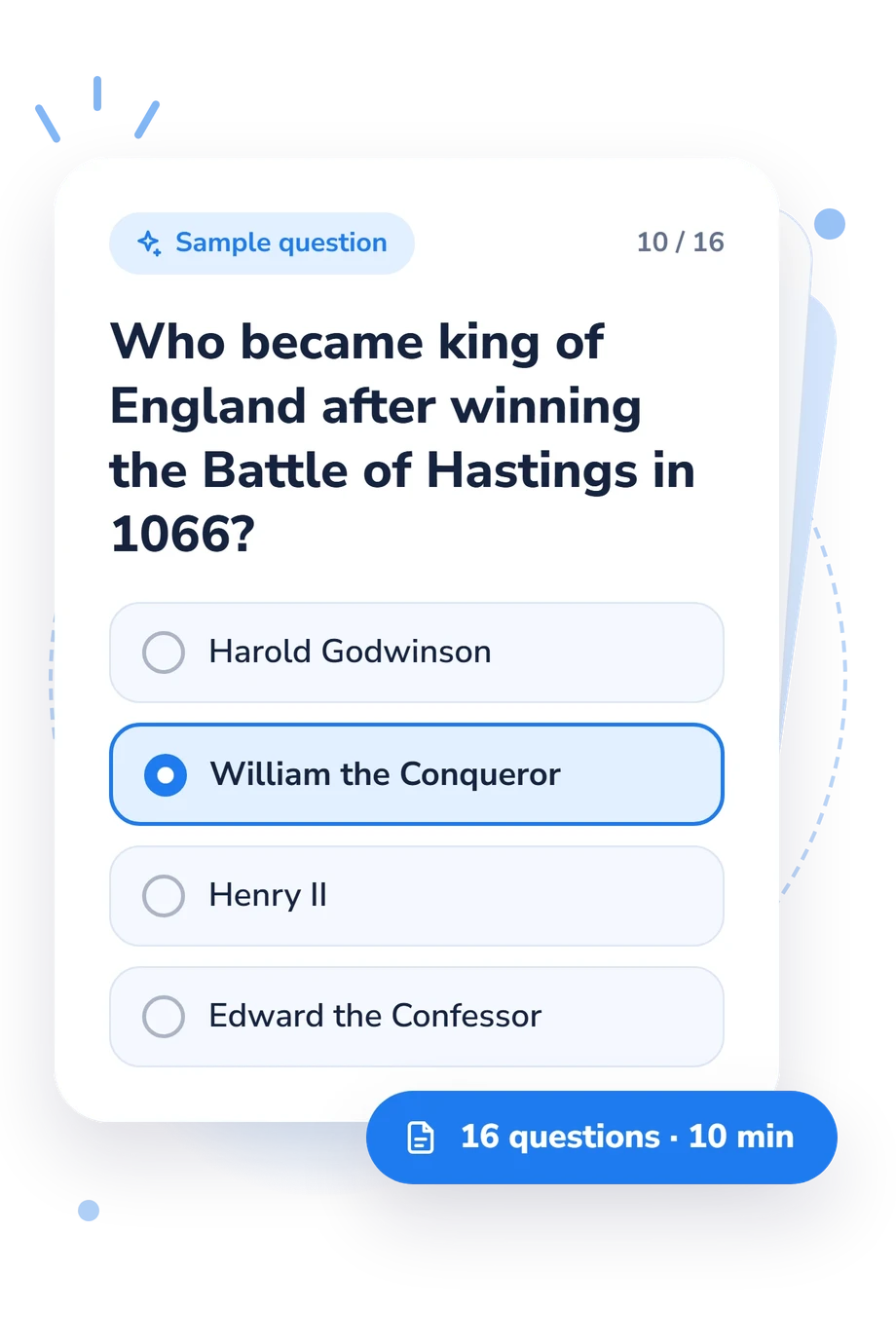
Example Questions From the Test
- King George IV
- Queen Anne
- Queen Elizabeth II
- Queen Victoria
- The monarch gained the right to suspend any law permanently
- The House of Commons was replaced by an elected presidency
- Parliament’s authority was strengthened relative to the Crown
- England returned to rule by an absolute Catholic monarchy
- It enfranchised only property-owning men over 30
- It gave all adults equal voting rights from age 18
- It enfranchised most adult men and some women aged 30 or over
- It removed the parliamentary vote from military personnel
British History Quiz - Description and methodology of the test
Readers who want a structured way to revisit Britain’s past can use this british history quiz to check how securely they connect events, people, institutions, and consequences. It suits learners, curious adults, and anyone preparing for further study who wants a concise snapshot of historical knowledge rather than a personality profile. As a British history test, it covers the British institutions, periods, and regions represented in the questions.
What This Assessment Explores
This quiz on UK history spans Roman Britain, the Norman Conquest, industrialization, reform, empire, and the twentieth century. Items test identification, chronology, significance, or explanation of historical situations, so the result reflects connected understanding as well as recall.
British History Knowledge is scored from 0-16. Foundations to build (0-6) means some major names or events are recognized, but periods and cause-and-effect links merit review. Developing knowledge (7-12) indicates a useful grasp with gaps in chronology, consequences, or reforms. Strong command (13-16) indicates accurate connections among events, figures, and developments across periods.
The quiz questions on British history cover these thematic groups:
- Political change shows how authority and representation shifted.
- Conflict and sovereignty show how wars and religious disputes reshaped power.
- Social and economic change shows how industry, population, and public services affected life.
- Wider connections show how empire and international events influenced Britain.
Methodology and Evidence Base
Each item presents a prompt with four answer choices. Respondents select the option that best fits the context, consequence, document, person, or development. This format makes the result easy to read but gives limited visibility into reasoning.
In this format, items can test more than names when they require causal explanation or constitutional significance. Prompts move among political institutions, social change, warfare, religion, empire, and international events. Within this UK history quiz, questions require respondents to distinguish an immediate effect from a long-term consequence. The result reflects recognition and comparison, not every step of reasoning.
The content is consistent with the chronology and themes in Morgan’s edited history of Britain. Wineburg’s historical-thinking framework treats historical understanding as contextual reasoning, while the history-assessment validity study by Smith, Breakstone, and Wineburg shows that validity depends on item demands. This questionnaire is conceptually consistent with those works, not an adaptation of them.
This online assessment produces a snapshot rather than a norm-referenced or questionnaire-specific psychometric result; performance can vary with prior education, guessing, familiarity with names, and wording.
- Morgan, Kenneth O., ed. The Oxford History of Britain. Revised ed. Oxford University Press, 2021. ISBN 9780198841111.
- Smith, Mark, Joel Breakstone, and Sam Wineburg. History Assessments of Thinking: A Validity Study. Cognition and Instruction 37, no. 1 (2019): 118-144. 10.1080/07370008.2018.1499646.
- Wineburg, Sam. Historical Thinking and Other Unnatural Acts: Charting the Future of Teaching the Past. Philadelphia: Temple University Press, 2001. ISBN 9781566398565.
Updated: