
Acne Quiz
How the Scales are Structured
Who Usually Takes This Test?
See How You Compare
Below is a preview of how scores are typically distributed across each scale.
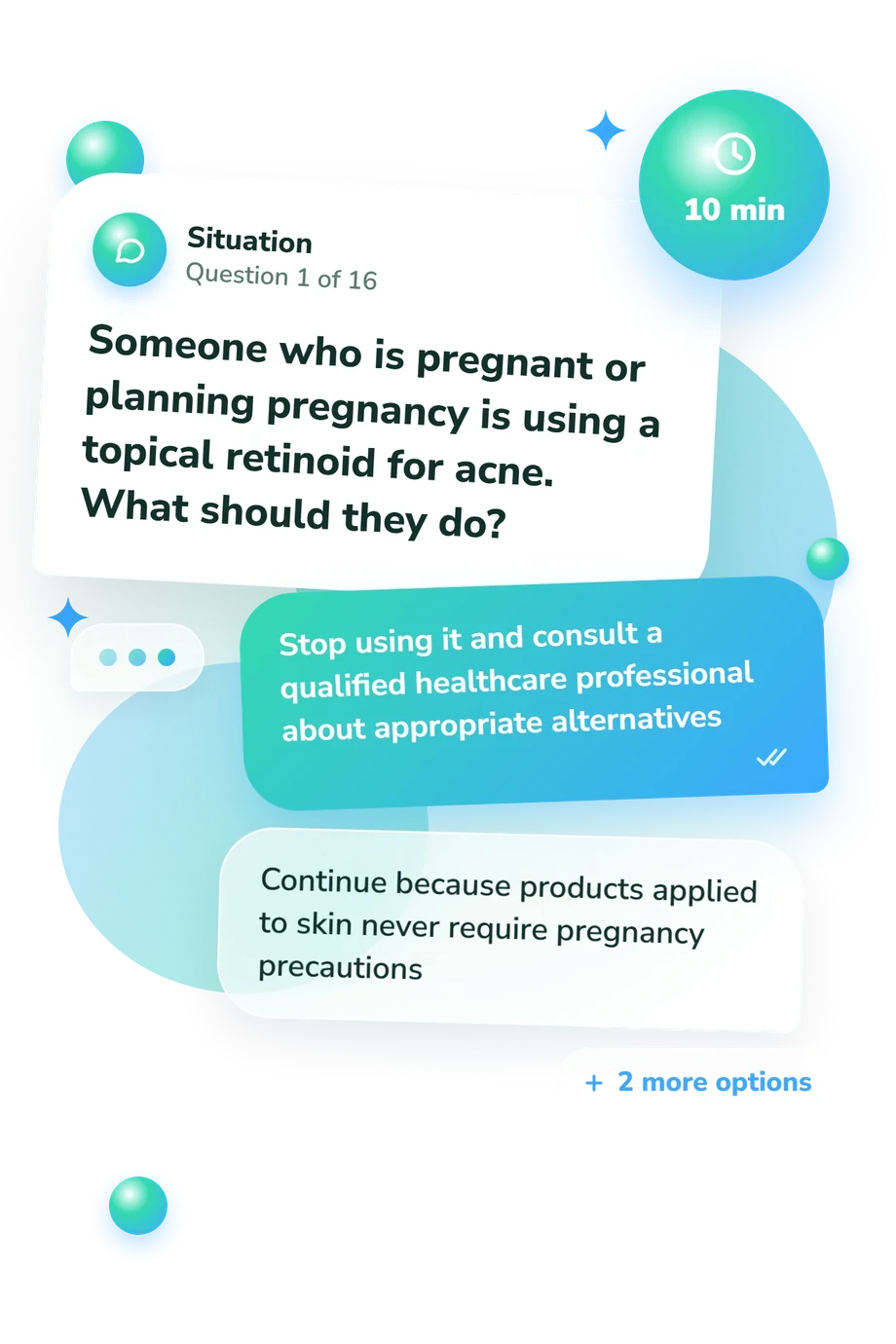
Example Questions From the Test
- Material in the open pore reacts with air and darkens
- Dirt becomes permanently trapped deep in the pore
- The follicle develops a bruise beneath the surface
- Melanin-producing cells collect only inside clogged pores
- A closed comedone
- A nodule
- A small superficial papule
- An open comedone
- A flat area of discoloration left after a blemish heals
- A deep, firm lump without visible surface inflammation
- An inflamed bump containing visible pus
- An open clogged pore with a dark surface
Acne Quiz - Description and methodology of the test
People who are unsure how confidently they can judge acne-related information can use this acne quiz to decide whether they need to revisit basic concepts before making skincare or treatment choices. It suits self-reflection for anyone navigating acne-related decisions, whether for themselves or someone they support. It can also serve as an acne treatment quiz, helping organize questions before discussing care with a qualified professional.
What This Assessment Explores
The assessment asks whether respondents can distinguish comedones, papules, pustules, and deeper nodules, and connect them with blocked follicles, inflammation, irritation, and scarring risk. Together, these questions form an acne knowledge assessment rather than a tool for classifying the respondent's own acne type.
The content falls into three themes covered by the questions:
- Lesion recognition covers common acne forms and what their features indicate.
- Skin-care choices cover cleansing, moisturizing, sun protection, picking, and irritation.
- Treatment judgment covers safe use, realistic timelines, pregnancy precautions, and situations needing professional attention.
The result reflects knowledge of acne, skincare, and treatment decisions across these themes, rather than identifying a personal acne type. Acne Knowledge: 0-16 uses Foundations to build (0-6), Developing knowledge (7-12), and Strong knowledge (13-16) to indicate understanding of the material.
Methodology and Scientific Basis
Methodologically, it is a structured multiple-choice acne knowledge questionnaire. Each item presents a scenario or factual question with four answer choices. The respondent selects the accurate option, and the score is reported as an educational total; its bands describe learning needs, not lesion severity.
The questions connect lesion vocabulary with product choices, treatment timing, irritation, and referral, so the educational result reflects knowledge areas rather than a personal acne classification.
The questionnaire is conceptually consistent with the acne-education study by Koch et al. (2008), which examined acne knowledge and beliefs, but this online version is not presented as its adaptation. Rasmussen and Smith add context on misconceptions, Tan, Vasey, and Fung on patient beliefs, and Reynolds and colleagues’ 2024 guideline supports treatment-safety content.
Those sources do not establish standardised norms, reliability, or validity for this online questionnaire. Responses can be affected by attention, prior information, and how a respondent interprets its scenarios. The result indicates educational strengths and review topics; painful, persistent, scarring, or suddenly severe acne and medication questions require broader assessment.
- Koch PE, Ryder HF, Dziura J, Njike V, Antaya RJ. Educating Adolescents About Acne Vulgaris: A Comparison of Written Handouts With Audiovisual Computerized Presentations. Archives of Dermatology. 2008;144(2):208-214. 10.1001/archdermatol.2007.35
- Rasmussen JE, Smith SB. Patient Concepts and Misconceptions About Acne. Archives of Dermatology. 1983;119(7):570-572. 10.1001/archderm.1983.01650310032006
- Tan JKL, Vasey K, Fung KY. Beliefs and Perceptions of Patients With Acne. Journal of the American Academy of Dermatology. 2001;44(3):439-445. 10.1067/mjd.2001.111340
- Reynolds RV, Yeung H, Cheng CE, Cook-Bolden F, Desai SR, Druby KM, et al. Guidelines of Care for the Management of Acne Vulgaris. Journal of the American Academy of Dermatology. 2024;90(5):1006.e1-1006.e30. 10.1016/j.jaad.2023.12.017
Updated: