
Why Am I Single Quiz
How the Scales are Structured
Who Usually Takes This Test?
See How You Compare
Below is a preview of how scores are typically distributed across each scale.
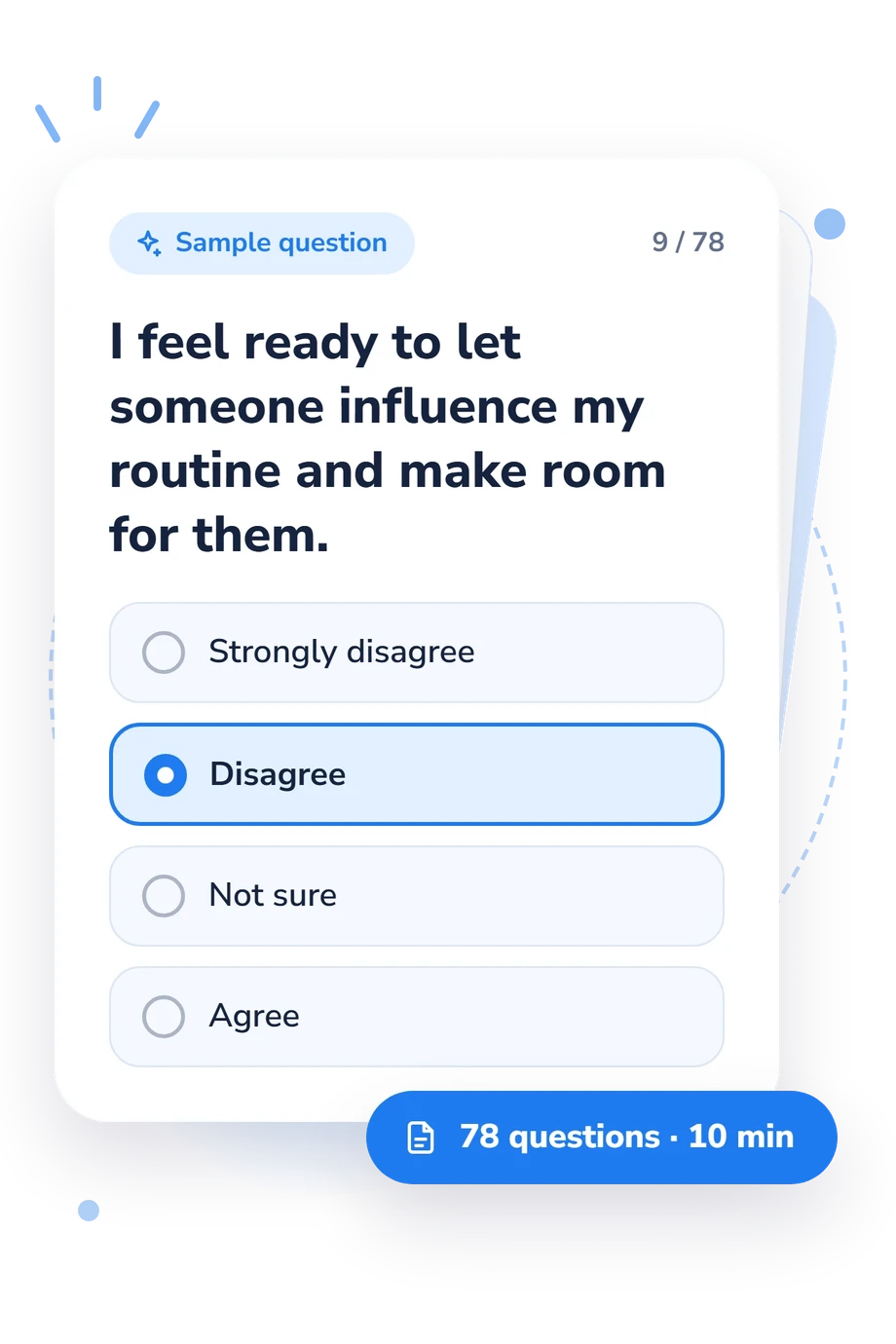
Example Questions From the Test
- Strongly disagree
- Disagree
- Agree
- Strongly agree
- Strongly disagree
- Disagree
- Not sure
- Agree
- Strongly disagree
- Disagree
- Agree
- Strongly agree
Why Am I Single Quiz - Description and methodology of the test
People who want to understand recurring barriers in their dating life can use this questionnaire as a structured dating self-reflection quiz. The Why Am I Single Quiz focuses on patterns that may affect connection, readiness, and access rather than treating relationship status as evidence of a personal flaw. It suits anyone seeking a practical assessment of the patterns that may be keeping them single and a clearer starting point for intentional change.
What This Assessment Explores
Using the why am i still single quiz, someone can examine three areas. Items cover listening, vulnerability, boundaries, conflict repair, recovery, availability, exposure, and follow-through. Results indicate skills to practise, readiness, or opportunities.
Displayed dimensions are:
- Connection Skills (0-30) measures communication, vulnerability, conflict comfort, and consistency. Needs Support 0-14; Developing 15-22; Strong 23-30. Higher scores show stronger connection skills; lower scores suggest friction points.
- Dating Readiness (0-30) measures emotional and practical room for dating. Low readiness 0-10; Moderate readiness 11-20; High readiness 21-30. Higher scores suggest readiness and openness; lower scores may signal a season for rest, recovery, or clarifying intentions.
- Opportunity & Access (0-30) measures exposure to compatible people, settings, availability, and follow-through. Limited access 0-10; Some access 11-20; High access 21-30. Higher scores show exposure and follow-through; lower scores indicate limited opportunities, low visibility, or practical barriers.
Methodology and Evidence Base
Brief self-report statements use an agreement scale, usually from Strongly disagree to Strongly agree, with Not sure available for some. Concrete situations-handling disagreement, expressing needs, making time, choosing social settings, and following conversations through to dates-make the result about perceived habits and circumstances rather than observed behavior.
Responses combine into displayed scores and bands, but ranges do not reveal each answer's point value; exact weighting should not be inferred. Read the profile as a dating patterns quiz highlighting friction points, resources, or practical barriers. The questionnaire has no stated standardization or norms, so scores are best read as an individual reflection profile rather than population-based measurements.
The themes are conceptually consistent with the Mate Access Scale (Walldén et al., 2020) for access and exposure, commitment-readiness research by Hadden, Agnew, and Tan (2018), and romantic-competence work by Faber et al. (2019). These sources are comparison points, not evidence that the online questionnaire adapts those measures. Self-awareness, honesty, current context, and response bias can affect results, so use them for focused reflection rather than to explain relationship status completely.
- Walldén, C., Westerlund, M., Gunst, A., Santtila, P., & Antfolk, J. (2020). Finding the Mating Gear: The Development and Validation of a Mate Access Scale. Evolutionary Psychology, 18(3), 1-9. 10.1177/1474704920935583
- Hadden, B. W., Agnew, C. R., & Tan, K. (2018). Commitment Readiness and Relationship Formation. Personality and Social Psychology Bulletin, 44(8), 1242-1257. 10.1177/0146167218764668
- Faber, A. J., Chin, E. G., Wilburn, V. R., & Shafaie, S. M. (2019). Measuring romantic competence in young adults: The Inventory of Romantic Relationship Competence. Interpersona: An International Journal on Personal Relationships, 13(1), 72-95. 10.5964/ijpr.v13i1.341
Updated: