
D&D Character Quiz
How the Scales are Structured
Who Usually Takes This Test?
See How You Compare
Below is a preview of how scores are typically distributed across each scale.
Example Questions From the Test
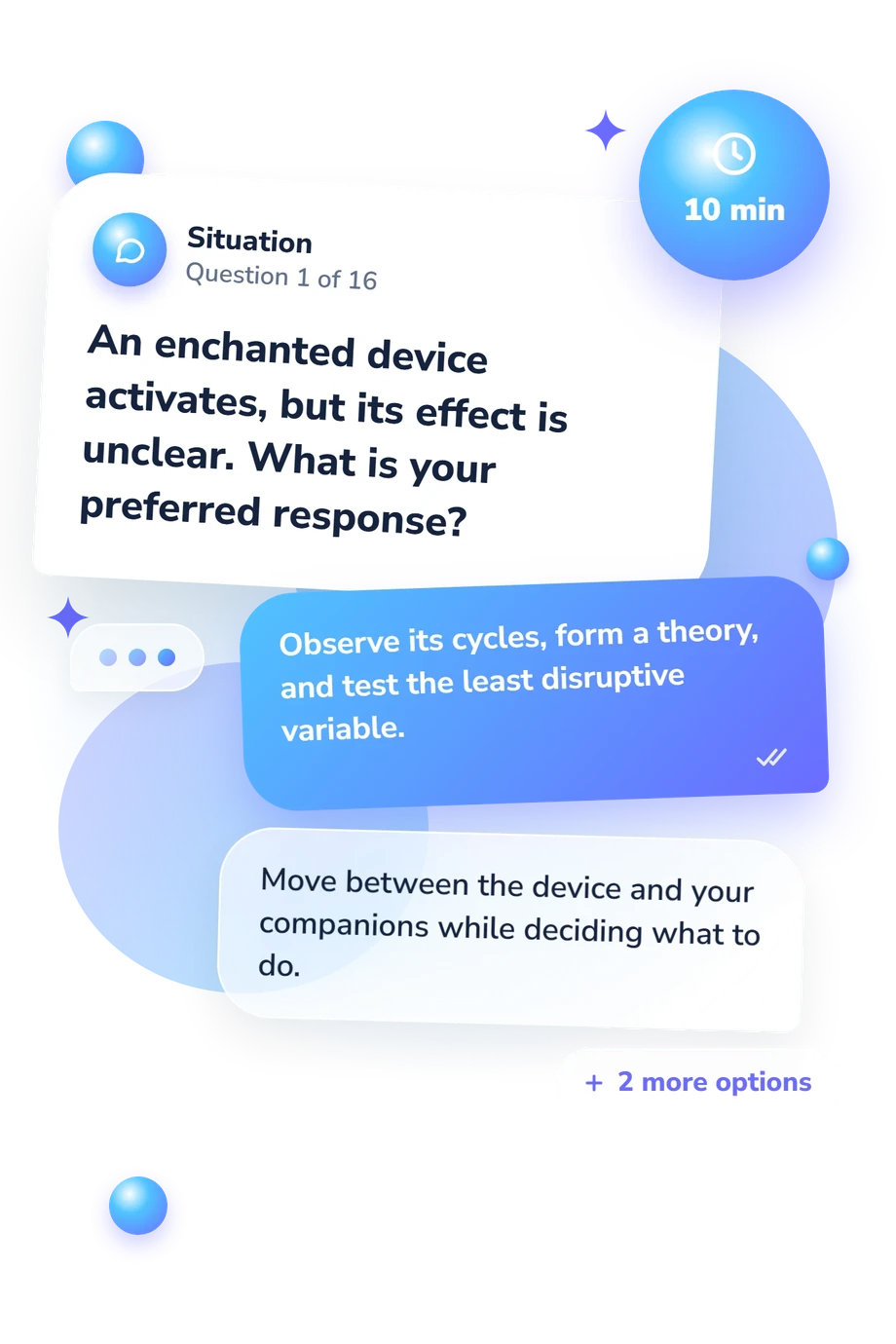
- Observe its cycles, form a theory, and test the least disruptive variable.
- Move between the device and your companions while deciding what to do.
- Look for whoever might have activated it and quietly study their behavior.
- Check how each companion is affected and coordinate a measured retreat if needed.
- Whether helping would strengthen mutual trust and keep people from being stranded.
- Whether the detour contains information or artifacts unavailable elsewhere.
- Whether a clever arrangement could secure part of the reward while assisting briefly.
- Whether the party can make a clear decision and complete one goal decisively.
- Practice a flexible cover story in case someone else reaches the ruins first.
- Assign clear responsibilities so the expedition can move with confidence.
- Consult old accounts, compare translations, and note recurring symbols.
- Discuss everyone’s concerns and prepare supplies for comfort as well as danger.
D&D Character Quiz - Description and methodology of the test
Players who want a personal character concept can use the D&D Character Quiz to explore which party role suits their decisions. It suits tabletop fans and groups comparing how each person handles pressure, discovery, or shared goals as a dnd character personality quiz. By examining party choices, it keeps the result tied to play style rather than fixed identity and offers a starting point for reflection.
What This Assessment Explores
Items place you in party situations involving mystery, danger, conflict, and setbacks. Responses describe play tendencies, not ability or permanent identity. Its dnd character creator quiz format links preferences to a party role. Its displayed scales are:
- Orin the Arcane Seeker (0-12) measures patterns, hidden knowledge, preparation, and meaning behind strange events: Practical Contrast (0-4), Curious Investigator (5-8), Strong Orin Affinity (9-12).
- Rook the Bold Vanguard (0-12) measures visible leadership, decisions under pressure, and direct action in danger: Quiet Contrast (0-4), Situational Vanguard (5-8), Strong Rook Affinity (9-12).
- Sana the Steadfast Warden (0-12) measures trust, protection, group cohesion, and success by what the party preserves together: Independent Path (0-4), Reliable Companion (5-8), Strong Sana Affinity (9-12).
- Vesper the Cunning Shadow (0-12) measures observation, independence, timing, and unconventional solutions: Open Approach (0-4), Selective Subtlety (5-8), Strong Vesper Affinity (9-12).
Methodology and Scientific Basis
Each prompt presents a fantasy situation with four response choices. The alternatives emphasize investigation, visible leadership, group protection, or indirect problem-solving, asking for a preferred approach rather than a permanent habit. This format makes the result a contextual reflection, not a fixed label.
The four displayed affinity scores are compared directly: the highest is the strongest affinity, and scores within one point form a blended match. In reflection, my dnd character quiz result shows which character best fits your preferred role rather than creating a fixed label.
Conceptually, the design is consistent with Park and Henley’s study, which links personality with fantasy character preferences; this questionnaire is not their adaptation or replication. Waskul and Lust’s work contributes a person-player-persona perspective, while the fifth-edition D&D rules supply role-playing context.
The outcome is a descriptive affinity profile; its bands are not population norms or clinical cutoffs. Mood, role-playing familiarity, and self-perception can influence answers; ask what is my dnd character quiz showing me, then use the outcome for role ideas and party discussion.
- Park, Anna E., and Tracy B. Henley. "Personality and Fantasy Game Character Preferences." Imagination, Cognition and Personality, vol. 27, no. 1, 2007, pp. 37-46. 10.2190/IC.27.1.d
- Waskul, Dennis, and Matt Lust. "Role-Playing and Playing Roles: The Person, Player, and Persona in Fantasy Role-Playing." Symbolic Interaction, vol. 27, no. 3, 2004, pp. 333-356. 10.1525/si.2004.27.3.333
- Mearls, Mike, Jeremy Crawford, Rodney Thompson, Peter Lee, James Wyatt, Robert J. Schwalb, and Bruce R. Cordell. Dungeons & Dragons Player's Handbook. 5th ed. Wizards of the Coast, 2014.
Updated: