
National Park Quiz
How the Scales are Structured
Who Usually Takes This Test?
See How You Compare
Below is a preview of how scores are typically distributed across each scale.
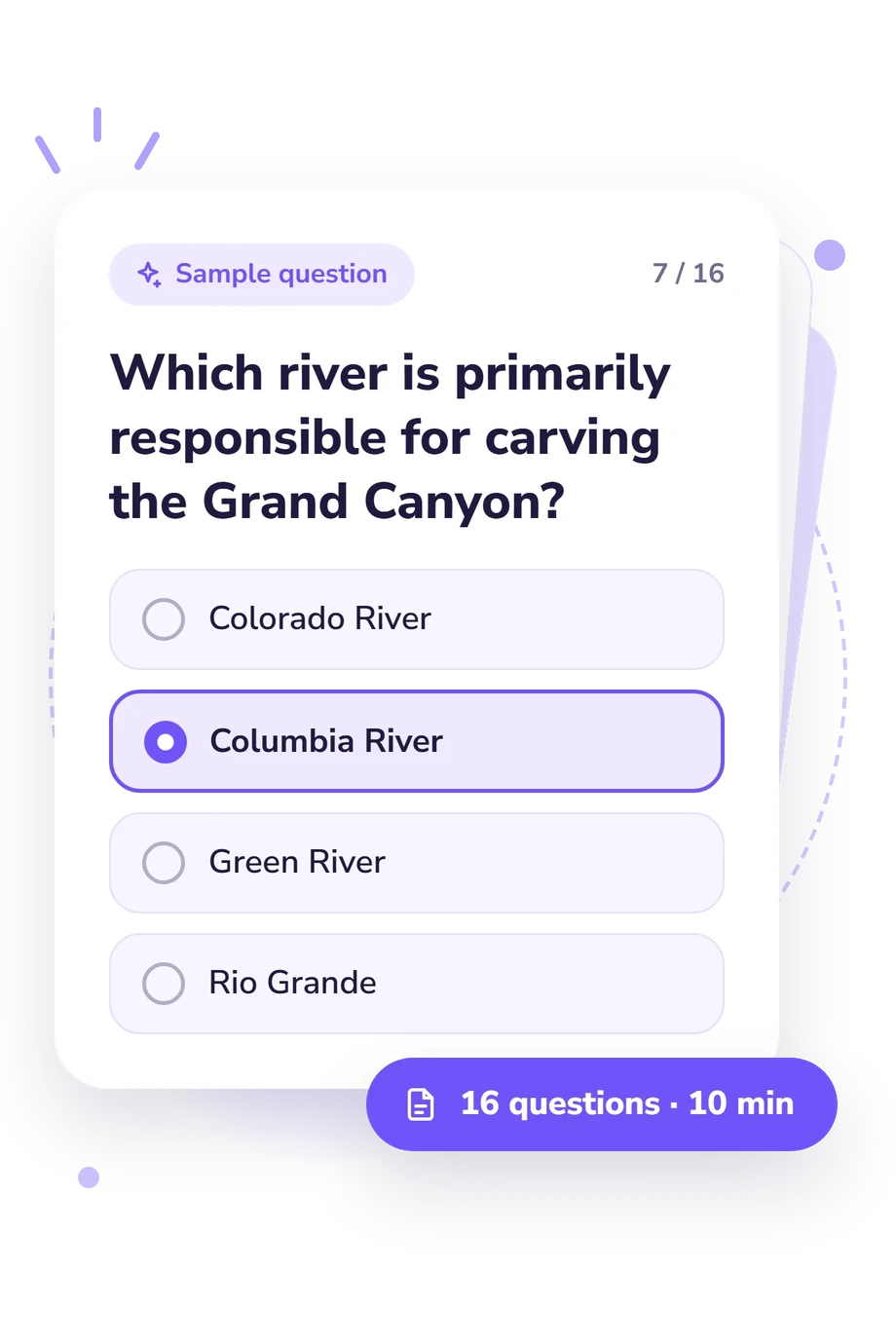
Example Questions From the Test
- New River Gorge National Park and Preserve
- Shenandoah National Park
- Cuyahoga Valley National Park
- Acadia National Park
- Hawaiʻi Volcanoes National Park
- Lassen Volcanic National Park
- Haleakalā National Park
- Crater Lake National Park
- Yellowstone National Park
- Yosemite National Park
- Sequoia National Park
- Mount Rainier National Park
National Park Quiz - Description and methodology of the test
For travelers and people curious about U.S. national parks, this national park quiz tests whether you can connect recognizable places with the geography, geology, ecology, and history that define them. This park quiz offers a quick way to check recall across U.S. regions and choose which landscapes to explore next.
What This Assessment Explores
The questions test recognition of parks through signature landmarks, ecosystems, geological processes, historical associations, state boundaries, and cultural features. Many prompts frame a traveler’s goal or describe a landscape, so identifying the answer depends on connecting clues rather than recalling a name in isolation.
The result turns national park trivia into a learning prompt: missed answers highlight regions or subjects to revisit, while a strong result reflects wide familiarity.
The displayed National Park Knowledge scale runs from 0-16 and is divided into these bands:
- Trailhead (0-6) indicates basic recognition with some mix-ups among places and processes.
- Park Explorer (7-12) reflects working knowledge across regions, with gaps in less familiar landscapes or history.
- Seasoned Explorer (13-16) shows consistent links among geography, ecology, geology, and cultural features.
Methodology and Scientific Basis
Each item presents a short clue followed by four answer choices. The format tests recognition and association: you select the park, feature, state pair, river, or geological explanation that best fits. The displayed score awards one point for each correct answer, creating a raw knowledge total rather than a weighted profile.
Conceptually, the questionnaire is consistent with the National Park Achievement Test, a published model for assessing national-park knowledge. It is not presented as an adaptation or validation of that instrument. Research on how people perceive protected landscapes and understand wilderness adds context, but it does not establish norms for this online version.
For interpretation, this national park knowledge test is best read as breadth of correct recall, not travel experience, environmental values, or general intelligence. Scores may reflect prior visits, regional familiarity, classroom learning, attention, or guessing. This online questionnaire is not a standardized or norm-referenced instrument, so its bands should be read as descriptive knowledge levels; reviewed answers can guide further reading.
- Yakar, Hamza; Öztürk Demirbaş, Çağrı; Dikmenli, Yurdal. (2021). Preservice Teachers' Perception and Knowledge Levels Towards National Parks: A Relative Study. International Journal of New Approaches in Social Studies, 5(1), 135-151. 10.38015/sbyy.903158
- Kostrakiewicz-Gierałt, Kinga; Gmyrek, Katarzyna; Jodłowski, Miłosz; Różycki, Paweł. (2026). Perceptions of Mountain National Parks by Tourists, Guides, and Park Employees: A Preliminary Study. Sustainability, 18(16), 8444. 10.3390/su18168444
- Hockett, Karen S.; Hall, Troy E. (2000). Visitors' Knowledge of Federal Wilderness: Implications for Wilderness User Research and Management. In Wilderness Science in a Time of Change Conference-Volume 4: Wilderness Visitors, Experiences, and Visitor Management, Proceedings RMRS-P-15-VOL-4, 122-127. U.S. Department of Agriculture, Forest Service, Rocky Mountain Research Station.
Updated: