
BoJack Character Quiz
How the Scales are Structured
Who Usually Takes This Test?
See How You Compare
Below is a preview of how scores are typically distributed across each scale.
Example Questions From the Test
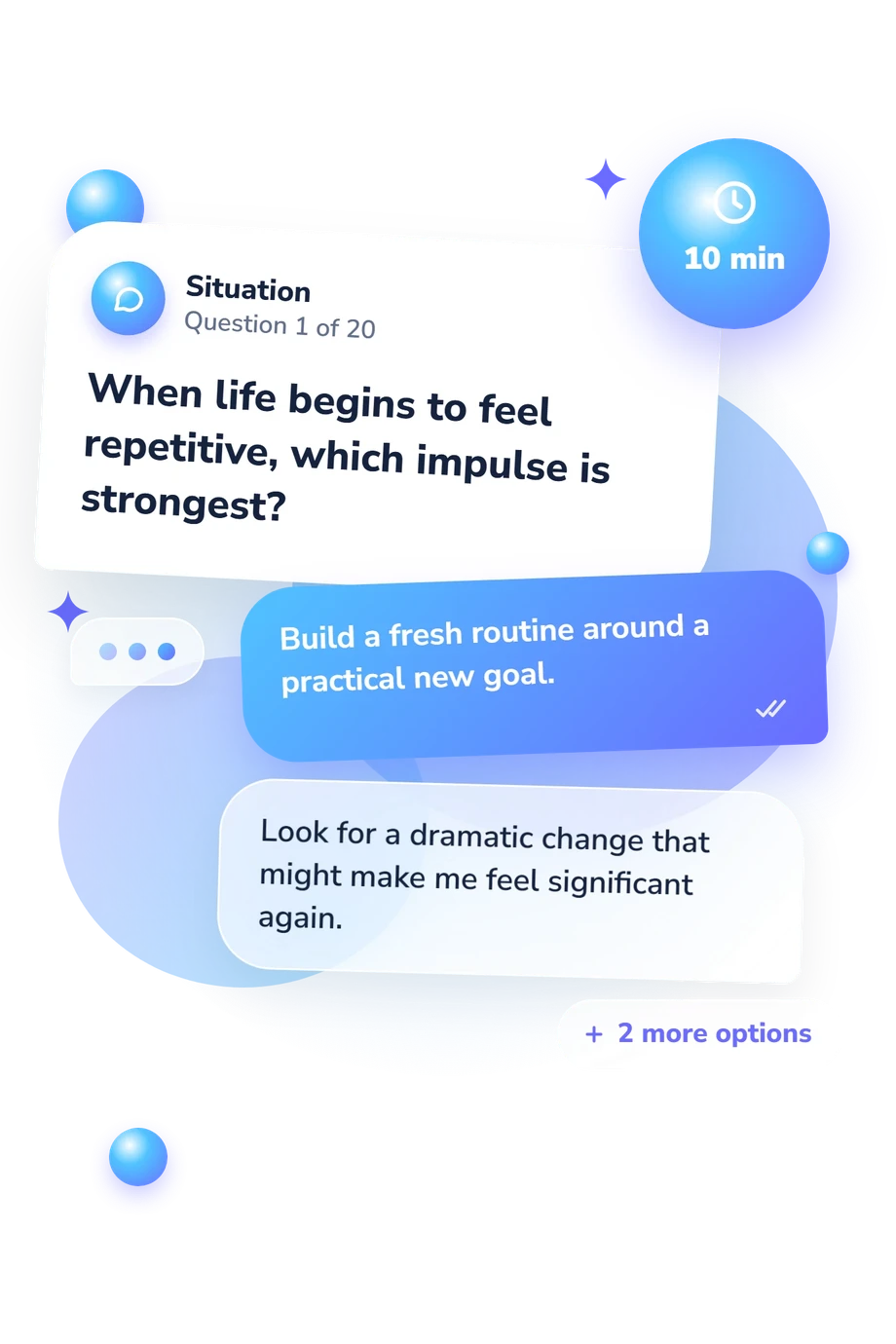
- Build a fresh routine around a practical new goal.
- Look for a dramatic change that might make me feel significant again.
- Question the larger story I have been telling myself about my life.
- Follow a curious idea without needing it to become important.
- I protect the evening and do something genuinely restorative.
- I use part of it to prepare for tomorrow so nothing slips.
- I check one or two loose ends, then switch off.
- I follow whichever spontaneous invitation appears first.
- Turn it into writing so I can understand what it means.
- Stay busy until the emotional charge fades enough to revisit it.
- Tell the story to friends and let their reactions reshape it.
- Change my surroundings and see what happens next.
BoJack Character Quiz - Description and methodology of the test
For viewers who enjoy using fictional characters as mirrors, the BoJack Character Quiz offers a playful way to compare everyday motives, social instincts, and responses to discomfort with personalities from the series. The Which BoJack Horseman Character Are You Quiz question can show whether your strongest resemblance leans toward reflection, optimism, ambition, guarded vulnerability, or improvisation in situations involving recognition, regret, self-awareness, skepticism, and difficulty sitting with painful feelings.
What This Assessment Explores
Prompts cover ambition, recognition, repair, social energy, and structure versus improvisation. The profile treats these as character affinities.
These dimensions make the profile a character-affinity quiz for BoJack Horseman fans:
- BoJack Horseman Affinity (0-12) reflects self-questioning and guarded vulnerability: Different wavelength (0-4), Some BoJack echoes (5-8), Strong BoJack affinity (9-12).
- Diane Nguyen Affinity (0-12) reflects analysis and meaning-making: Different wavelength (0-4), Some Diane echoes (5-8), Strong affinity (9-12).
- Mr. Peanutbutter Affinity (0-12) reflects optimism and sociability: Different wavelength (0-4), Some Mr. Peanutbutter echoes (5-8), Strong Mr. Peanutbutter affinity (9-12).
- Princess Carolyn Affinity (0-12) reflects resourcefulness and ambition: Different wavelength (0-4), Some Princess Carolyn echoes (5-8), Strong Princess Carolyn affinity (9-12).
- Todd Chavez Affinity (0-12) reflects openness and improvisation: Different wavelength (0-4), Some Todd echoes (5-8), Strong Todd affinity (9-12).
Methodology and Evidence Base
Each item is a situational self-report prompt with four response choices. You select the option closest to your usual impulse, so the format asks about recognizable decisions rather than plot recall or factual knowledge. That structure makes this BoJack Horseman character quiz a way to compare perceived resemblance through ordinary dilemmas.
Methodologically, research by Huang and Fung (2024) on identification with narrative characters, alongside Cohen (2001) plus van Krieken, Hoeken, and Sanders (2017) on perspective, emotion, and engagement, provides conceptual background only; it does not validate this questionnaire or its scoring.
After completion, the highest score indicates your strongest character affinity. Scores within one point of it form a blended result, allowing overlap rather than forcing a single label. The result bands are descriptive labels for this online character-affinity profile, and the cited studies do not standardize its scoring; the online scoring has no published validation.
Because self-report shifts with current mood, self-awareness, and presentation style, read the profile as a snapshot of fictional resemblance that may prompt reflection but cannot establish emotional health, maturity, or a mental-health condition.
- Huang, K. Y., & Fung, H. H. (2024). Measuring identification with narrative characters: the development and validation of a new scale. Current Psychology, 43, 24835-24849. 10.1007/s12144-024-06191-2
- Cohen, J. (2001). Defining Identification: A Theoretical Look at the Identification of Audiences With Media Characters. Mass Communication and Society, 4(3), 245-264. 10.1207/S15327825MCS0403_01
- van Krieken, K., Hoeken, H., & Sanders, J. (2017). Evoking and Measuring Identification with Narrative Characters - A Linguistic Cues Framework. Frontiers in Psychology, 8, 1190. 10.3389/fpsyg.2017.01190
Updated: