
Hamlet Act 1 Quiz
How the Scales are Structured
Who Usually Takes This Test?
See How You Compare
Below is a preview of how scores are typically distributed across each scale.
Example Questions From the Test
- He will imitate the ghost to frighten Claudius
- He will challenge Fortinbras to single combat
- He intends to perform comic plays at court
- He may pretend to behave irrationally or madly
- He believes ghosts can appear only inside churches
- He suspects the guards are supporting Fortinbras
- He already knows the figure is Claudius in disguise
- He is skeptical and wants evidence before believing them
- As potentially deceptive promises meant to win her affection
- As a diplomatic plan to unite Denmark and France
- As evidence that Hamlet intends to renounce the throne
- As proof that Hamlet has secretly married Ophelia
Hamlet Act 1 Quiz - Description and methodology of the test
For students, teachers, and general readers who want to check their grasp of Shakespeare’s opening act, the Hamlet Act 1 Quiz offers a focused recall and interpretation exercise. It suits revision after reading the scene sequence or a quick self-check before discussion. Its Hamlet Act One Quiz format highlights whether plot knowledge, character relationships, language, or dramatic tension deserves closer attention.
What This Quiz Measures
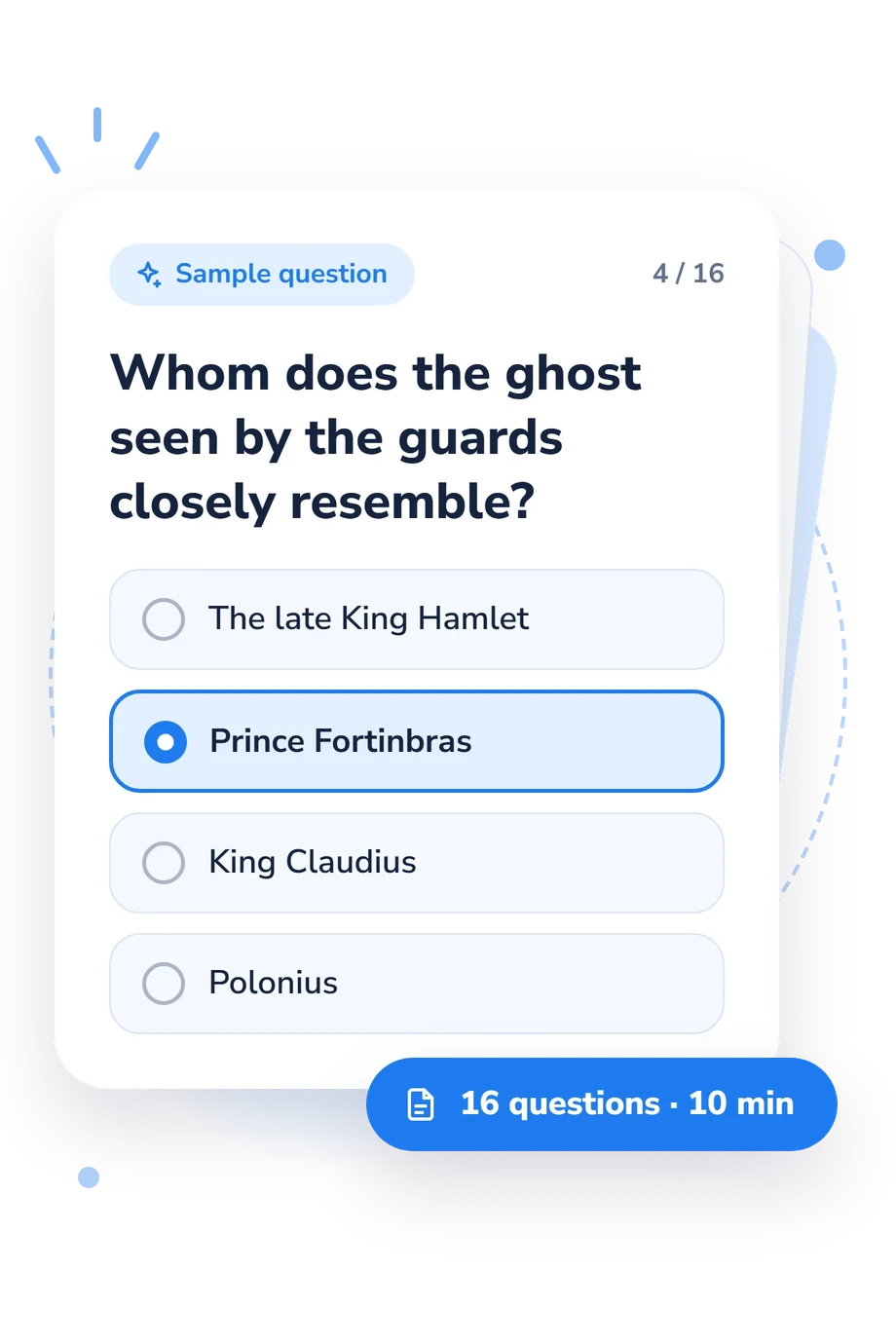
The questionnaire checks understanding of events, motives, relationships, political pressures, important lines, and tensions beneath courtly language. Prompts range from concrete recall-such as the guards’ location and the Ghost’s resemblance-to interpretation of speeches, family conflict, and ominous imagery.
Checking answers for the Act 1 Hamlet quiz against the play can reveal whether uncertainty concerns sequence, character motive, Shakespearean language, or the act’s pattern of suspicion and disorder.
The result uses one scale, Hamlet Act 1 Knowledge (0-16), measuring overall command of plot, characters, language, and dramatic tensions. Its bands are:
- Foundation (0-6) indicates that central elements are recognized but key sequence, relationships, or speeches may need review.
- Developing (7-12) indicates a sound grasp with room to strengthen close reading and thematic interpretation.
- Strong (13-16) indicates detailed understanding across the act.
This profile supports revision and discussion preparation.
Methodology and Evidence Base
Each item presents a prompt with four answer choices. Responses are marked correct or incorrect, and the number correct determines the displayed score. The multiple-choice format of the Act 1 Hamlet quiz keeps attention on recognition and interpretation within a defined passage rather than broad knowledge of Shakespeare.
This is a text-based knowledge check, not a standardized psychological or educational instrument. Its reference point is Hamlet Act 1 (Shakespeare), read alongside Thompson and Taylor (2016). Mowat and Werstine (2012), along with Edwards (1985), help anchor scene details.
Miriam Joseph’s 1961 study adds context for the Ghost and Hamlet’s uncertainty. The questionnaire is conceptually consistent with these works, not an adaptation of a published test. Read the score as feedback about present command of the act, not a norm-referenced measure.
Performance may vary with prior exposure, edition, memory, and familiarity with Shakespearean language. A lower band identifies material to revisit; a higher band suggests stronger recall, but neither captures every defensible reading of a scene.
- Shakespeare, William. Hamlet: Revised Edition. Edited by Ann Thompson and Neil Taylor. The Arden Shakespeare Third Series. Bloomsbury Publishing, 2016. ISBN 9781472518385.
- Shakespeare, William. Hamlet. Edited by Barbara A. Mowat and Paul Werstine. Simon & Schuster, 2012. ISBN 9781451669411.
- Shakespeare, William. Hamlet, Prince of Denmark. Edited by Philip Edwards. The New Cambridge Shakespeare. Cambridge University Press, 1985. ISBN 9780521293662.
- Joseph, Miriam, C.S.C. “Discerning the Ghost in Hamlet.” PMLA, vol. 76, no. 5, 1961, pp. 493-502. 10.2307/460542.
Updated: