
Emoji Movie Quiz
How the Scales are Structured
Who Usually Takes This Test?
See How You Compare
Below is a preview of how scores are typically distributed across each scale.
Example Questions From the Test
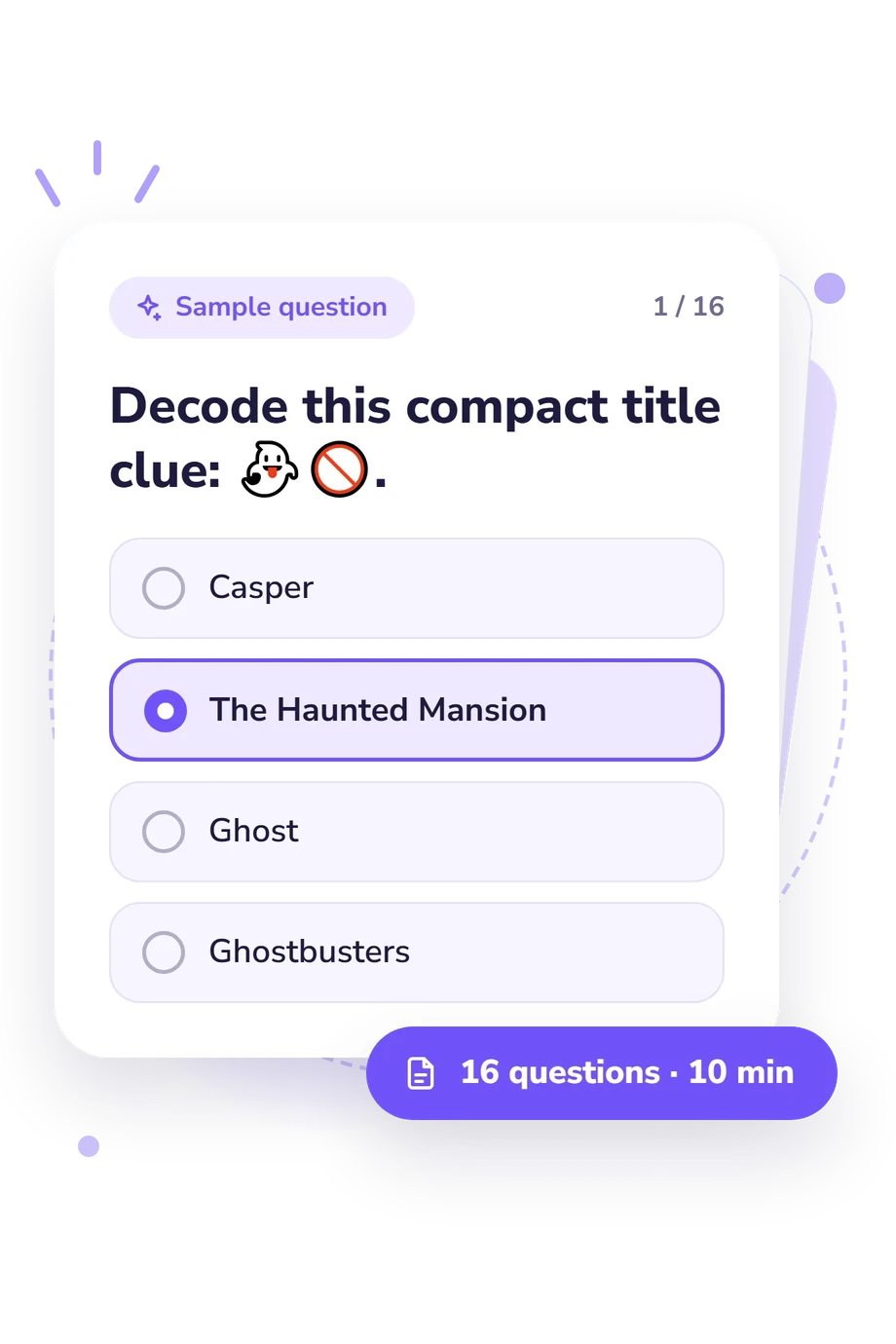
- Casper
- The Haunted Mansion
- Ghost
- Ghostbusters
- Cloudy with a Chance of Meatballs
- Ratatouille
- The Princess and the Frog
- The Secret Life of Pets
- The Perfect Storm
- The Poseidon Adventure
- Frozen
- Titanic
Emoji Movie Quiz - Description and methodology of the test
Readers who enjoy cinema and visual wordplay can use this emoji movie quiz as a light, self-guided challenge for testing recognition of familiar films. This emoji film quiz asks readers to connect visual hints with titles, characters, and story moments without requiring a formal review of film history. The exercise offers a focused indication of performance on this particular set of clues.
What This Test Measures
These clues measure movie-title recognition and retrieval. Each item compresses a film into visual signs, asking you to identify the likely title from competing answers. The questions form a name-the-movie emoji quiz: each clue asks readers to connect familiar references with a film title.
The single scale is Emoji Movie Knowledge (0-16). Opening Credits (0-6) marks elusive layered clues; Feature Presentation (7-12) reflects decoding many familiar films and their characters, objects, or plots; Emoji Auteur (13-16) reflects impressive accuracy with multi-part clues. The bands describe this fan-made quiz, not complete film knowledge.
The main clue dimensions are:
- Titles are identified when symbols combine into a familiar name.
- Characters, objects, and settings are linked when visual details signal a film.
- Plot events are inferred when emojis suggest an action or turning point.
Methodology and Evidence Base
Each question presents a compact emoji sequence with four answer choices. You select the movie that best fits the combined clue, making this a forced-choice performance task rather than a self-report inventory. The score records correct identifications across the set; it does not estimate intelligence, creativity, or total film knowledge.
The emoji format is conceptually consistent with Pearlman’s Movie Emojis (2021), but this questionnaire is not an adaptation of that book. Cappallo and colleagues describe emoji challenges involving prediction, anticipation, and retrieval, while Miller and colleagues show that emoji meanings can vary between readers. Related emoji studies provide context about retrieval and interpretive variation, but they do not establish the psychometric quality of this quiz.
The final score is best read as a snapshot from a movie emoji trivia quiz, judged under these clues and choices. Film familiarity, cultural references, emoji conventions, and ambiguous symbols can affect performance. The bands describe performance on this quiz and should not be treated as population norms or a validated film-knowledge measure; they summarize success with the specific titles, symbols, and choices presented here.
- Pearlman, Robb. Movie Emojis: 100 Cinematic Q&As. Rizzoli Universe, 2021. ISBN 9780789339522.
- Cappallo, Spencer, Stacey Svetlichnaya, Pierre Garrigues, Thomas Mensink, and Cees G. M. Snoek. “New Modality: Emoji Challenges in Prediction, Anticipation, and Retrieval.” IEEE Transactions on Multimedia 21, no. 2 (2019): 402-415. DOI 10.1109/TMM.2018.2862363.
- Miller, Hannah, Jacob Thebault-Spieker, Shuo Chang, Isaac Johnson, Loren Terveen, and Brent Hecht. “Blissfully Happy” or “Ready to Fight”: Varying Interpretations of Emoji. Proceedings of the International AAAI Conference on Web and Social Media 10, no. 1 (2016): 259-268. DOI 10.1609/icwsm.v10i1.14757.
Updated: