
April Fools Quiz
How the Scales are Structured
Who Usually Takes This Test?
See How You Compare
Below is a preview of how scores are typically distributed across each scale.
Example Questions From the Test
- April Fools!
- The joke is over!
- Spring surprise!
- First of April!
- The arrival of spring
- The first of April
- The king of fools
- The final day of March
- The first Monday in April
- April 1
- March 31
- April 15
April Fools Quiz - Description and methodology of the test
People who want to connect cultural context with everyday judgment may find this assessment useful, especially when using this April Fools Day quiz for students in classroom discussion. The April Fools Quiz brings together practical decisions about whether a surprising claim deserves attention, whether a digital request is safe to follow, and whether a joke respects another person's boundaries. In classroom use, this quiz about April Fools for students can prompt discussion; for individuals, it offers a structured way to review those decisions.
What This Assessment Explores
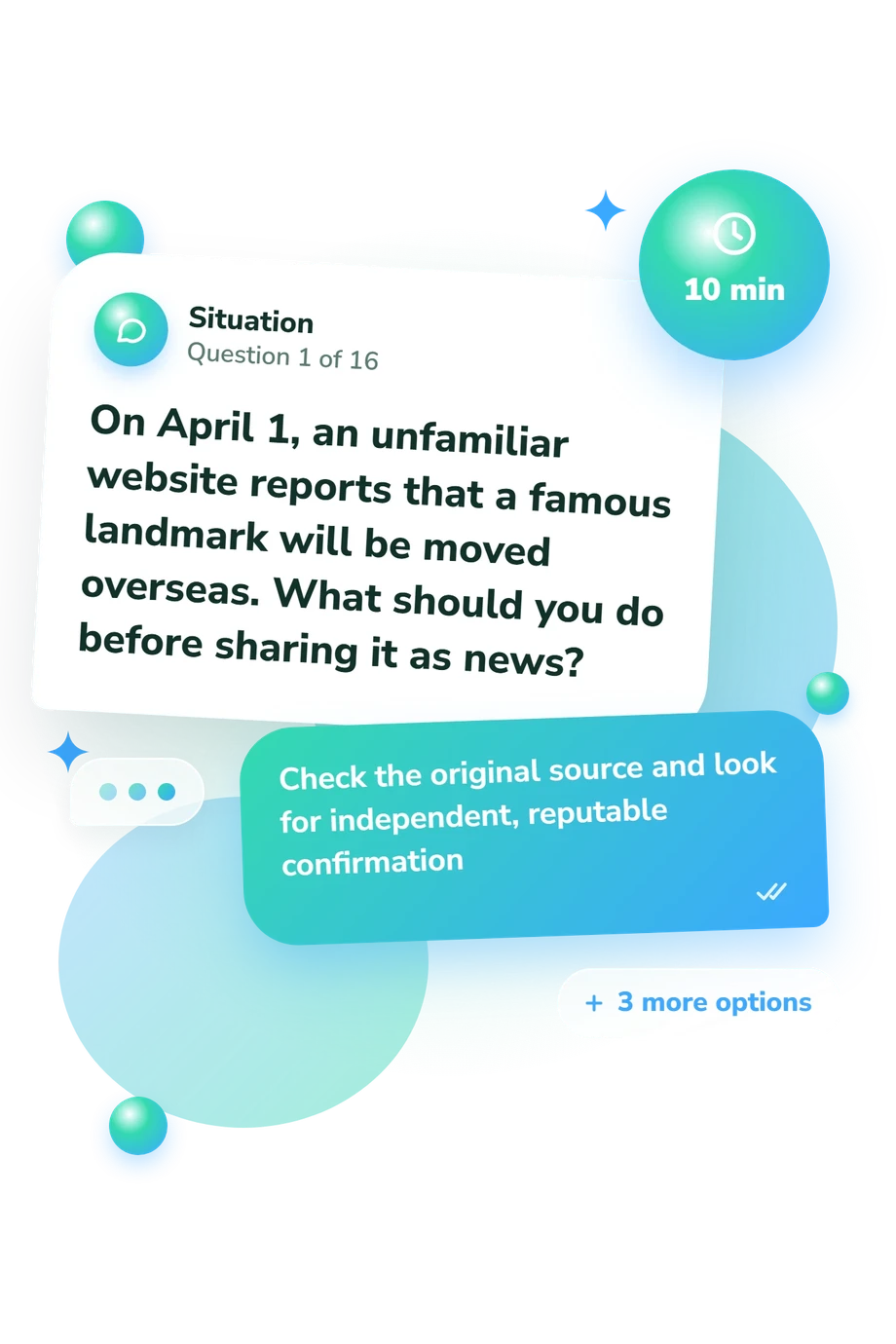
The questionnaire measures knowledge of April 1 traditions, cultural references, source checking, and responsible prank boundaries. It suits readers reviewing holiday lore while considering misleading claims, credential requests, emotional harm, and emergency scenarios. The result reflects knowledge and applied judgment on the topics represented by the items.
The displayed scale is April Fools' Knowledge (0-16), with these levels:
- Getting Oriented (0-6) indicates basic recognition with room to learn about traditions, verification, and prank boundaries.
- Developing Know-How (7-12) reflects solid knowledge with some cultural or practical gaps.
- April Fools Savvy (13-16) shows strong command of customs, media clues, and responsible-pranking principles.
Taken as a whole, this April Fools Day quiz summarizes performance across the combined knowledge, verification, and responsible-pranking material rather than separating these areas. The bands describe performance on the tested material, not personality or intelligence.
Methodology and Evidence Base
Items use scenarios or knowledge questions with several choices. They call for recall, interpretation, source evaluation, or practical judgment, while the questionnaire reports one result on the displayed scale. Topics include historical conventions, source verification, phishing-style requests, and choices involving harm, consent, and emergencies. The catalogue's bands describe this score range; interpretation remains tied to the material tested.
Conceptually, the content is consistent with McEntire (2002), who treats April Fool deception as a social performance involving recognition and reveal, and Dundes (1988), who links ritual pranks with role reversal and shared customs. Neither source created or validated this questionnaire.
Source-checking items echo Wineburg and McGrew (2019), whose work emphasizes independent evidence over polished design or popularity. Burris and Leitch (2018) examine links between sadistic motivation and harmful prank behavior; harm-related items are conceptually consistent with that work. In practice, this April Fools pop quiz can prompt discussion of phishing requests, false emergencies, and reversible jokes. As a classroom activity, it may produce varied responses because of prior knowledge, cultural familiarity, attention, and assumptions.
- McEntire, Nancy Cassell. "Purposeful Deceptions of the April Fool." Western Folklore, 61(2), 133-151, 2002. 10.2307/1500334
- Dundes, Alan. "April Fool and April Fish: Towards a Theory of Ritual Pranks." Etnofoor, 1(1), 4-14, 1988.
- Wineburg, Sam, and Sarah McGrew. "Lateral Reading and the Nature of Expertise: Reading Less and Learning More When Evaluating Digital Information." Teachers College Record, 121(11), 1-40, 2019. 10.1177/016146811912101102
- Burris, Christopher T., and Rebecca Leitch. "Harmful Fun: Pranks and Sadistic Motivation." Motivation and Emotion, 42(1), 90-102, 2018. 10.1007/s11031-017-9651-5
Updated: