
Should I Date Him Quiz
How the Scales are Structured
Who Usually Takes This Test?
See How You Compare
Below is a preview of how scores are typically distributed across each scale.
Example Questions From the Test
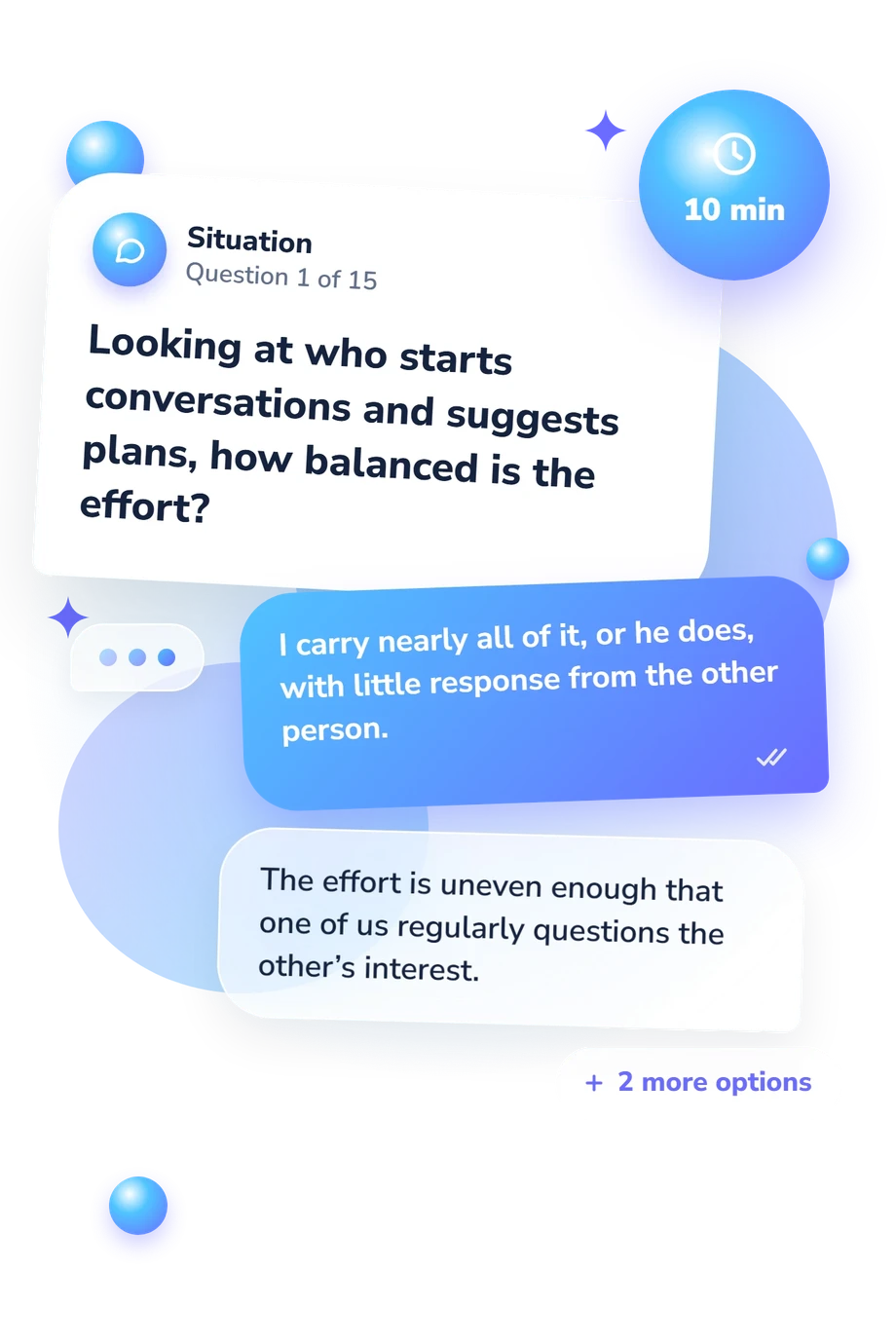
- I carry nearly all of it, or he does, with little response from the other person.
- The effort is uneven enough that one of us regularly questions the other’s interest.
- One person initiates more, but both respond and contribute in meaningful ways.
- We both initiate, follow through, and make room for each other.
- One person would repeatedly have to give up the kind of life they prefer.
- The difference often produces frustration or separate plans neither person enjoys.
- We can alternate or split the weekend, though it takes effort.
- We can make room for both needs without either person feeling sidelined.
- I can disagree or say no without feeling intimidated.
- I sometimes become guarded because his reactions can be sharp or unpredictable.
- He has blocked my exit, broken things, driven dangerously, or used intimidation.
- He has threatened, restrained, hit, injured, or otherwise used physical force against me.
Should I Date Him Quiz - Description and methodology of the test
People weighing a connection can use this assessment to slow down and examine more than attraction alone. The Should I Date Him Quiz is suited to someone who wants a structured way to consider mutual effort, everyday fit, emotional availability, boundaries, and safety before choosing a pace. That process turns impressions into questions to check against behavior, which gives this should you date him quiz a practical focus.
What This Assessment Explores
This assessment separates everyday fit, mutual dating readiness, and respect and safety concerns. Items cover routines, communication, priorities, initiative, availability, limits, jealousy, deception, threats, coercion, and consent. Someone taking the should i be dating him quiz can see what seems workable, unclear, or concerning-not a character verdict.
The dimensions are:
- Everyday Compatibility (0-15) reflects how naturally values, routines, communication, and future direction fit: Major friction/unknowns (0-5), Mixed but workable (6-10), or Strong everyday fit (11-15).
- Mutual Dating Readiness (0-15) reflects current availability, reciprocity, pacing, and intention: Pause before investing (0-5), Readiness is developing (6-10), or Intentional and reciprocal (11-15).
- Respect and Safety Concerns (0-15) is an unvalidated reflective summary of accumulated concerns, not a severity cutoff or diagnosis: Watch the details (0-5), Concerns accumulating (6-10), or Strong concern pattern (11-15).
Methodology and Scientific Basis
Each item offers four descriptions; the respondent chooses one. Options describe levels of fit, readiness, or concern; direction varies by topic. Responses produce three result displays, but the questionnaire does not state how many points each answer contributes; bands are labels, not universal cutoffs. Neither fit nor readiness predicts long-term success.
The questionnaire is conceptually consistent with CADRI (Wolfe et al., 2001), which examines harmful dating behaviors, and overlaps with CTS2 (Straus et al., 1996) on coercion and aggression. The Investment Model Scale (Rusbult et al., 1998) and Hendrick’s measure (1988) offer conceptual reference points for commitment, alternatives, investment, and satisfaction. These are conceptual reference instruments, not this questionnaire’s scoring system.
Interpret scores with the answers, not the total alone. Any single red-flag response involving threats, force, injury, stalking, or ignored sexual consent overrides a reassuring score; zero concerns cannot guarantee safety. The questionnaire can help someone answer the should i date him or not quiz by comparing a concern with observed behavior, but it cannot capture private context or future changes in conduct. Self-report, memory, stress, and incomplete information shape results.
- David A. Wolfe, Katreena Scott, Deborah Reitzel-Jaffe, Christine Wekerle, Carolyn Grasley, and Anna-Lee Straatman. (2001). Development and Validation of the Conflict in Adolescent Dating Relationships Inventory. Psychological Assessment, 13(2), 277-293. 10.1037/1040-3590.13.2.277
- Murray A. Straus, Sherry L. Hamby, Sue Boney-McCoy, and David B. Sugarman. (1996). The Revised Conflict Tactics Scales (CTS2): Development and Preliminary Psychometric Data. Journal of Family Issues, 17(3), 283-316. 10.1177/019251396017003001
- Caryl E. Rusbult, John M. Martz, and Christopher R. Agnew. (1998). The Investment Model Scale: Measuring Commitment Level, Satisfaction Level, Quality of Alternatives, and Investment Size. Personal Relationships, 5(4), 357-387. 10.1111/j.1475-6811.1998.tb00177.x
- Susan S. Hendrick. (1988). A Generic Measure of Relationship Satisfaction. Journal of Marriage and the Family, 50(1), 93-98. 10.2307/352430
Updated: