
Sex Position Quiz
How the Scales are Structured
Who Usually Takes This Test?
See How You Compare
Below is a preview of how scores are typically distributed across each scale.
Example Questions From the Test
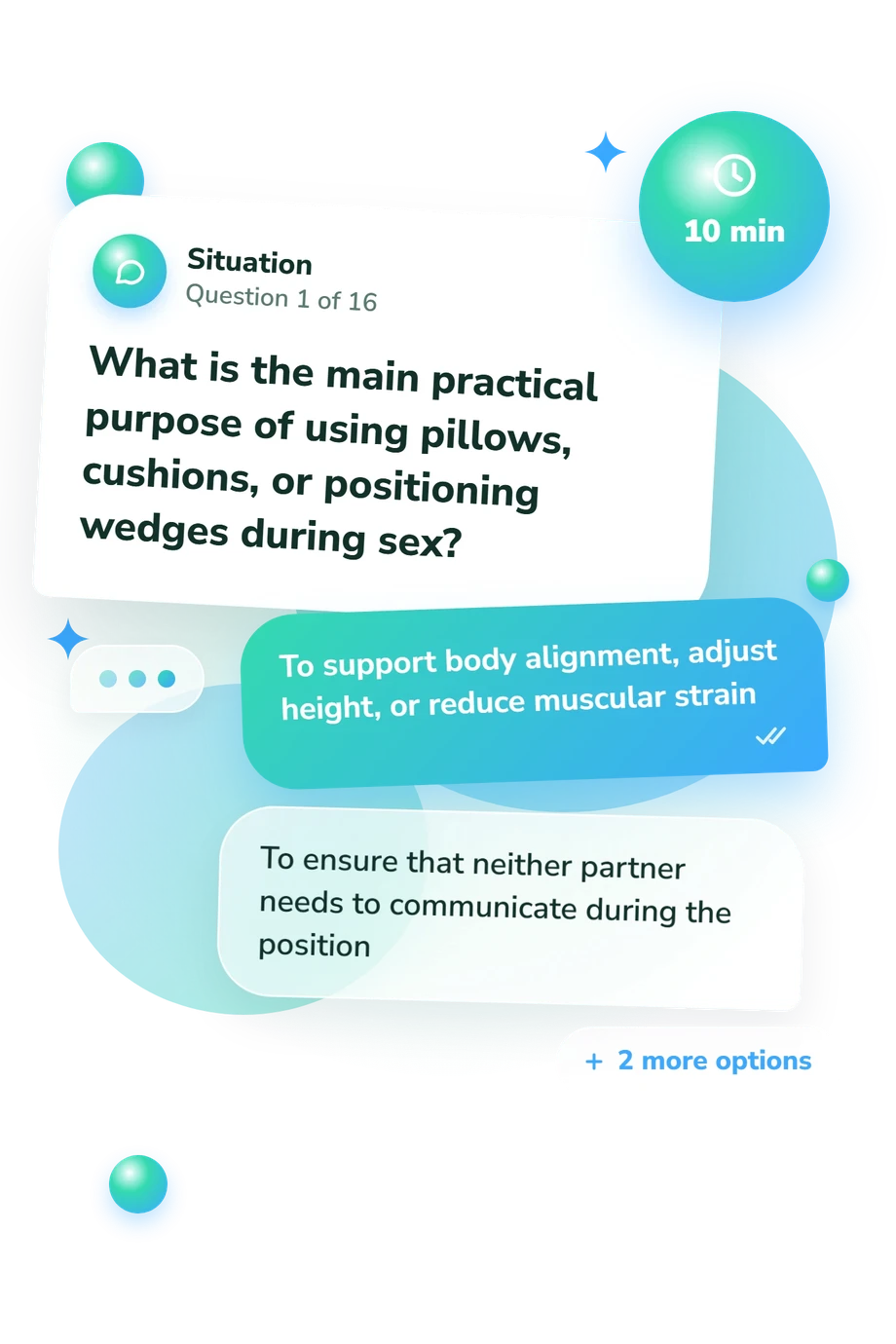
- To support body alignment, adjust height, or reduce muscular strain
- To ensure that neither partner needs to communicate during the position
- To guarantee deeper penetration regardless of anatomy
- To keep both partners completely motionless
- Move farther away from any stable furniture and continue standing
- Increase speed so the position ends sooner
- Change to a supported lying, seated, or side-lying position
- Shift all body weight onto the partner with better balance
- Lying underneath and facing away from the other partner
- Astride the partner who is lying down, usually facing them
- Kneeling behind a partner who is on hands and knees
- Lying alongside the other partner in the same direction
Sex Position Quiz - Description and methodology of the test
People who want to check practical sexual knowledge can use this sex position quiz to examine how well they recognize common positions, useful adaptations, consent principles, and safer-sex considerations. Its educational focus suits readers who want clearer language for discussing comfort and preparation with a partner. The format functions as a sexual knowledge assessment, testing understanding rather than preference or sexual performance.
What This Assessment Measures
Questions cover position names and adaptations, plus practical reasoning: how supports affect alignment, how adjustments change comfort or stimulation, when balance and stable surfaces matter, and how consent and safer-sex practices guide choices. The result helps readers identify concepts worth reviewing without judging technique.
One displayed scale, Sex Position Knowledge: 0-16, reflects correct answers about terminology, adaptations, consent, comfort, and safer-sex considerations. Its bands are:
- Foundations to Build (0-6) indicates that several terms or principles may need review, with emphasis on communication and support.
- Developing Knowledge (7-12) indicates familiarity with many common concepts while leaving room to review adaptations and safer transitions.
- Strong Knowledge (13-16) indicates a well-rounded grasp of terminology and practical considerations, without measuring performance, compatibility, or medical safety.
Methodology and Evidence Base
Each item presents a position name, practical adjustment, or situation involving consent, comfort, balance, pregnancy, or safer sex. Several choices are offered, and the respondent selects the answer that best matches the principle. This tests applied knowledge rather than personal preference.
Scoring compares responses with keyed answers and summarizes correct concepts in the educational bands above. The online format is educational; the displayed categories are descriptive rather than population norms or clinical cutoffs. It works as a sexual health education quiz while leaving experience unmeasured.
Krejčová et al. (2020) is the closest comparison because it examines sexual positions in a population study; this questionnaire is conceptually consistent with that focus, not an adaptation. Sadat et al. (2018) offers a model for structured sexual-knowledge assessment, while UNESCO-led guidance supports consent and safer-sex education. These sources support the themes, not this questionnaire’s validation.
Interpret the result as a snapshot of answer accuracy. Wording, memory, cultural context, and assumptions can affect performance. The score cannot establish sexual performance, compatibility, or medical safety; anatomy, pain, pregnancy, mobility, or circumstances may change what is suitable. Consent can change throughout an encounter.
- Krejčová L, Kuba R, Flegr J, Klapilová K. Kamasutra in Practice: The Use of Sexual Positions in the Czech Population and Their Association With Female Coital Orgasm Potential. Sexual Medicine. 2020;8(4):767-776. 10.1016/j.esxm.2020.07.003
- Sadat Z, Ghofranipour F, Azin SA, Montazeri A, Goshtasebi A, Bagheri A, Barati E. Development and psychometric evaluation of the sexual knowledge and attitudes scale for premarital couples (SKAS-PC): An exploratory mixed method study. International Journal of Reproductive BioMedicine. 2018;16(1):41-50. 10.29252/ijrm.16.1.41
- UNESCO, UNAIDS, UNFPA, UNICEF, UN Women, WHO. International technical guidance on sexuality education: an evidence-informed approach. Revised edition. Paris: UNESCO; 2018.
Updated: