
Vaping Quiz
How the Scales are Structured
Who Usually Takes This Test?
See How You Compare
Below is a preview of how scores are typically distributed across each scale.
Example Questions From the Test
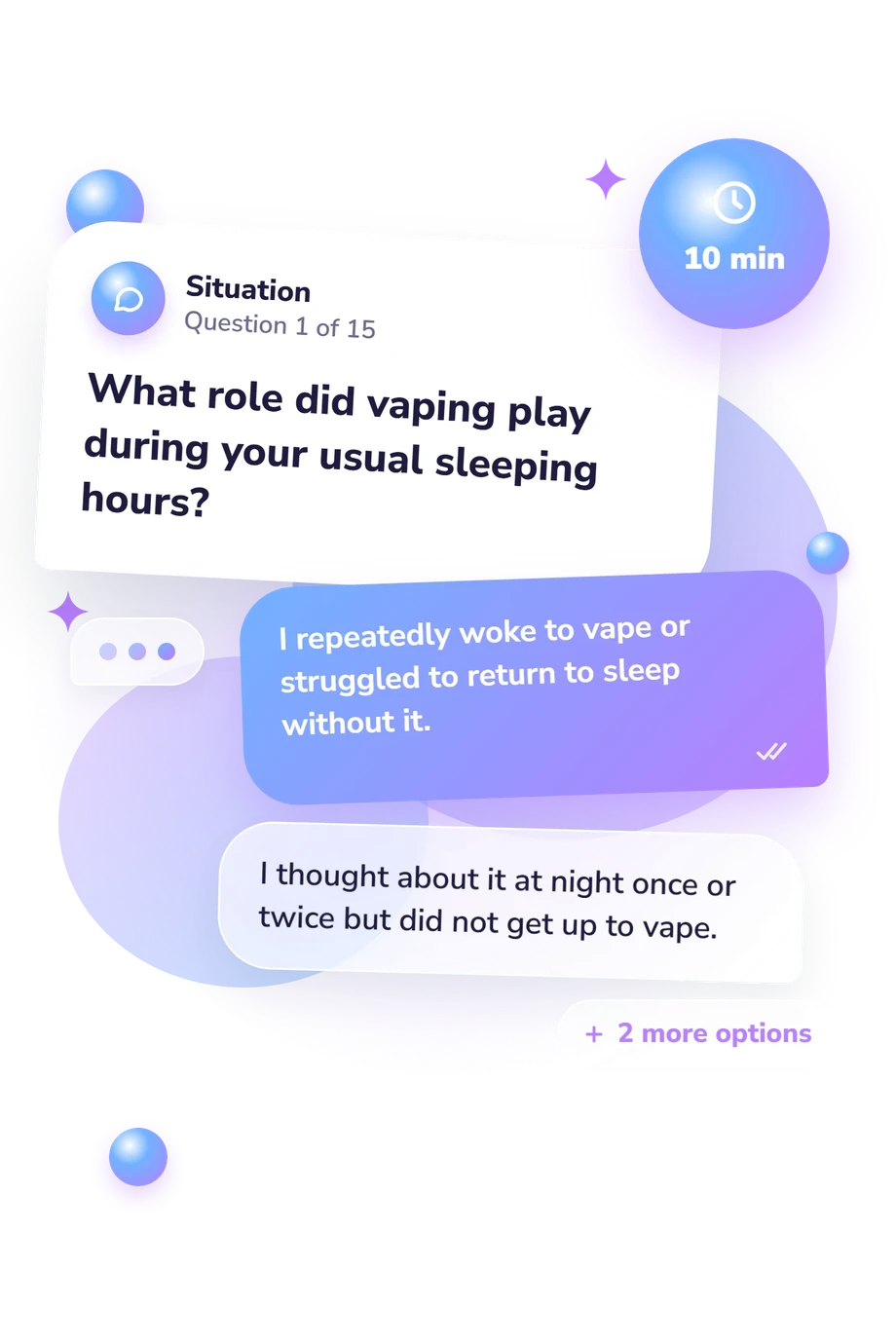
- I repeatedly woke to vape or struggled to return to sleep without it.
- I thought about it at night once or twice but did not get up to vape.
- It did not enter my sleeping hours.
- I got up to vape on several nights.
- I noticed an urge, but the task was not meaningfully affected.
- I was unable to continue or function normally until I could vape.
- I completed the task without a noticeable vaping-related problem.
- Craving or discomfort repeatedly distracted me or slowed the task.
- It held most of the time, with one minor exception.
- I repeatedly crossed the boundary even after resetting it.
- It held consistently.
- I crossed it on several occasions.
Vaping Quiz - Description and methodology of the test
People who want to understand whether vaping is becoming difficult to direct can use this vaping quiz as structured self-reflection. It is intended for anyone noticing cravings, automatic use, consequences, or trouble delaying use. The result separates patterns worth monitoring and gives structure to the question of whether I am addicted to vaping.
What This Assessment Explores
Items connect everyday situations with three patterns: control, consequences, and nicotine-related discomfort. They address sleep, concentration, spending, plans, symptoms, safety incidents, automatic use, emotional relief, tolerance change, and attempts to delay use. A reader considering a nicotine vape dependence test can see which pattern needs attention.
These are the three displayed dimensions:
- Control Over Vaping (0-15) shows difficulty directing timing, amount, access, or automatic use; its bands are No indicator endorsed (0), Worth noticing (1-2), and Take action (3-15).
- Health and Daily-Life Effects (0-15) shows physical, functional, financial, or device-safety effects; its bands are No indicators endorsed (0), Worth noticing (1-2), and Take action (3-15).
- Withdrawal and Nicotine Pull (0-15) shows craving, discomfort, adaptation, or disruption after delay; its bands are No indicator endorsed (0), Worth noticing (1-2), and Take action (3-15).
Together, the domains preserve meaningful differences instead of reducing every concern to one label.
Methodology and Scientific Basis
Each prompt describes a concrete situation and offers four responses, ranging from no noticeable issue through occasional or repeated difficulty to serious disruption or harm. Because answer order varies, the respondent must read each situation rather than rely on a fixed position.
Responses are grouped into domains and converted into displayed totals, but the wording does not establish how many points each option contributes. Read the result by domain: any concerning experience matters on its own, and a score-3 red-flag response overrides the total.
The content is conceptually consistent with Soule et al. (2020), whose qualitative work identified user-described indicators of vaping dependence, and with Foulds et al. (2015) and Bold et al. (2018), which address electronic-cigarette dependence measurement. This questionnaire is not presented as an adaptation of those published instruments.
For someone taking a nicotine dependence quiz, the bands are unvalidated reflective summaries, not severity, dependence, or clinical cutoffs. Self-report may shift with memory, current context, response bias, and self-awareness, so consider the result alongside the specific experiences it identifies.
Chest pain, severe breathing trouble, fainting, seizures, persistent vomiting, serious burns, or suspected liquid-nicotine poisoning require urgent help.
- Soule, Eric K., Joseph G. Lee, Kathleen L. Egan, Kendall M. Bode, Abigail C. Desrosiers, Mignonne C. Guy, Alison Breland, and Pebbles Fagan. “I cannot live without my vape”: Electronic cigarette user-identified indicators of vaping dependence. Drug and Alcohol Dependence. 2020;209:107886. DOI 10.1016/j.drugalcdep.2020.107886
- Foulds, Jonathan, Susan Veldheer, Jessica Yingst, Shari Hrabovsky, Stephen J. Wilson, Travis T. Nichols, and Thomas Eissenberg. Development of a questionnaire for assessing dependence on electronic cigarettes among a large sample of ex-smoking E-cigarette users. Nicotine & Tobacco Research. 2015;17(2):186-192. DOI 10.1093/ntr/ntu204
- Bold, Krysten W., Steve Sussman, Stephanie S. O'Malley, Rachel Grana, Jonathan Foulds, Howard Fishbein, and Suchitra Krishnan-Sarin. Measuring E-cigarette dependence: Initial guidance. Addictive Behaviors. 2018;79:213-218. DOI 10.1016/j.addbeh.2017.11.015
Updated: