
Is My Baby Ready for Solids Quiz
How the Scales are Structured
Who Usually Takes This Test?
See How You Compare
Below is a preview of how scores are typically distributed across each scale.
Example Questions From the Test
- Plain applesauce, pear purée, or mashed banana served without other foods
- Soft shredded meat, mashed beans, or iron-fortified infant cereal prepared in an age-appropriate texture
- Full-fat yogurt mixed with fruit as the main iron source
- Soft cucumber, avocado, or steamed courgette offered at each meal
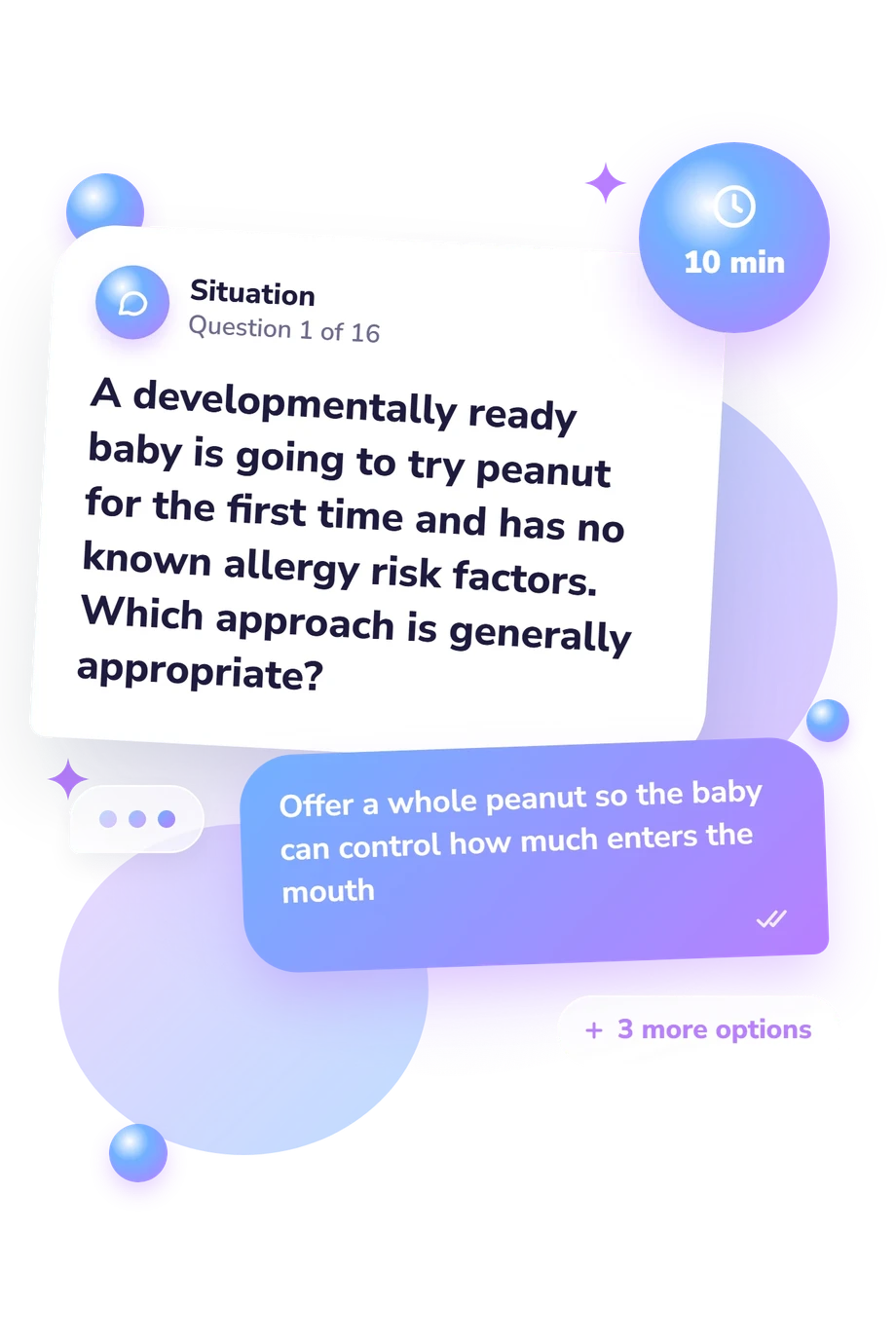
- Offer a whole peanut so the baby can control how much enters the mouth
- Offer a small amount in a safe form, such as smooth peanut butter thinned appropriately, and observe for a reaction
- Delay all peanut products until several years of age because early exposure commonly causes allergy
- Mix peanut with several other new allergens so multiple foods can be introduced efficiently
- This always means the airway is fully blocked and food should be removed blindly with a finger
- This proves the food texture is unsuitable and only smooth purées should be used for several months
- This may be gagging, which is usually noisy; choking is more likely to involve inability to breathe, cry, or cough effectively
- This is a sign of fullness rather than a protective feeding reflex
Is My Baby Ready for Solids Quiz - Description and methodology of the test
Caregivers deciding whether to begin complementary feeding can use the Is My Baby Ready for Solids Quiz to organize practical questions about developmental signs, food safety, and feeding skills. The test is for caregivers reviewing feeding guidance before considering solids. Its questions help organize a starting solids checklist, while the overall band provides broad feedback about knowledge of the tested guidance.
What This Assessment Explores
The questions test whether a caregiver recognizes the practical conditions for starting solids. The assessment, framed as an Is My Baby Ready for Weaning Quiz, looks beyond age to posture, head and trunk control, oral coordination, food interest, and fullness cues. It covers textures, milk, iron, allergens, honey, and airway safety.
Results use Starting Solids Knowledge: 0-16. Foundations to build (0-6) signals review; Developing knowledge (7-12) reflects partial understanding; Strong knowledge (13-16) reflects broad familiarity. It is an unvalidated educational score about knowledge of the tested guidance.
The questions cover these themes in the overall knowledge result:
- Developmental readiness shows whether you recognize the physical skills for eating.
- Food and nutrition knowledge shows whether you choose suitable foods and keep milk central.
- Texture, allergen, and airway awareness shows whether food forms are safe and responses fit gagging, choking, or refusal.
Methodology and Scientific Basis
Each item presents a feeding scenario or knowledge question with four answer choices. Viewed as a baby solids readiness test, the format checks knowledge rather than clinical status, and responses are summarized as a score whose displayed educational bands provide feedback on tested knowledge rather than medical clearance for a particular baby.
Its evidence base is conceptual, not a claim that this online questionnaire reproduces a validated instrument. The questionnaire is conceptually consistent with the developmental-readiness study by Putnick and colleagues, ESPGHAN and WHO complementary-feeding guidance, and NIAID peanut-introduction guidance; it is not an adaptation of those sources.
Interpret the outcome as a prompt for targeted review. A lower band can point to topics needing more attention, such as readiness signs, posture, choking response, or nutrition; a higher band indicates stronger familiarity with the tested material. Because answers depend on memory, self-awareness, and general scenarios, the score cannot capture individual medical or developmental circumstances.
- Putnick DL, Ghassabian A, Clayton PK, Sundaram R, Yeung EH. Developmental Readiness for Complementary Feeding: Associations with Initiation Before Age 6 Months. The Journal of Pediatrics. 2025;286:114722. 10.1016/j.jpeds.2025.114722
- Fewtrell M, Bronsky J, Campoy C, et al. Complementary Feeding: A Position Paper by the European Society for Paediatric Gastroenterology, Hepatology, and Nutrition (ESPGHAN) Committee on Nutrition. Journal of Pediatric Gastroenterology and Nutrition. 2017;64(1):119-132. 10.1097/MPG.0000000000001454
- World Health Organization. WHO Guideline for complementary feeding of infants and young children 6-23 months of age. Geneva: World Health Organization; 2023. ISBN 978-92-4-008186-4
- Togias A, Cooper SF, Acebal ML, et al. Addendum Guidelines for the Prevention of Peanut Allergy in the United States: Report of the National Institute of Allergy and Infectious Diseases-Sponsored Expert Panel. The Journal of Allergy and Clinical Immunology. 2017;139(1):29-44. 10.1016/j.jaci.2016.10.010
Updated: