
Relationship Status Quiz
How the Scales are Structured
Who Usually Takes This Test?
See How You Compare
Below is a preview of how scores are typically distributed across each scale.
Example Questions From the Test
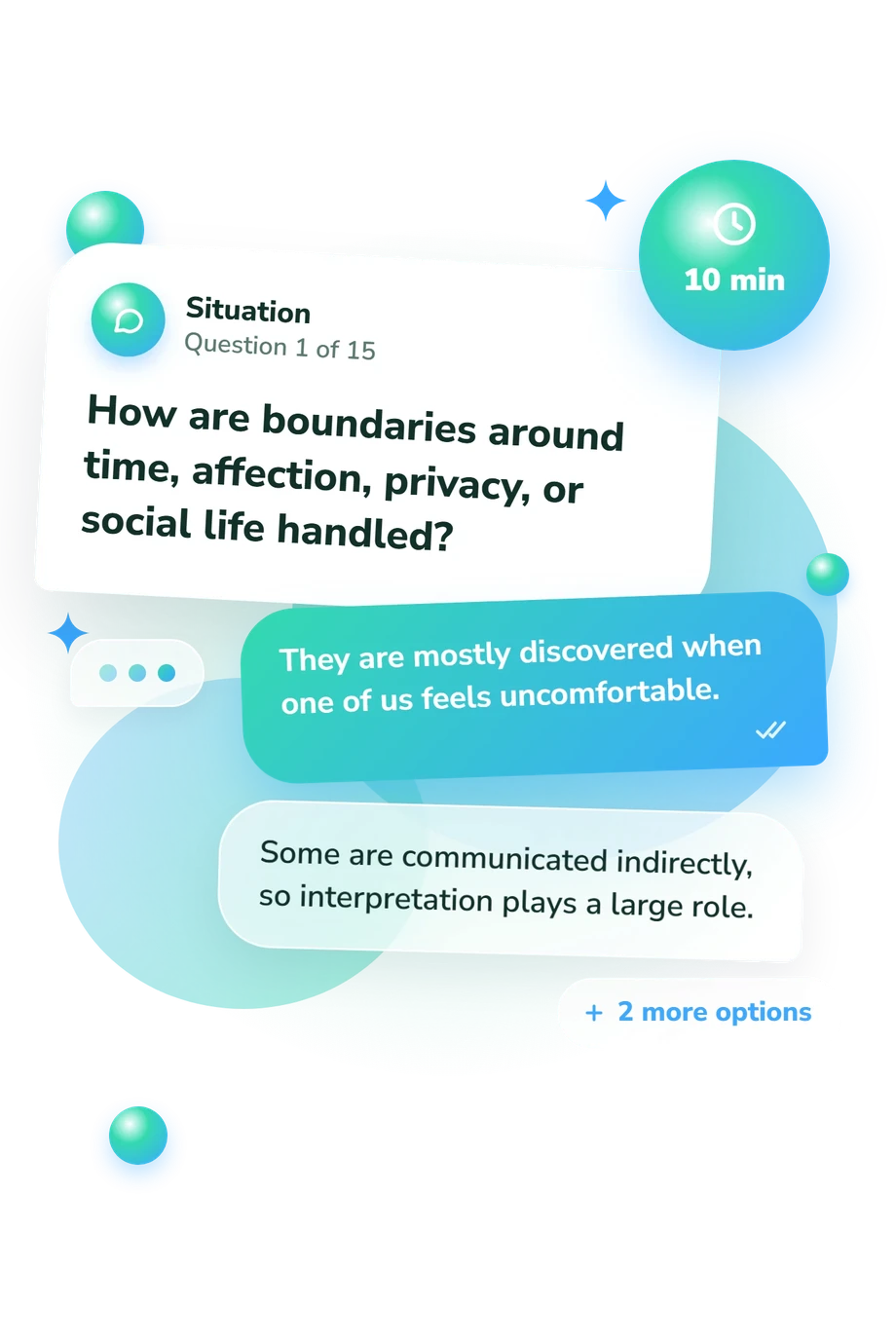
- They are mostly discovered when one of us feels uncomfortable.
- Some are communicated indirectly, so interpretation plays a large role.
- We discuss boundaries when they become relevant, with occasional uncertainty afterward.
- We can state, hear, and revisit boundaries directly without assuming they will never change.
- My reaction feels too tangled or changeable to interpret.
- I notice a strong feeling, but I am not yet sure what it says about what I want.
- I see both appealing and difficult parts and can name the main tension between them.
- I have a clear sense of whether the current form fits my emotional needs and values.
- I would have little shared context for knowing what either description means.
- I would wonder whether the difference reveals an unspoken disagreement.
- I would know our broad status but want to clarify why the wording changed.
- I would understand which descriptions fit and whether the wording meaningfully changes anything.
Relationship Status Quiz - Description and methodology of the test
People who feel uncertain about a romantic connection can use this relationship status quiz to organize reactions without forcing a premature label. It suits someone seeking clarity about a relationship who wants to separate personal feelings from shared expectations and the connection’s direction. The result offers a structured view of what feels settled, unclear, or ready for a direct conversation.
What This Assessment Explores
Rather than assigning a single label, the questionnaire examines how clearly you recognize reactions, coordinate with the other person, and understand the connection’s status and direction. Situations include boundaries, affection, exclusivity, contact, plans, conflict, descriptions, and next steps. As a relationship status assessment, it focuses on patterns that make a connection feel defined or ambiguous, rather than deciding what it should become.
The three dimensions shown in the result are:
- Emotional Grounding (0-15) shows recognition of feelings, needs, and choices: Emotionally Unsettled (0-5), Mixed but Emerging (6-10), or Grounded Awareness (11-15).
- Mutual Alignment and Communication (0-15) shows how directly needs, boundaries, and priorities are coordinated: Limited Coordination (0-5), Partial Alignment (6-10), or Active Alignment (11-15).
- Relationship Definition Clarity (0-15) shows how clearly the label, boundaries, and direction are understood: Open Question (0-5), Emerging Picture (6-10), or Shared Definition (11-15).
Methodology and Scientific Basis
Each situation has four ordered responses, moving from uncertainty or indirectness toward clearer self-awareness, coordination, or shared understanding. Choose the option that best fits; no answer is correct or incorrect. Results combine responses into three scores, but each response’s contribution and each total score’s meaning cannot be inferred from the displayed ranges alone.
Knobloch and Solomon (1999) offer the closest conceptual comparison: their work distinguishes uncertainty about self, partner, and relationship, including definition and future direction. Emery et al. (2021) adds couple identity and commitment, while Salovey et al. (1995) offers a Trait Meta-Mood Scale framework for attending to and clarifying feelings. This questionnaire is conceptually consistent with those works, not an adaptation of them.
Viewed as a relationship status test, this questionnaire yields a descriptive profile of present patterns. Its displayed bands are the questionnaire’s own descriptive categories, not population norms or clinical cutoffs. Current circumstances, self-awareness, and response style can influence answers, so use the pattern to identify useful questions and conversations rather than treat it as a fixed judgment.
- Knobloch, Leanne K., and Denise Haunani Solomon. “Measuring the Sources and Content of Relational Uncertainty.” Communication Studies 50, no. 4 (1999): 261-278. 10.1080/10510979909388499
- Emery, Lydia F., Wendi L. Gardner, Kathleen L. Carswell, and Eli J. Finkel. “Who Are ‘We’? Couple Identity Clarity and Romantic Relationship Commitment.” Personality and Social Psychology Bulletin 47, no. 1 (2021): 146-160. 10.1177/0146167220921717
- Salovey, Peter, John D. Mayer, Susan Lee Goldman, Carolyn Turvey, and Tibor P. Palfai. “Emotional Attention, Clarity, and Repair: Exploring Emotional Intelligence Using the Trait Meta-Mood Scale.” In Emotion, Disclosure, & Health, edited by James W. Pennebaker, 125-154. Washington, DC: American Psychological Association, 1995. 10.1037/10182-006
Updated: